Vivani Medical (VANI): placement-agent relationships, supplier posture, and investor implications
Vivani Medical monetizes by developing biocompatible implant drug-delivery systems and advancing those candidates through clinical and regulatory milestones while financing development through public equity raises and placement-agent-led offerings. The company outsources manufacturing and analytical work to third parties, relies on capital markets to fund operations, and captures value when clinical advances increase optionality for partners or acquirers. For investors evaluating supplier and services relationships, the short record of placement-agent activity and explicit third‑party manufacturing language point to a capital‑intensive, outsourced operating model with concentrated counterparty exposure and operational criticality. Learn more about supplier and counterparty risk at our homepage: NullExposure.
What the recent filings and press releases reveal about market-facing relationships
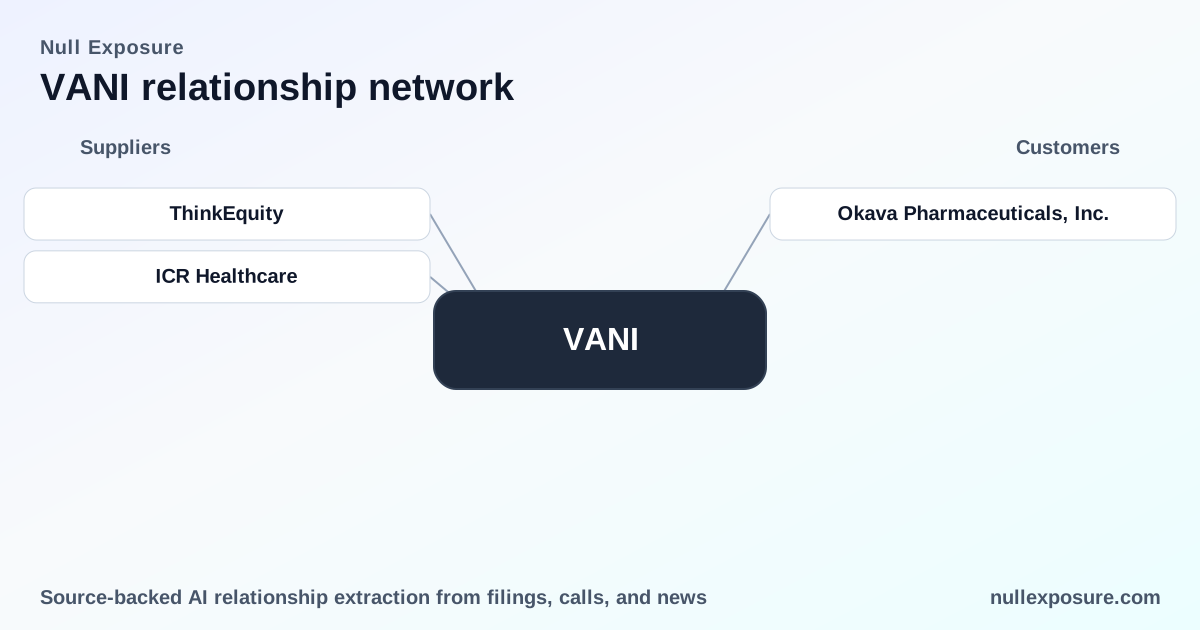
Vivani’s public disclosures and press activity over FY2025–FY2026 show repeated engagement with ThinkEquity as the company’s placement agent for registered direct and other offerings, plus routine use of healthcare PR firms for media. These relationships are commercial and capital-market facing rather than product‑manufacturing partnerships, but they are material to Vivani’s liquidity and execution of its financing strategy.
ThinkEquity — active placement agent for multiple offerings
- A GlobeNewswire release dated October 28, 2025 reports that ThinkEquity acted as sole placement agent for a closing of a common stock offering, confirming a completed capital raise executed with ThinkEquity’s sole placement services (GlobeNewswire, 2025-10-28: https://www.globenewswire.com/news-release/2025/10/28/3175941/0/en/Vivani-Medical-Inc-Announces-Closing-of-Common-Stock-Offering.html).
- A GlobeNewswire pricing announcement on January 26, 2026 states that ThinkEquity was acting as sole placement agent for the registered direct offering that Vivani priced, indicating ThinkEquity led the primary execution work for that financing (GlobeNewswire, 2026-01-26: https://www.globenewswire.com/news-release/2026/01/26/3225217/0/en/vivani-medical-inc-announces-pricing-of-common-stock-offering.html).
- A GlobeNewswire closing notice on January 27, 2026 confirms ThinkEquity acted as sole placement agent at closing for the registered direct offering, showing the completion of the January offering under the same agent (GlobeNewswire, 2026-01-27: https://www.globenewswire.com/news-release/2026/01/27/3227076/0/en/Vivani-Medical-Inc-Announces-Closing-of-Common-Stock-Offering.html).
- A market news reproduction on StockTitan repeats the January 26, 2026 pricing language, again noting ThinkEquity as the acting sole placement agent, reflecting broad syndication of the press release text across wire aggregators (StockTitan, 2026-01-26: https://www.stocktitan.net/news/VANI/vivani-medical-inc-announces-pricing-of-common-stock-qq14p6i6e8wu.html).
- An additional GlobeNewswire entry of January 26, 2026 mirrors the pricing announcement and again cites ThinkEquity as placement agent, representing the canonical issuer release circulated that day (GlobeNewswire, 2026-01-26: https://www.globenewswire.com/news-release/2026/01/26/3225217/0/en/Vivani-Medical-Inc-Announces-Pricing-of-Common-Stock-Offering.html).
ThinkEquity — historical advisory role referenced to corporate action
- A press notice sourced through Optics.org references FY2022 activity where ThinkEquity acted as financial advisor to Second Sight in connection with a merger that resulted in Vivani trading under the new ticker (Nasdaq: VANI), linking ThinkEquity to Vivani’s earlier corporate transformation and listing history (Optics.org press, 2022: https://optics.org/press/5529).
ICR Healthcare — media and investor‑relations support
- The January 26, 2026 GlobeNewswire release lists ICR Healthcare as the media contact for the offering announcement, indicating Vivani retained a healthcare-focused PR/IR firm to manage communications around the financing (GlobeNewswire, 2026-01-26: https://www.globenewswire.com/news-release/2026/01/26/3225217/0/en/vivani-medical-inc-announces-pricing-of-common-stock-offering.html).
Operating model constraints and what they signal for operators and investors
Vivani’s public language and constraint excerpts create a coherent portrait of operating posture:
- Outsourced manufacturing and services are central to operations. The company states it purchases drug substance from third‑party manufacturers and engages contract manufacturers and analytical labs for selected processes, making third‑party supply critical to product development timelines and cost structure.
- Supplier relationships are material to enterprise risk. Vivani acknowledges complex manufacturing challenges and reliance on third parties that could substantially increase costs and limit supply, which translates to operational concentration and execution risk for investors.
- Service provider role extends beyond manufacturing to clinical and capital markets support. Vivani’s engagements with contract research organizations, clinical trial sites, and sales agents (e.g., ThinkEquity) indicate a broad outsourcing pattern for both development and financing activities.
- Relationship lifecycle volatility exists. The record contains a company-level note that “The TFSSA terminated effective December 31, 2024,” signaling that some third‑party agreements can and do terminate, which elevates the importance of counterparty continuity planning.
These constraints collectively indicate a capital‑intensive, outsourced model with concentrated supplier criticality and moderate counterparty fragility—a profile common to early-stage biotech where execution hinges on both manufacturing continuity and successful equity financing.
Investment implications and risk checklist
- Financing dependency: Repeated sole‑agent placements with ThinkEquity show Vivani relies on placement-agent relationships to access capital. This is positive for execution when markets are receptive but increases execution risk if placement channels close.
- Operational concentration: The firm’s outsourcing of manufacturing and analytics is cost-effective but creates single‑point dependencies; any manufacturing disruption would directly affect development timelines and cash burn.
- Disclosure and communications: Use of ICR Healthcare for media outreach demonstrates deliberate investor‑relations discipline around financings; consistent, clear communication reduces information asymmetry for public investors.
If you allocate to Vivani, focus diligence on counterparty continuity clauses, manufacturing contingency plans, and the length and exclusivity of placement-agent arrangements. For a deeper supplier-risk read on Vivani and similar biotech suppliers, visit NullExposure.
Key takeaways for operators and counterparties
- ThinkEquity is the primary placement agent across multiple 2025–2026 equity raises, making them a strategic capital-market counterparty for Vivani (see GlobeNewswire releases, Oct 2025 – Jan 2026).
- Vivani outsources manufacturing and lab work and views those relationships as material risk factors, so counterparties providing manufacturing or analytical services command strategic leverage.
- Termination of agreements can and does occur, so counterparties should expect negotiation cycles and potential replacements; operators should maintain redundancy in critical supply chains.
For corporate development teams and investors evaluating partnership terms, confirm escalation clauses, lead-time guarantees, and alternative supplier pathways in contractual negotiations. Learn more about mapping supplier criticality and placement-agent exposure at NullExposure.
Final note: the public record for Vivani’s supplier and service relationships in the FY2025–FY2026 period is dominated by placement-agent activity and routine PR engagements, overlaid on an explicitly outsourced manufacturing model that is material to both operations and valuation. Investors should treat placement‑agent continuity and manufacturer contracts as primary levers of execution risk in any investment thesis on VANI.