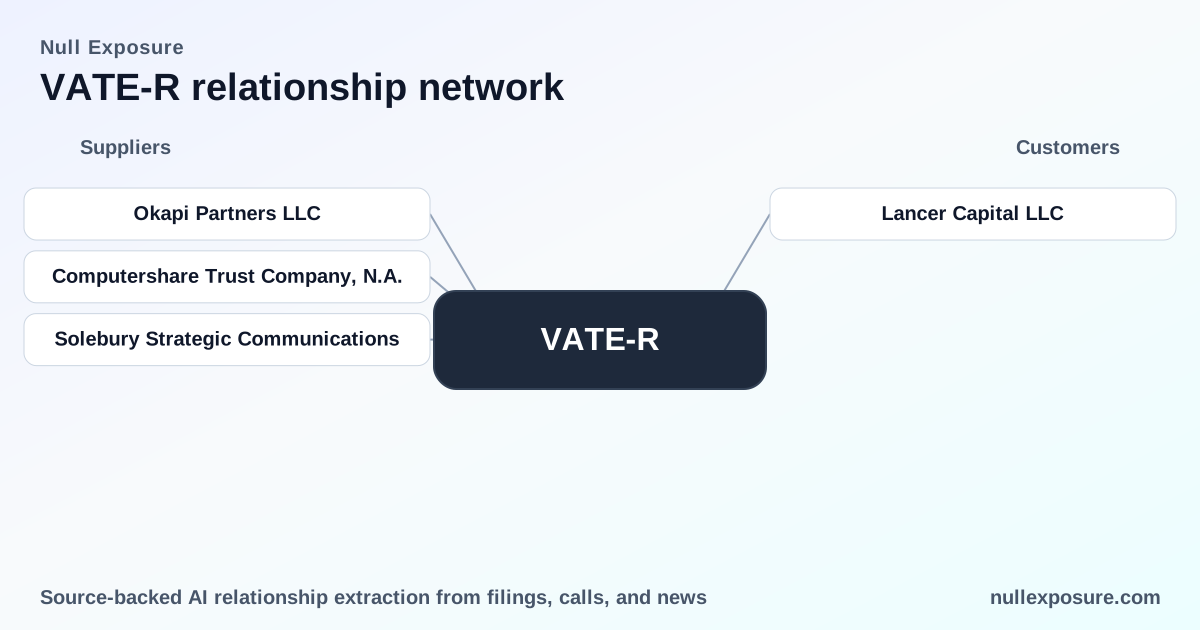
VATE-R supplier relationships: what investors need to know
VATE-R’s most visible supplier relationships occur in the context of a corporate rights offering: service providers execute investor communications, process subscriptions and manage public relations, while the issuer raises capital through the offering. For investors and operators, the commercial model is straightforward — the issuer monetizes by securing financing from shareholders; suppliers monetize through fee-for-service engagements tied to the transaction (information agent, subscription agent, and IR/PR). Understanding which vendors were appointed and how responsibilities are split is essential to assessing execution risk and governance discipline. For a quick view of how we source and structure these signals, visit https://nullexposure.com/.
Why the supplier list matters for valuation and risk
Rights offerings are one-off capital events where vendor performance is directly tied to whether an issuer hits its financing target. The supplier roster therefore signals contracting posture (transactional vs. ongoing), concentration of third‑party exposure, and operational criticality. In VATE-R’s case, the supplier mix skews to established financial services firms and a specialist communications adviser — a configuration that supports rapid execution but concentrates critical functions into a few vendors.
- Contracting posture: engagement-based, transaction-specific relationships for the offering rather than long-term platform deals.
- Concentration: the issuer relies on a compact set of specialist providers; this reduces coordination overhead but raises single-vendor impact.
- Criticality: these vendors are mission-critical for subscriber processing, information flow and investor communications — failures directly affect fundraising outcomes.
- Maturity: suppliers are institutional players with prior experience in capital markets transactions, which reduces execution risk relative to inexperienced firms.
Supplier-by-supplier: what the record shows
Below are the relationships disclosed in public reporting relevant to the rights offering. Each is summarized in plain language with the publicly available source.
Okapi Partners LLC
Okapi is listed as the information agent for the rights offering, the party investors should contact for questions about the rights process and mechanics. According to a March 10, 2026 StockTitan notice tied to the rights offering (FY2024), Okapi Partners LLC was named as the information agent for the event (https://www.stocktitan.net/news/VATE/innovate-corp-announces-commencement-of-rights-8jp4jwhmmvdf.html).
Computershare Trust Company, N.A.
Computershare acted as the subscription agent, handling receipt and return of excess subscription payments and the mechanics of subscription settlements; the press release notes that excess payments will be returned through the same payment method without interest or deduction. This role is documented in a GlobeNewswire press release dated April 24, 2024 describing the closing mechanics for the rights offering (https://www.globenewswire.com/news-release/2024/04/24/2869151/0/en/INNOVATE-Corp-Announces-Closing-of-Rights-Offering.html).
Solebury Strategic Communications
Solebury is listed as the communications contact for investor relations, providing public and media-facing support for the offering; the contact information is published in the rights offering notice. A StockTitan posting from March 10, 2026 includes Solebury Strategic Communications as the IR contact for the transaction (https://www.stocktitan.net/news/VATE/innovate-corp-announces-commencement-of-rights-8jp4jwhmmvdf.html).
Contracting, execution risk and governance implications
These supplier appointments create a familiar operating profile for a one-off capital raise:
- Transactional contracting: supplier relationships are event-driven, implying short-term fee arrangements and limited operational integration with the issuer’s ongoing systems.
- High operational criticality: the subscription agent and information agent are directly responsible for cash handling and investor notifications; failures are single‑point execution risks.
- Low vendor count increases single-failure impact: relying on a few specialized vendors limits complexity but places outsized importance on vendor execution and controls.
- Institutional counterparties reduce baseline risk: Computershare and Okapi bring established processes for subscription handling and investor outreach, which mitigates but does not eliminate execution and reputational risk.
These characteristics should influence how investors size event-related risk premia and how operators govern vendor selection and oversight.
Risk checklist investors should track
Investors evaluating VATE-R exposure or counterparties around the rights offering should monitor a short list of concrete operational risks:
- Subscription settlement timing and refunds: Computershare’s role in returning excess subscription payments is central; timeliness and accuracy affect investor confidence. (See GlobeNewswire, April 24, 2024: https://www.globenewswire.com/news-release/2024/04/24/2869151/0/en/INNOVATE-Corp-Announces-Closing-of-Rights-Offering.html)
- Investor communications clarity: Okapi and Solebury’s outputs determine whether the offering is understood by retail and institutional holders; poor communications create voting and participation frictions (StockTitan, March 10, 2026: https://www.stocktitan.net/news/VATE/innovate-corp-announces-commencement-of-rights-8jp4jwhmmvdf.html).
- Concentration of service providers: a narrow vendor roster speeds decisions but raises substitution cost if a provider underperforms.
If you need a structured review of vendor risk and how it maps to capital raising outcomes, see our analysis and tools at https://nullexposure.com/.
Governance signal: constraints and disclosure
The public supplier record for VATE-R shows the named providers above and no additional supplier-level constraints were disclosed in the available reporting. The absence of explicit constraints is itself a company-level signal: it indicates that the issuer did not publicly report supplier-specific limitations, contingency plans, or vendor concentration stress tests in the materials reviewed. That absence requires investors to place greater emphasis on counterparty reputation, contractual terms, and the operational history of the appointed firms rather than relying on vendor-level constraint disclosures.
Practical takeaways for investors and operators
- Focus on the subscription agent and information agent — these two relationships are the operational center of the rights offering and the most consequential for fundraising success.
- Treat the roster as transactional but critical: short-term engagements can still drive material outcomes; ensure contractual remediation and SLAs are clear.
- Rely on reputational signals from institutional providers but validate execution metrics where possible (refund timeliness, communication cadence, and investor queries handled).
For a deeper dive into how supplier configuration affects capital-raising execution and to benchmark service-provider risk across offerings, visit https://nullexposure.com/ for our full suite of supplier intelligence and investor briefings.
Closing thought: VATE-R’s supplier list is compact and functionally complete for a rights offering — the issuer appointed proven market participants for the three mission-critical roles, which reduces baseline operational risk but concentrates impact in a small number of vendors. Investors should evaluate those counterparties’ recent transaction performance and contract terms to convert that reduced baseline risk into a concrete investment view.