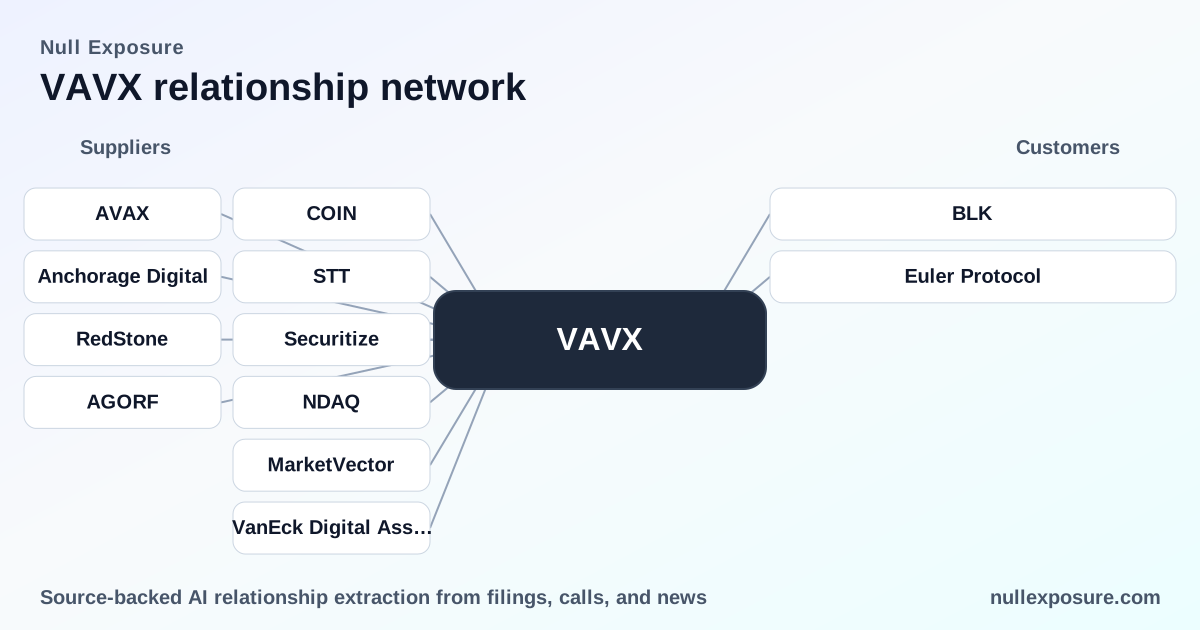
VAVX supplier map: who powers VanEck’s Avalanche ETF and what investors need to know
VanEck’s VAVX is an issuer-sponsored spot ETF that gives investors regulated exposure to the Avalanche token (AVAX) while capturing staking rewards. The fund monetizes through standard management and sponsor fees plus a staking service fee (reported at 4%), with custody, staking, NAV publication and market listing provided by a tightly scoped set of regulated counterparties and market infrastructure partners. Read operational signals and counterparty exposures to triage vendor concentration and custody risk before underwriting position size or institutional distribution agreements.
For a broader supplier-risk view and ongoing monitoring, visit https://nullexposure.com/.
How VAVX makes money and how the stack is organized
VanEck issues and sponsors the trust, which holds AVAX and transacts staking and settlement through regulated providers. Fee economics are twofold: (1) the fund charges management/sponsor fees; (2) staking rewards are collected for the fund, with a reported 4% service fee paid to the staking provider. Custody is handled by regulated custodians that hold tokens in cold storage, and the product lists and trades on Nasdaq with on‑chain NAV and benchmark prices supplied by third-party pricing services. Those structural choices concentrate critical operational functions—custody, staking, NAV/pricing, and listing—with a small set of counterparties, creating predictable revenue capture but also clear vendor risk that investors should monitor.
Visit https://nullexposure.com/ to review third‑party intelligence on these counterparties and pricing sources.
Who’s on the roster — partner-by-partner summaries
Coinbase Crypto Services (staking)
VanEck named Coinbase Crypto Services as the fund’s initial staking provider, with a 4% service fee deducted from staking rewards and rewards accruing to the fund’s NAV (FY2025 filing). A public Coindesk filing (Dec 20, 2025) details the staking arrangement and fee structure.
Source: Coindesk (Dec 20, 2025).
Coinbase Custody (custody)
AVAX holdings for the fund are placed with regulated custodians including Coinbase Custody, which stores tokens offline in cold wallets per the prospectus disclosure. This is presented as part of the custody layer that isolates token private keys from operational systems.
Source: Coindesk (Dec 20, 2025).
Anchorage Digital (custody)
Anchorage Digital is listed alongside Coinbase Custody as a regulated custodian responsible for cold storage of AVAX assets supporting the trust, providing an independent custody path. This reduces single‑custodian concentration but keeps custody within regulated crypto custody providers.
Source: Coindesk (Dec 20, 2025).
State Street Bank & Trust (treasury custody for tokenized assets)
For tokenized U.S. Treasury bills underlying other VanEck tokenized products, State Street Bank & Trust is named as custodian; reporting indicates State Street custodies short‑term Treasury holdings while on‑chain NAV is supplied via oracles—an infrastructure pattern VanEck repeats across tokenized products (FY2025). Investors should treat State Street as the fiat/Treasury custodian model VanEck uses where applicable.
Source: CryptoSlate (FY2025).
RedStone (on‑chain NAV/pricing oracle)
VanEck uses RedStone oracles to supply daily on‑chain NAV data for tokenized instrument workflows, a crucial market‑data feed that underpins on‑chain valuation and atomic redemption rails (FY2025 reporting). Oracle reliability is therefore a direct operational dependency for NAV accuracy.
Source: CryptoSlate (FY2025).
Securitize (placement agent for VBILL product)
VanEck named Securitize as the placement agent for a related tokenized Treasury product (VBILL), evidencing VanEck’s use of regulated distribution and tokenization partners when bringing tokenized securities to market. That placement role signals the firm’s preference for established digital securities intermediaries.
Source: CryptoSlate (FY2025).
MarketVector (benchmark pricing)
The ETF’s valuation follows an Avalanche Benchmark Rate calculated by MarketVector using prices from the top five AVAX trading platforms, which VanEck cites as its price‑discovery methodology (FY2025). Benchmark provider selection directly affects spread and slippage assumptions for authorized participants and market makers.
Source: MarketVector coverage via Bitcoinsensus (FY2025).
Nasdaq (listing venue and market listing mechanics)
The fund listed and began trading on Nasdaq (ticker VAVX) on Jan. 26, 2026; VanEck also waived sponsor fees on the first $500 million of assets through Feb. 28, 2026 as an initial launch incentive. Nasdaq handled the listing mechanics and rule‑change filings required to bring the ETF to market.
Source: Nasdaq filings and market reports (Jan–Mar 2026).
VanEck Digital Assets (sponsor/issuer)
VanEck Digital Assets sponsors the trust and manages investment policy, custody relationships and product governance—effectively owning the commercial and regulatory responsibility for VAVX. Prospectus and filing language place VanEck at the center of operational decisions and counterparty onboarding.
Source: AltcoinBuzz / VanEck prospectus reporting (FY2025).
Avalanche (network partner and educational cooperation)
VanEck has signaled an ongoing working relationship with the Avalanche team to help educate investors on the network; this is a marketing and ecosystem partnership rather than a contractual custody or settlement link. The collaboration supports investor outreach and token economics explanation.
Source: Decrypt (FY2026).
Redundancy and liquidity partner — Agora (atomic redemption)
VanEck’s tokenized product descriptions note atomic redemption into Agora’s AUSD stablecoin for frictionless liquidity pathways, suggesting a design to enable on‑chain settlement and redemption into a major stablecoin when relevant. That integration affects how institutional liquidity and redemption are executed on the chain.
Source: CryptoSlate (FY2025).
How the operating model shapes vendor risk and concentration
VanEck’s stack concentrates critical functions with a small group of regulated crypto custodians, a single prominent staking provider (Coinbase Crypto Services), a benchmark provider (MarketVector), and an on‑chain oracle (RedStone). This design produces three structural signals:
- Contracting posture: VanEck contracts with regulated, market‑recognized providers (Coinbase, Anchorage, State Street), prioritizing regulatory alignment and custody strength over decentralization.
- Concentration: A narrow supplier base creates operational simplicity and consistent fee capture, but also single‑point-of-failure exposures for custody, staking and NAV oracles.
- Criticality and maturity: Custody and listing partners are mature financial institutions and established crypto custodians; oracles and atomic‑redemption rails (RedStone, Agora) are newer and deserve active monitoring for uptime and governance changes.
These company‑level signals define where to focus counterparty diligence—fund governance, custodian audits, staking fee mechanics and oracle resilience.
What investors should monitor now
- Confirm custody attestations and the frequency of third‑party audits for Coinbase Custody and Anchorage.
- Monitor staking revenue receipts and fee accruals versus the 4% service fee disclosed in filings.
- Validate MarketVector benchmark updates and RedStone oracle uptime for NAV integrity.
- Track Nasdaq liquidity and the impact of any promotional fee waivers on AUM growth and liquidity provisioning.
For a structured vendor‑risk checklist and ongoing alerts, check https://nullexposure.com/ — the ideal starting point for counterparty surveillance.
Bottom line: concentrated operational simplicity with clear counterparty trades
VAVX trades as a managed, regulated wrapper that captures staking yield while relying on a small set of regulated custody and infrastructure partners. That architecture delivers transparent monetization and operational clarity, but it concentrates execution risk in custody, staking and price‑feed providers. Active monitoring of Coinbase Crypto Services (staking), custodians (Coinbase Custody, Anchorage), oracle providers (RedStone) and benchmark administrators (MarketVector) is essential for institutional counterparties and underwriters. For ongoing supply‑chain intelligence and supplier risk scoring, visit https://nullexposure.com/.