VBI Vaccines (VBIV): How supplier relationships reveal the company’s commercial posture
VBI Vaccines develops and commercializes vaccine candidates and licensed products by combining in‑house R&D with outsized reliance on external partners for commercialization, clinical development support, and transactional legal work. VBI monetizes through grant funding, milestone and license arrangements, and product commercialization executed by third‑party commercial partners, rather than a vertically integrated sales force. For investors evaluating supplier risk and strategic concentration, the company’s supplier map signals a predictable partner-driven operating model and a small, concentrated set of external dependencies. Learn more at https://nullexposure.com/.
What the partner set says about how VBI runs the business
VBI’s supplier roster reads like a biotech that outsources non-core functions and leverages policy and commercial partners to scale. Commercialization is contracted out, grant and public‑private funding drives clinical progress, and legal counsel relationships reflect corporate transactions and cross‑jurisdictional complexity. Those traits translate into several operational signals investors should weigh:
- Contracting posture: VBI places commercialization and large operational programs with established service providers, reducing fixed overhead but increasing counterparty dependency.
- Concentration: A small number of recurring partners for commercialization and transactional work concentrates execution risk.
- Criticality: Partners that handle commercialization or large grants are mission‑critical — delays or disagreements with these firms would directly affect revenue timing.
- Maturity: Use of international and specialist legal counsel around a merger indicates corporate governance maturity and active dealmaking.
Mid‑deal or timeline details are found in VBI press materials and partner announcements; these documents frame the commercial commitments and funding cadence investors should model. If you want a structured supplier risk brief, start here: https://nullexposure.com/.
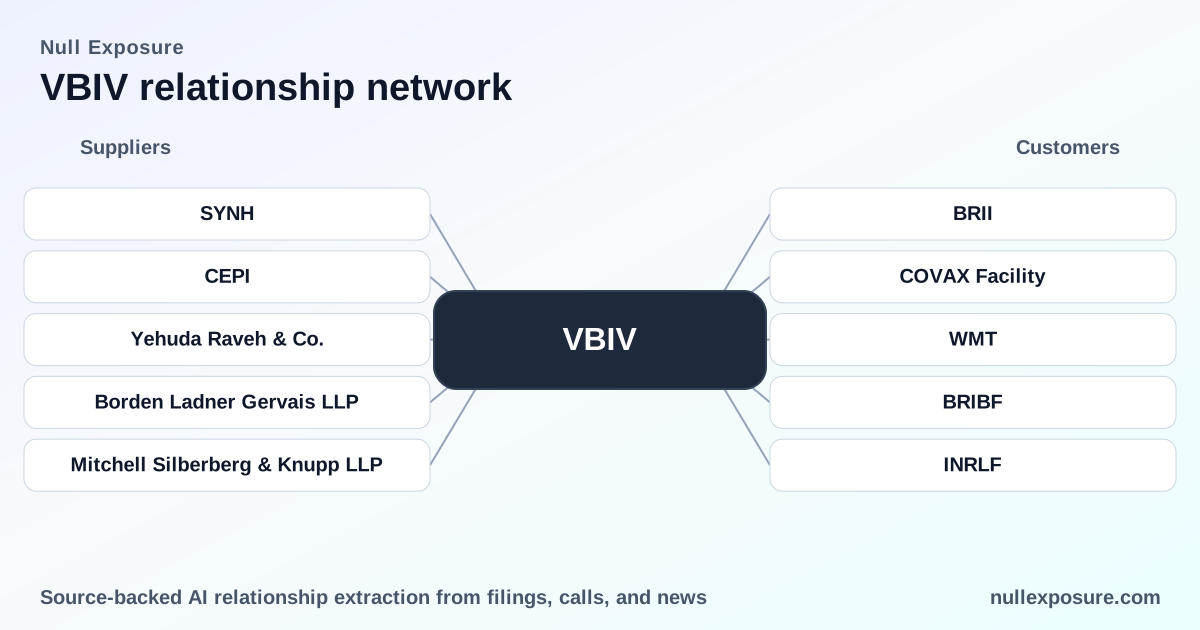
Supplier and partner roll call (plain English, sourced)
Below are every relationship returned in the supplier search, with a concise investor‑oriented description and a source for verification.
Syneos Health
VBI has engaged Syneos Health as its U.S. commercialization partner for PreHevbrio™, and executives have moved between the organizations—illustrating an embedded commercial relationship and talent flow that supports U.S. launch activities. According to VBI’s Q2 2022 press release, John Dillman joined VBI after serving as VBI’s Commercial Lead at Syneos Health, which served as the U.S. commercialization partner for PreHevbrio (vbivaccines.com/press-releases/q2-2022). A profile piece on partner dynamics also discusses the agile partnership model between VBI and Syneos (pharmaphorum.com, FY2022).
CEPI
VBI received targeted grant funding from CEPI to advance a COVID‑19 variant vaccine candidate, demonstrating reliance on public‑private funding to de‑risk early clinical development. CEPI committed up to $33 million to support VBI‑2905 through Phase 1 development, per CEPI’s collaboration announcement (cepi.net, FY2021).
Yehuda Raveh & Co.
When VBI executed the SciVac merger, Yehuda Raveh & Co. served as VBI’s Israeli legal counsel, signaling cross‑border legal needs and the use of local counsel for country‑specific transactional and regulatory matters. This is documented in VBI’s merger press release (vbivaccines.com/press-releases/vbi-scivac-merger-agreement/, FY2015).
Borden Ladner Gervais LLP
VBI retained Borden Ladner Gervais LLP as Canadian counsel in the SciVac merger, reflecting the company’s obligation to assemble jurisdictional legal teams for M&A and regulatory work in Canada. The counsel listing is included in VBI’s merger material (vbivaccines.com/press-releases/vbi-scivac-merger-agreement/, FY2015).
Mitchell Silberberg & Knupp LLP
Mitchell Silberberg & Knupp LLP acted as VBI’s U.S. legal counsel during the SciVac merger process, indicating use of U.S. transactional counsel for IP and corporate structuring around that deal. The engagement is recorded in the same merger press release (vbivaccines.com/press-releases/vbi-scivac-merger-agreement/, FY2015).
How these relationships translate into investment risk and opportunity
The relationships above create a clear investor checklist. Outsourced commercialization through Syneos reduces VBI’s fixed costs but concentrates revenue execution risk in a partner. The CEPI grant demonstrates an ability to secure non‑dilutive capital for clinical work, which de‑risks certain programs but also leaves later‑stage financing and commercialization dependent on partners or capital markets.
Legal counsel diversity across jurisdictions argues that VBI has executed cross‑border transactions and will rely on external advisors for future M&A or licensing — an operationally prudent but costed approach. From a risk perspective, crediting the partner set requires active diligence on service agreements, milestone timing, and grant deliverables.
If you want a supplier risk scorecard built from these relationships, explore detailed supplier mapping at https://nullexposure.com/ — it’s the most direct next step for due diligence.
Practical next steps for investors and operators
- Pull and review the Syneos commercial agreement terms and launch timelines to model revenue recognition and milestone risk. VBI’s press materials point to Syneos as the commercialization vehicle (vbivaccines.com/press-releases/q2-2022, FY2022).
- Validate CEPI disbursement schedule and milestones for VBI‑2905 to confirm clinical funding runway (cepi.net, FY2021).
- Review M&A filings and counsel invoices historically tied to the SciVac merger to assess legal spend cadence and potential recurring transactional needs (vbivaccines.com/press-releases/vbi-scivac-merger-agreement/, FY2015).
Bottom line: partner‑centric model, concentrated execution risk
VBI operates a partner‑centric commercial model that converts scientific assets into market access through third‑party commercialization and grant financing. That structure lowers fixed cost and preserves capital but concentrates execution and timing risk in a handful of suppliers and funding sources. Investors should prioritize contract terms, milestone schedules, and public‑sector funding commitments in their diligence.
For a concise supplier risk memo or to commission a tailored supplier map for VBIV, visit https://nullexposure.com/.