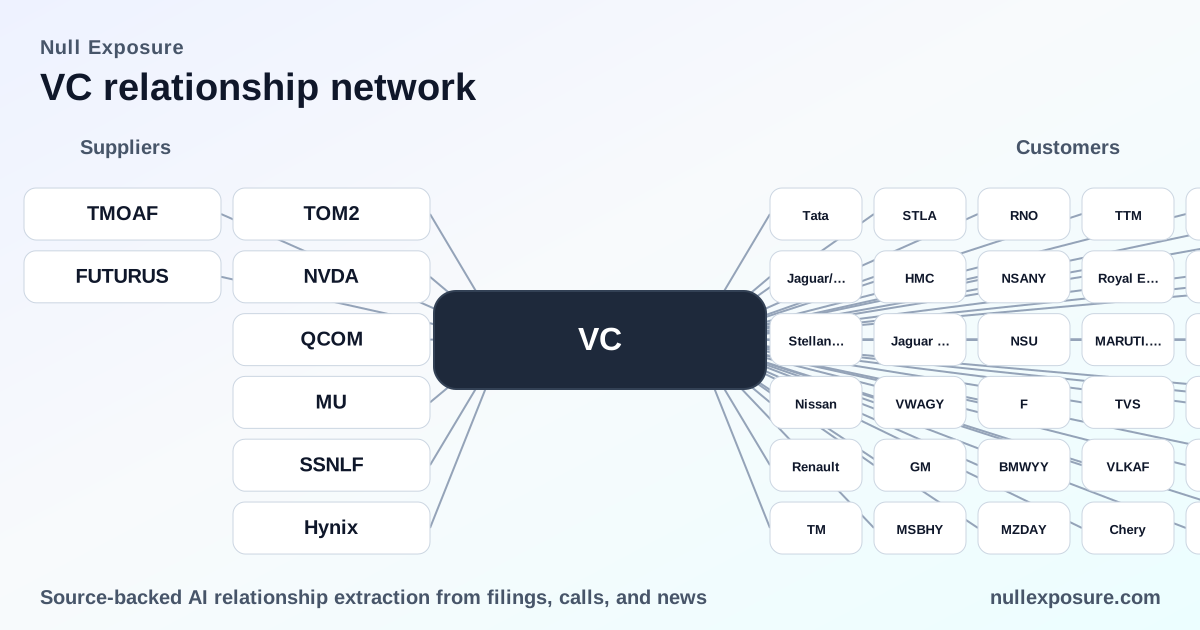
Visteon (VC) — supplier map and what it means for investors
Visteon is a supplier of software-defined cockpit and vehicle electronics that monetizes through OEM design wins, hardware units and embedded software licensing, and post-sale support and integration services. The company captures margin at the intersection of proprietary system integration and third‑party compute and content partnerships, converting design wins into multi-year revenue streams as vehicles move from pilot to production. For an investor, the key questions are design-win conversion rates, the company's ability to manage semiconductor and navigation content supply, and how multiple compute partnerships coexist inside customer programs. Learn more about supplier exposure and signals at https://nullexposure.com/.
Executive summary — the investment thesis in one paragraph
Visteon is executing a platform play: it packages displays, cockpit software (cognitoAI), navigation and compute modules into OEM-ready solutions and relies on a mosaic of specialized suppliers — chipmakers for compute and memory, map/content providers for navigation, and niche display partners — to deliver production systems. That model amplifies revenue upside through scalable software and repeatable hardware designs but concentrates execution risk in supplier availability, design-win cadence, and the competitive dynamics between compute partners. Monitor OEM adoption breadth and the pace at which announced collaborations convert into production revenue.
How Visteon runs its supplier relationships and why that matters
Visteon operates as an OEM‑facing systems integrator with an explicit contracting posture: it negotiates design-win engagements that bundle Visteon hardware and software with licensed third‑party IP and components. This is not a transactional buyer-supplier model — contracts are structured around vehicle programs with multiyear cadence and high switching costs once embedded. Company-level signals from recent disclosures show: no supplier contract excerpts were provided in the source package, indicating contractual detail is not publicly disclosed here; relationships are concentrated in a small set of strategic partners for compute and memory; and partnerships are transitioning from R&D demonstrations toward production-ready announcements, signaling increasing maturity of the product portfolio.
Visit https://nullexposure.com/ for deeper supplier analytics and monitoring.
Supplier relationship roll call — what each link means for revenue and risk
TomTom — navigation integration for privacy-first in-car experience
Visteon integrates TomTom's Automotive Navigation Application into its cognitoAI platform to deliver a privacy-first local navigation experience that can be embedded in OEM cockpits. This is a content and UX play that positions Visteon to offer differentiated navigation without building mapping assets in-house. Source: Finviz and StockTitan reports, March 10, 2026.
NVIDIA — high-performance AI/ADAS compute and legacy collaboration
Visteon has public collaborations that include NVIDIA DRIVE AGX Orin for AI-ADAS compute; announcements describe Visteon solutions powered by NVIDIA's safety-certified DriveOS and DRIVE AGX hardware. That relationship supplies Visteon with high-end AI compute capability for certain ADAS and cockpit functions and represents a clear pathway for advanced, safety‑critical features. Source: Finviz and StockTitan coverage, March 10, 2026.
Qualcomm — Snapdragon Cockpit Elite platform for production-ready compute
Visteon showcased a High‑Performance Compute solution built on Qualcomm's Snapdragon® Cockpit Elite platform and highlighted OEM implementations and production specifications, advancing a Qualcomm-based product into OEM consideration and demonstration phases. This indicates Visteon is pursuing multi-vendor compute strategies to address different OEM needs and cost/performance tradeoffs. Source: StockTitan and Finviz reports, March 10, 2026.
Micron, Samsung, Hynix — memory supply concentrated among three players
Visteon confirmed long-standing, strategic relationships with the three dominant memory suppliers — Samsung, SK Hynix and Micron — and noted the market concentration where roughly 90% is provided by those vendors. Memory is critical to cockpit and AI compute systems; those supplier ties are operationally essential and represent a concentration risk for production ramp and pricing. Source: InsiderMonkey transcript of Visteon Q4 2025 earnings call, reported March 2026.
FUTURUS — next-generation head‑up display and projection technology
Visteon is previewing next‑generation HUD and projection technologies developed with FUTURUS, expanding its display portfolio into immersive visualization layers that integrate digital content into the driving environment. This relationship targets cockpit differentiation through advanced visualization rather than compute or memory. Source: Barchart coverage of Visteon’s CES showcase, March 10, 2026.
What these relationships imply about contracting posture, concentration, criticality and maturity
- Contracting posture: Visteon operates as a program-based integrator contracting at the OEM level, not as a simple component buyer. Partner agreements commonly sit behind program-level commitments and are therefore commercially coupled with Visteon’s design‑win success. No supplier contract excerpts were provided in the source material; treat contract terms and commercial protections as undisclosed in these disclosures.
- Concentration: Semiconductor memory supply is concentrated across Samsung, Hynix and Micron, which creates a persistent procurement and pricing lever for Visteon’s cost structure. Compute capability is split across NVIDIA and Qualcomm, indicating deliberate vendor diversity but introducing complexity in product roadmaps and customer negotiations.
- Criticality: Relationships with compute and memory suppliers are mission‑critical; loss or delay from these partners would directly delay vehicle production and revenue recognition. Navigation and display vendors are strategically important for differentiation and customer stickiness.
- Maturity: Public statements and production-spec showcases indicate a transition from concept to production readiness, particularly for the Qualcomm-based cockpit solution and NVIDIA collaborations; that progression elevates revenue convertibility in the near term.
Risk lens and what investors should monitor next
- Design‑win conversion: Announcements do not equal revenue; track OEM program awards, production timelines, and supplier order flows to confirm revenue conversion.
- Supplier conflict and coexistence: Visteon’s simultaneous NVIDIA and Qualcomm collaborations introduce integration complexity; investors should watch whether customers accept dual‑stack approaches or force exclusivity decisions.
- Memory supply and pricing: Heavy dependence on three large memory suppliers is a structural procurement risk that influences gross margins and inventory exposure.
- Disclosure gap: The absence of supplier contract excerpts in the data set is itself a signal that contractual protections, lead times, and penalty structures are not visible publicly.
Actionable checklist for investors
- Track near-term OEM production awards and vehicle launch schedules tied to Qualcomm- and NVIDIA-based solutions.
- Monitor semiconductor inventory and bookings for signs of supplier-induced delays or price pressures from Samsung, Hynix and Micron.
- Watch customer statements on platform preferences to see which compute stack (NVIDIA vs Qualcomm) scales across programs.
- Validate that navigation and display partnerships (TomTom, FUTURUS) are embedded in signed OEM contracts rather than pilot trials.
For ongoing supplier exposure monitoring and to model supplier concentration into portfolio risk, visit https://nullexposure.com/.
Closing note: Visteon’s supply relationships reveal a company pushing from demonstration toward scaled, production-ready cockpit platforms, but the stock’s upside rests on consistent design‑win conversion and disciplined management of concentrated semiconductor and compute partner exposure. For a deeper, investor-grade supplier heatmap and ongoing alerts, go to https://nullexposure.com/.