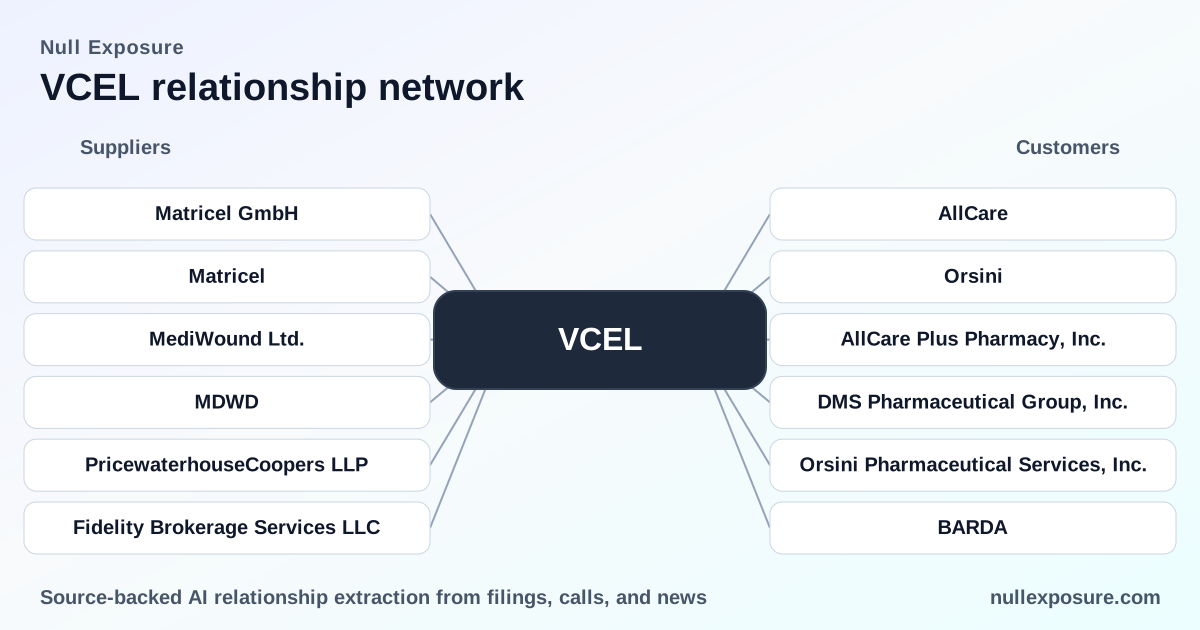
Vericel's supplier map: concentrated manufacturers, multi‑year commitments, and operational leverage
Vericel (VCEL) manufactures and commercializes cell- and tissue-based therapies—notably MACI (a collagen membrane–based autologous cartilage implant) and NexoBrid (an enzymatic debridement product licensed for North America). The company monetizes through product sales and licensing arrangements while outsourcing critical manufacturing and component supply to a small set of third‑party partners; Vericel’s margin and commercial growth trajectory therefore hinge on the stability and contractual scope of these supplier relationships. For actionable diligence and ongoing monitoring, see the supplier hub at https://nullexposure.com/ for updated relationship profiles and filings.
Why suppliers matter more than line-item spend
Vericel’s operating model blends exclusive licenses and long-term purchase commitments with a residual population of order-by-order, sole-source suppliers. That duality creates two dynamics investors must price: (1) predictable cost and volume under long-term contracts that support revenue visibility for core products, and (2) single‑point failure risk where short-term suppliers supply critical components without long-term guarantees. The 10‑K shows both features in plain terms and quantifies at least one multi‑year commitment that meaningfully affects near‑term spend.
- Contracting posture: Mix of long-term agreements (renewed Matricel contract) and purchase‑order suppliers for niche components.
- Concentration and criticality: Several suppliers are sole or single source for essential components; failures would be material to supply.
- Maturity: Long-term supplier contracts extend to the end of 2030 with optional extensions, indicating multi-year operational alignment for at least one major product.
- Geographic exposure: Manufacturing and raw‑material sourcing spans Israel and APAC (e.g., bromelain raw material from Taiwan), creating geopolitical and logistics risk vectors.
Explore the full supplier dossier and primary-source excerpts at https://nullexposure.com/ to validate these points against the underlying filings.
Relationship roster: who supplies what and what that implies
Matricel GmbH / Matricel — the membrane supplier anchoring MACI
Matricel is the sole supplier of the ACI‑Maix collagen membrane used to manufacture MACI, and Vericel renewed a long‑term supply agreement on July 1, 2023 that is effective through December 31, 2030 with an option to extend to 2033; the contract carries annual minimum purchase commitments totaling roughly €12.5 million over an eight‑year term. According to Vericel’s FY2024 Form 10‑K, this agreement establishes predictable supply and spend for a core product but also concentrates procurement risk with one vendor.
Source: Vericel FY2024 Form 10‑K (supply agreement renewal and purchase commitments, July 1, 2023).
MediWound Ltd. / MediWound (MDWD) — exclusive licensor and contract manufacturer for NexoBrid
Vericel holds an exclusive North American license from MediWound for NexoBrid while MediWound manufactures and supplies the product to the U.S. market on a unit‑price basis; under the May 2019 agreements MediWound acts as both licensor and manufacturer. Vericel’s 10‑K and related news commentary note that production is largely located in Israel and that MediWound’s ability to meet demand is a commercial dependency that can affect Vericel’s product availability.
Source: Vericel FY2024 Form 10‑K (exclusive license and supply agreements); 2026 news coverage noting NexoBrid trademark licensing and Israeli manufacturing risks.
PricewaterhouseCoopers LLP — financial reporting touchpoint
PricewaterhouseCoopers is referenced in relation to Vericel’s preliminary financial data disclosures, with the firm not having audited or reviewed those preliminary figures. This relationship is a standard external audit/assurance touchpoint and is mentioned in SEC filing coverage in 2026.
Source: 2026 SEC filing coverage (news summary of 8‑K, PricewaterhouseCoopers LLP reference).
Fidelity Brokerage Services LLC — transaction/broker identity in filings
Fidelity Brokerage Services is identified in a 2026 filing as the broker in a transaction disclosure; the mention is administrative rather than operational but relevant for investor‑level tracing of ownership and market activity.
Source: 2026 SEC filing summary noting Fidelity Brokerage Services LLC as the broker (13D/transaction disclosure context).
What these relationships tell investors about risk and runway
Vericel’s supplier profile is a study in concentrated operational leverage. Matricel’s long‑term, high‑minimum contract reduces short‑term unit cost volatility but centralizes supply risk, while MediWound’s license-and-manufacture arrangement shifts manufacturing responsibility—and geopolitical exposure—outside Vericel’s direct control. Simultaneously, the company’s disclosures about purchase‑order, single‑source suppliers for other components indicate pockets of short‑term procurement exposure that could cause supply interruptions.
- Financial predictability: The Matricel commitment creates multi‑year minimum revenue for the supplier and a predictable input flow for MACI production—this supports revenue stability but locks in minimum spend in the €10–100M band over the term.
- Operational fragility: Single‑source suppliers and offshored manufacturing (Israel for MediWound; bromelain sourcing in Taiwan) create concentrated supply‑chain and geopolitical risk that can translate to material revenue impact if disrupted.
- Contract maturity mix: The presence of both long‑term contracts and short‑term purchase arrangements requires active supplier risk management and contingency planning to protect growth initiatives.
If you want an enterprise-grade monitoring setup that tracks these exact contract milestones and any new supplier filings, check our supplier intelligence page at https://nullexposure.com/ for continuous updates and source-linked evidence.
Investment implications and watchlist
For investors, the commercial outlook for Vericel depends on three levers: product demand, third‑party manufacturing continuity, and the company’s ability to diversify single‑source inputs. Key watch items are: Matricel purchase‑commitment enforcement and any negotiations that change price or volume; MediWound’s manufacturing output and regional stability; and any SEC filings that describe new supplier agreements or contingency plans.
Near-term catalysts to monitor:
- Quarterly supply‑chain disclosures and any interruptions tied to MediWound’s Israel facilities.
- Renewals or re‑pricing discussions with Matricel as the contractual option window approaches.
- Any moves by Vericel to internalize manufacturing or add alternate suppliers for single‑source components.
For a consolidated view of these supplier contracts, primary‑document excerpts, and a time‑line of obligations, visit https://nullexposure.com/ and subscribe to supplier alerts.
Final takeaways
- Vericel’s revenue profile is materially influenced by a small number of manufacturing partners. Matricel’s long‑term contract and MediWound’s exclusive license/manufacturing role are the two most consequential relationships for core products.
- Concentration is both stabilizing and risky: long‑term contracts give visibility; single‑source suppliers and offshore manufacturing create outsized downside if disrupted.
- Active supplier monitoring is essential for accurate valuation and risk management—use primary filings and real‑time disclosure tracking to detect changes in contracts, geography, or capacity.
If you need a sector‑level briefing or a customized supplier risk memo for Vericel, start here: https://nullexposure.com/ and request a tailored report.