Vine Hill Capital Investment Corp (VCIC): Supplier relationships and operational signals investors should know
Vine Hill Capital Investment Corp operates as a sponsored blank‑check acquisition vehicle that monetizes by raising capital through a public unit offering, executing unit separation to list ordinary shares and warrants, and completing a business combination with target companies in the industrial and services sectors; the company also outsources core administrative and transaction functions to third‑party advisors and a sponsor affiliate that it compensates on a recurring basis. For investors, the relevant commercial model is simple: capital formation today, transaction value capture via a future acquisition, and a lightweight ongoing cost base delivered through external service providers. Learn more at https://nullexposure.com/.
Why the supplier map matters to valuation and deal risk
VCIC’s supplier relationships reveal a classic SPAC operating posture: high dependency on external advisors, concentrated deal execution roles, and modest internal running costs. The company explicitly pays an affiliate of its sponsor $10,000 per month for office and administrative support, which signals a deliberate choice to keep headcount and fixed operating expenses low while outsourcing critical functions. Several constraints reinforce that view: the vehicle targets North American industrial and services targets with an acquisition size ambition in the $500 million to $1 billion+ range, implying substantial deal sourcing and financing needs.
Key implications for investors:
- Contracting posture: Outsourced and vendor‑driven; the company functions largely as a deal sponsor with third‑party legal, transfer agent, and underwriting partners.
- Concentration and criticality: A small set of advisors (legal counsel, transfer agent, and book‑running manager) are critical to IPO mechanics, compliance, and the ability to consummate a business combination.
- Maturity and stage: The company has completed formation and the offering but has not started revenue‑generating operations; relationships are active for administrative support and prospecting activities.
- Deal scale signal: The declared spend band (target enterprise value $500M–$1B+) indicates the need for robust external underwriting and legal structures to execute sizable acquisitions.
If you want a concise, investor-ready supplier risk profile, visit https://nullexposure.com/ for further analysis.
The supplier landscape — relationship-by-relationship review
Below are the supply and advisory relationships cited in public coverage and filings, with a plain‑English description and source reference for each.
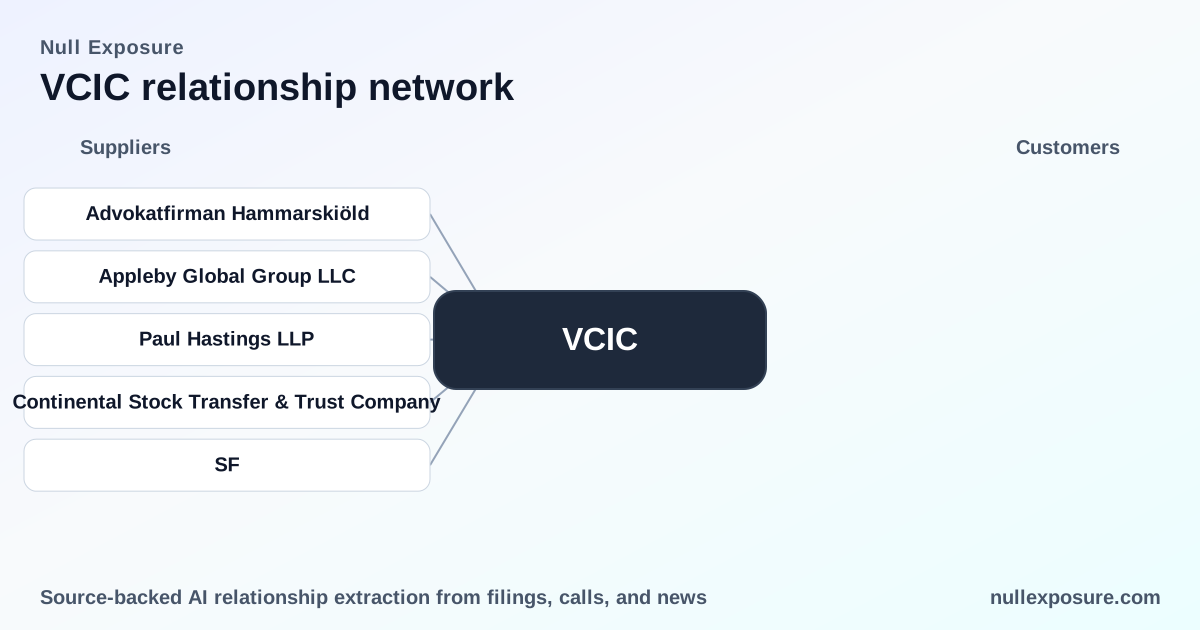
Paul Hastings LLP
Paul Hastings LLP is serving as Vine Hill’s U.S. legal advisor on matters related to the company’s public listing and cross‑jurisdictional corporate matters; this places them at the center of U.S. securities and transaction counsel for VCIC’s capital markets activity. A Yahoo Finance report (March 10, 2026) notes Paul Hastings’ role in advising Vine Hill on U.S. law issues during listing matters (FY2025).
Appleby Global Group LLC
Appleby Global Group LLC is retained to advise Vine Hill on Jersey and Cayman Islands law, reflecting the SPAC’s need for offshore legal structuring and governance counsel in multiple jurisdictions. According to the same Yahoo Finance piece (March 10, 2026), Appleby is acting for Vine Hill on channeling corporate and listing structures under Jersey and Cayman law (FY2025).
Advokatfirman Hammarskiöld
Advokatfirman Hammarskiöld provides Swedish law advice to Vine Hill, indicating cross‑border legal coverage and possible ties to Scandinavian investors or regulatory considerations. The Yahoo Finance article (March 10, 2026) lists Advokatfirman Hammarskiöld as the advisor on Swedish law matters for the company (FY2025).
Continental Stock Transfer & Trust Company
Continental Stock Transfer & Trust Company serves as VCIC’s transfer agent and is the operational counterpart for the mechanical process of separating Units into ordinary shares and warrants, an action that affects liquidity and shareholder rights. A StockTitan disclosure (first seen March 10, 2026) instructs brokers to contact Continental for unit separation, confirming their operational role (FY2024).
Stifel, Nicolaus & Company, Incorporated
Stifel acted as sole book‑running manager for VCIC’s offering, providing underwriting and distribution services critical to the successful capital raise and aftermarket liquidity of the company’s units. The StockTitan notice (first seen March 10, 2026) identifies Stifel as sole book‑running manager for the offering (FY2024).
What each relationship means for transaction execution and investor risk
Legal advisors (Paul Hastings, Appleby, Advokatfirman Hammarskiöld) together represent a comprehensive cross‑jurisdictional legal infrastructure that enables VCIC to navigate U.S., Jersey/Cayman, and Swedish legal requirements for listing and deal execution; their presence reduces legal execution risk on cross‑border aspects of a target acquisition. The transfer agent (Continental) is operationally critical for shareholder mechanics such as unit separation, which directly affects investor liquidity and option exercise timing. The book‑runner (Stifel) is crucial to distribution and capital markets support; underwriting concentration with a single book‑runner concentrates execution risk but also simplifies coordination.
From a governance and cost perspective, company disclosures show recurring payments to a sponsor affiliate for administrative support rather than in‑house staffing, signaling lower fixed costs but higher vendor dependency. The firm’s target acquisition size (enterprise value band of $500M–$1B+) means these supplier relationships must scale to support larger, more complex deals.
Investor actions and monitoring checklist
- Track formal filings and press releases for any changes to legal counsel, transfer agent, or underwriting arrangements; shifts here are meaningful to execution risk.
- Confirm the timing and mechanics of units separation with Continental Stock Transfer, since separation affects when warrants and shares trade independently and therefore affects liquidity.
- Monitor sponsor affiliation and administrative agreements disclosed in filings to understand recurring cash outflows and potential conflicts of interest tied to sponsor affiliates.
For an investor‑oriented supplier risk matrix and ongoing monitoring, see https://nullexposure.com/ — the homepage offers a concise view of supplier concentration and criticality across SPACs.
Final assessment and recommended next steps
VCIC runs a lean operating model that relies on a compact set of external advisors to deliver capital markets execution and post‑closing support. That model is appropriate for a SPAC focused on rapid dealmaking and low running costs, but it concentrates execution risk in a few vendors: legal teams for cross‑border structuring, a single book‑runner for underwriting, and a transfer agent for equity mechanics. Investors should treat these relationships as material to both upside (successful deal execution) and downside (delays or conflicts harming transaction completion).
If you are evaluating VCIC exposure or similar sponsored vehicles, prioritize due diligence on advisor continuity, sponsor economics, and the timeline for announcing a target. For more supplier intelligence and comparative analysis across sponsored vehicles, visit https://nullexposure.com/ and subscribe for updates.