VCI Global (VCIG) — Supplier ecosystem and strategic partners investors should watch
VCI Global operates as a cross‑sector platform builder that monetizes through three linked engines: capital markets origination and placement, digital asset infrastructure and custody/tokenization services, and asset ownership and project delivery in AI and renewable infrastructure. The company generates near‑term cash via capital raises and placement fees, builds recurring revenue through custody/tokenization and software services, and targets long‑duration cash flows from EPC+F renewable projects and owned AI compute assets. For a concise rollout of partner exposure and implications, review the partner map below — and for ongoing monitoring and supplier risk scoring visit https://nullexposure.com/.
What the partner map reveals about VCI’s operating posture
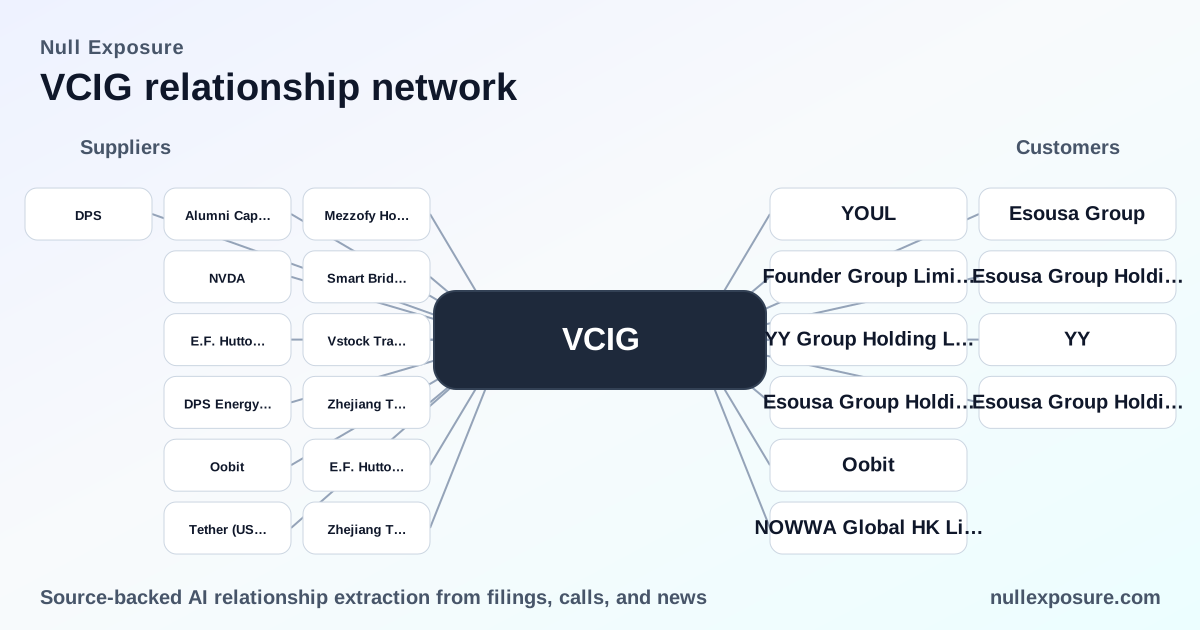
VCI’s partner roster shows a hybrid model: transactional capital‑markets relationships (placement agents, transfer agents), infrastructure vendors (NVIDIA for GPUs; Tianneng for EPC+F battery/solar), and digital rails and custody providers (Smart Bridge, Oobit, Tether). This mix signals a capital‑intensive, partner‑dependent scaling strategy where external counterparties deliver critical capabilities that convert announcements into recurring revenues and project milestones. There are no explicit constraints listed in the relationship payload; instead, the information yields company‑level operating signals around contracting posture, concentration, criticality, and maturity that investors must price into valuation and operational risk.
The partners — who they are and what they do for VCI
Below are every supplier and intermediary mentioned in public reporting associated with VCIG, each summarized in plain English with source attribution.
-
Mezzofy Holding Limited — Mezzofy is tabbed to supply authorized, redeemable merchant vouchers as part of a broader RWA initiative, supporting VCI’s tokenized asset use cases. According to a StockTitan report in March 2026, Mezzofy will provide merchant voucher supply while another vendor handles tokenization and settlement.
-
Smart Bridge Technologies Limited — Smart Bridge is acting as the platform implementation and custody provider for VCI’s tokenization and RWA roadmap; the relationship includes exchange operations, custody, settlement and regulatory compliance services. StockTitan coverage (March 2026) also highlights Smart Bridge’s role in a separate $200M RWA consultancy mandate, positioning it as a recurring‑services vendor for VCI.
-
Vstock Transfer, LLC — Vstock will serve as transfer agent and act as exchange agent for VCI’s reverse stock split, performing standard transfer‑agency and shareholder record functions. This role is described in VCI’s SEC 6‑K filing disclosed in March 2026.
-
Zhejiang Tianneng Energy Storage Technology Development Co., Ltd (Tianneng) — Tianneng has been appointed as VCI Energy’s primary EPC+F partner to deliver up to 250MW of solar and up to 800MWh of BESS, effectively acting as the engineering, procurement, construction and financing facilitator for the renewable roadmap. GlobeNewswire and MacauBusiness reporting (Jan–Mar 2026) detail the fully funded renewable project collaboration.
-
E.F. Hutton & Co. — E.F. Hutton is VCI’s exclusive placement agent on a $5 million registered direct offering, an advisory and distribution engagement that underwrites near‑term liquidity and market execution. Yahoo Finance and Intellectia coverage in March 2026 identify E.F. Hutton as the lead placement intermediary for the raising.
-
NVIDIA (NVDA) — NVIDIA supplies the GPU technology stack powering VCI’s AI GPU computing center and enterprise LLM platform; the launch of a Blackwell‑powered AI GPU Lounge signals ownership or privileged access to premium inferencing hardware. Finviz and StockTitan articles from March 2026 report the Malaysia launch and the use of NVIDIA Blackwell GPUs.
-
DPS Energy Sdn Bhd / DPS Resources Berhad (DPS) — DPS Energy (a DPS Resources subsidiary) executed an MoU with VCI to develop a large‑scale solar PV platform on long‑tenure land in Malacca; DPS brings local project execution capability and permitting relationships. StockTitan commentary (FY2025 reporting) notes the MoU and DPS Resources’ role as a Malaysian energy delivery partner.
-
Oobit — Oobit payment rails are slated for integration into VCI’s sovereign RWA ecosystem to provide settlement rails. StockTitan’s roadmap disclosure in 2025 outlines Oobit’s payment‑rail integration.
-
Tether (USDT) — Tether is named as a strategic liquidity and instant settlement participant within VCI’s RWA payment rails, offering stablecoin liquidity for institutional flows. StockTitan reporting (FY2025 roadmap) cites Tether’s intended strategic participation.
-
Alumni Capital — Alumni Capital provided an ELOC commitment that VCI credited with delivering flexible liquidity during a critical scaling period, indicating a short‑term credit/commitment relationship rather than project delivery. SahmCapital commentary (Dec 2025) discusses Alumni Capital’s ELOC contribution.
How these relationships translate into operational constraints and levers
There are no explicit constraints reported in the relationship payload, so interpret the following as company‑level signals derived from partner roles and public disclosures:
-
Contracting posture: VCI uses a mix of exclusive placement agents, MOUs for local development, and named primary EPC+F and custody vendors — suggesting strategic exclusivity on capital and implementation, and more transactional ties for payments and vouchers.
-
Concentration and criticality: Reliance on a small number of specialized partners (e.g., Smart Bridge for custody/tokenization; Tianneng for EPC+F; NVIDIA for GPU supply) creates single‑point‑of‑delivery risk for critical revenue paths. That concentration elevates execution risk if a major supplier underperforms.
-
Maturity profile: Partners range from established market leaders (NVIDIA, Tether, E.F. Hutton) to specialized regional developers and fintech firms (DPS Energy, Smart Bridge, Oobit). This mix mitigates commercial risk through brand strength but retains operational execution risk in project delivery.
-
Commercial levers: Placement fees, ELOC liquidity and EPC+F facilitation are near‑term levers; longer‑term recurring revenue depends on custody/tokenization services and owned AI/energy assets successfully reaching commercial operations.
If you want continuous mapping and risk scoring of VCIG’s supplier relationships and contract concentration, visit https://nullexposure.com/ for a live supplier overview.
Investment implications and actionable takeaways
-
Positive: VCI’s partner set combines blue‑chip technology (NVIDIA), capital markets distribution (E.F. Hutton), and a named EPC+F partner (Tianneng) — collectively enabling both capital raises and asset delivery, which supports the company’s narrative of moving from announcement to recurring revenue.
-
Negative: Execution risk is concentrated around a handful of suppliers; failure to operationalize the Tianneng EPC+F roadmap or to secure GPU supply/installation timelines would meaningfully delay revenue realization. The company’s dependence on placement agents and external liquidity lines also places near‑term financing risk outside internal control.
-
What to watch next: milestone confirmations for EPC contracts, custody integrations and audit attestations from Smart Bridge, deployment timelines and utilization metrics for the NVIDIA GPU center, and completed capital raises or drawdowns under Alumni Capital’s ELOC.
For a structured supplier risk report and monitoring dashboard that ties these partner events to valuation sensitivity, see https://nullexposure.com/.
VCI’s strategy is execution‑heavy: the partner map gives the company the building blocks to monetize its three engines, but investors must price concentrated execution risk and track partner deliverables as the primary driver of whether announced projects convert to long‑duration cash flows.