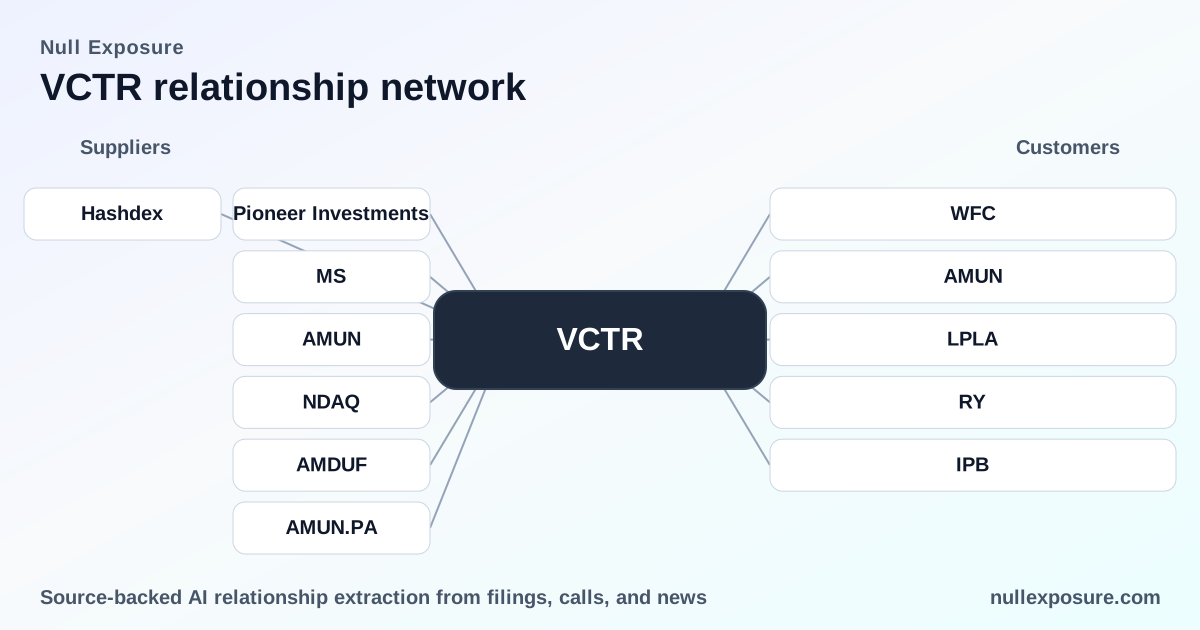
Victory Capital (VCTR): Supplier relationships that drive distribution and product expansion
Victory Capital is a fee-driven asset manager that monetizes scale: it collects management and performance fees on assets under management, grows revenue through product launches and distribution partnerships, and outsources non-core operations to variable-cost service providers to preserve operating leverage. The company's strategy converts strategic acquisitions and distribution wins into higher AUM and incremental fee income while keeping fixed costs muted through usage‑based vendor contracts. Learn more about how these supplier and partner linkages change the risk-reward profile at https://nullexposure.com/.
How Victory runs and charges for the business — a concise thesis for investors
Victory Capital generates revenue primarily by collecting percentage-based fees on AUM across active and passive products, including ETFs, mutual funds and UCITS. The company expands AUM through acquisitions (notably Pioneer Investments via its Amundi partnership), placement on wealth-manager platform lists (e.g., Morgan Stanley) and new product launches (including crypto‑linked vehicles). Victory deliberately pushes non-core functions—transfer agency, trade settlement, portfolio accounting, reporting—to scaled third-party service providers on variable, usage‑based contracts, which preserves operating margin sensitivity to revenue growth while transferring operational execution to specialists.
Key operating characteristics: Victory runs a distribution- and product-led model, funded by AUM fees; it holds variable-cost vendor relationships that compress fixed cost and emphasize scalability; and it relies on a small number of critical service providers that amount to concentration and operational dependency. For further context on supplier exposures and partner dynamics, visit https://nullexposure.com/.
The partner map you need to read today
Below I review every relationship that appears in the supplier findings and provide a plain-English takeaway with source context.
Pioneer Investments — (earnings call, 2025 Q4)
Victory announced that it integrated Pioneer Investments onto its platform as part of the strategic partnership with Amundi, signaling immediate distribution and product synergies. This was disclosed on the company’s 2025 Q4 earnings call in March 2026.
Morgan Stanley — (earnings call, 2025 Q4)
Victory reported that its VictoryShares Core Intermediate Bond ETF (UITB) and VictoryShares Short-Term Bond ETF (USTB) were added to Morgan Stanley’s wealth management focus list, a distribution milestone that should increase intermediary-driven flows. The disclosure came during the 2025 Q4 earnings call in March 2026.
Amundi US — (press release, FY2025)
Victory’s AUM was materially increased by assets acquired from Amundi US, totaling $114.6 billion, according to the company’s FY2025 reporting and the August 7, 2025 press release summarizing second-quarter results. That acquisition is the primary driver of a step-change in scale for Victory’s platform.
Nasdaq — (industry coverage, FY2021)
Victory launched vehicles that track the Nasdaq Crypto Index, an index co-developed by Nasdaq and Hashdex, indicating an early move into crypto-linked products under Nasdaq branding. This product-level partnership and indexing choice was discussed in coverage from 2021 on ETF industry outlets.
Amundi (strategic partner) — (earnings call, 2025 Q4)
On the 2025 Q4 earnings call, management reiterated that it closed a strategic partnership with Amundi, which underpins both product distribution (UCITS) and the Pioneer integration onto Victory’s platform. The partnership is foundational to Victory’s international product expansion.
Pioneer Investments — (press release coverage, FY2025)
A company press release and related coverage in August 2025 described the acquisition of Pioneer Investments as a key new Investment Franchise, confirming the strategic intent announced on the earnings call and quantifying the transaction’s impact on AUM growth.
Amundi (UCITS expansion) — (news coverage, FY2025)
Industry reports in 2025 noted that Victory added three new UCITS through its partnership with Amundi, expanding its European product shelf and cross-border distribution capability under Amundi’s infrastructure.
Hashdex — (industry coverage, FY2021)
Hashdex served as Victory’s partner on crypto funds and is credited with developing early crypto index funds, which supported Victory’s launch of products tracking the Nasdaq Crypto Index and signaled a willingness to enter niche product markets.
What these relationships tell investors and operators
Victory’s supplier and partner footprint reveals a clear operational posture:
-
Contracting posture: The company employs usage‑based, variable-cost contracts for distribution intermediaries and middle/back-office services, which aligns costs with AUM and preserves margin upside as revenues scale. This is a deliberate design to maintain operating leverage while limiting fixed overhead.
-
Concentration and criticality: Several relationships—especially the Amundi strategic partnership and a limited set of large service providers—are critical to Victory’s product distribution and operations. That concentration creates single‑point dependencies that elevate operational risk if a key partner relationship falters.
-
Role mix: Victory functions both as a buyer of operational services (outsourced back-office, custody, transfer agents) and as a seller/partner to distribution platforms (Morgan Stanley inclusion, Amundi UCITS rollout). That dual posture accelerates scale but requires strong vendor governance and contractual discipline.
-
Maturity and scale: The combination of the Amundi/Pioneer transaction and ongoing platform placements indicates a maturing global footprint—product breadth has expanded (UCITS, ETFs, crypto) while operational frameworks remain centered on scalable third-party providers.
Operational implication: Investors should view gross AUM growth through the lens of vendor concentration and the durability of distribution agreements—growth is profitable but dependent on maintaining outsourcer performance and partner channels.
For a targeted breakdown of supplier risk and distribution exposures, visit https://nullexposure.com/ and see how these relationships score on contract type and criticality.
Bottom line and next steps for investors
Victory Capital has converted a high‑quality distribution milestone set (Morgan Stanley placement, Amundi partnership, Pioneer acquisition) into a larger, more diversified AUM base while preserving margin through usage‑based outsourcing. The primary upside is fee growth from acquired and newly distributed assets; the primary operational risk is vendor concentration and the execution of third‑party service providers.
Actionable items:
- Track retention and integration metrics for the Pioneer/Aumundi assets to confirm revenue conversion from announced AUM.
- Monitor third‑party service performance and any public mentions of transfer agent or custody issues, since these are critical to fund operations.
- Consider allocation to Victory exposure as a play on scalable asset managers that manage risk through variable-cost vendor structures, but underwrite potential vendor concentration.
For a deeper supplier-risk profile and live updates on partner relationships, go to https://nullexposure.com/.