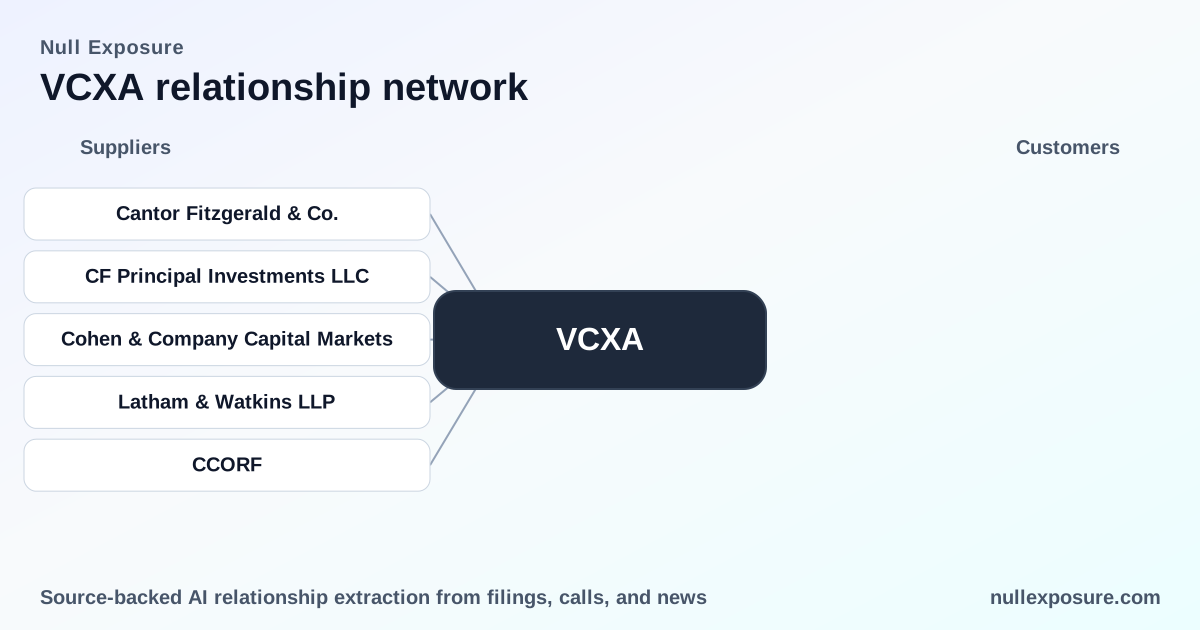
VCXA supplier relationships: what investors need to know
VCXA operates as a supplier to capital markets and corporate transaction workflows, monetizing through transaction fees, facilitation arrangements and placement or commitment-related revenues tied to capital raises. The company’s commercial model is execution-oriented: it connects issuers and sponsors with capital providers and advisory firms, and captures value as deals close or financing commitments are drawn. For investors, the critical lens is whether VCXA’s revenue profile is driven by recurring, diversified fee streams or by episodic, concentrated financings.
Discover deeper relationship analysis and supplier risk scoring at https://nullexposure.com/.
Why this set of relationships matters for valuation and risk
The recent disclosures show VCXA embedded in a multi-advisor capital raise for 10X Capital and PrimeBlock. That configuration signals a transaction-led revenue cadence and reliance on large financing counterparties and advisory networks to execute deals. Deal execution scale, counterparty quality (investment banks, legal counsel, committed equity providers), and the size of facilities are the primary drivers of near-term revenue and downside concentration risk.
Explore supplier-level intelligence on the platform: https://nullexposure.com/
The counterparties identified (what each relationship means)
According to a March 10, 2026 Yahoo Finance report covering a financing tied to 10X Capital and PrimeBlock, the following supplier relationships are documented.
-
Cantor Fitzgerald & Co. — Cantor is serving as capital markets advisor to 10X Capital, positioning it as the lead advisory firm orchestrating the transaction and placement strategy. (Source: Yahoo Finance, March 10, 2026.)
-
CF Principal Investments LLC — An affiliate of Cantor Fitzgerald, CF Principal Investments provided a $300 million committed equity financing facility to 10X Capital and PrimeBlock, representing a substantial committed-capital backstop for the transaction. (Source: Yahoo Finance, March 10, 2026.)
-
Cohen & Company Capital Markets (division of J.V.B. Financial Group, LLC) — Cohen & Company is acting as a financial advisor to 10X Capital on the transaction, adding execution bandwidth and distribution support alongside other advisors. (Source: Yahoo Finance, March 10, 2026.)
-
Latham & Watkins LLP — Latham & Watkins is legal counsel to 10X Capital on the deal, providing transaction structuring and documentation services that are critical to closing and regulatory compliance. (Source: Yahoo Finance, March 10, 2026.)
-
Canaccord Genuity — Canaccord is serving as a financial advisor to 10X Capital in tandem with other advisory firms, contributing to marketing and placement of the financing. (Source: Yahoo Finance, March 10, 2026.)
Each of these relationships is documented in the same transaction coverage and collectively reflects a traditional capital markets syndicate: lead capital markets advisor, committed-equity partner, co-advisors and legal counsel. That configuration drives both fee generation on close and operational dependency on transaction timing.
What the relationship mix tells investors about VCXA’s operating model
-
Contracting posture: The adviser-and-committed-capital setup indicates short-term, transaction-based contracts rather than long-term service agreements. Revenue recognition is likely event-driven and concentrated around financings.
-
Concentration: Presence of a single large committed facility ($300 million) implies downside sensitivity if one or two financings account for a large share of revenue; concentrated counterparties amplify counterparty credit and execution risk.
-
Criticality: Legal and capital markets advisors (Latham & Watkins, Cantor) are critical to deal completion; failure or withdrawal by those firms materially affects closing probability and timing, which in turn affects VCXA’s cash flows tied to the transaction.
-
Maturity: The counterparty roster is institutional and experienced, signaling a mature capital markets execution chain—this reduces execution risk compared with early-stage or unproven advisor networks, but does not eliminate market-cycle exposure.
Note: there are no explicit constraint disclosures in the available materials, so the above are company-level signals inferred from the structure of the disclosed relationships rather than contract excerpts.
Investment implications — upside and risk
-
Upside: When large committed facilities are placed and advisory syndicates perform, transaction fees and placement commissions can be meaningful in the short term, lifting top-line growth and potentially feeding higher-margin advisory revenue.
-
Risk: The combination of event-driven revenue and a sizable committed equity facility concentrates earnings around a small number of deals. If capital markets slowdown or a sponsor pulls back, revenue volatility will be significant. Counterparty concentration (single committed-provider relationships) elevates credit and execution risk.
-
Mitigant: The quality of advisors and legal counsel documented (Cantor Fitzgerald, Latham & Watkins, Canaccord) increases probability of execution in normal market conditions and provides reputational benefit. However, reputational strength does not remove macro-driven financing risk.
Tactical recommendations for investors and operators
-
For valuation: adjust forecasted near-term revenue to reflect event-driven recognition and stress test scenarios where the committed facility is delayed or not drawn.
-
For due diligence: prioritize contract terms that define fee tranches, commitment breakage provisions, and dependency metrics tied to single financings.
-
For operators: diversify the pipeline of financings to reduce one-off concentration and negotiate more recurring or retainer-based advisory mandates where possible.
Learn how this supplier-level intelligence integrates with counterparty monitoring at https://nullexposure.com/.
Final read: what to watch next
Monitor public deal announcements and filings for (1) drawdown activity on the $300 million CF Principal facility, (2) any amendments to advisor roles or fees, and (3) signs of additional committed capital providers joining syndicates to reduce concentration. The immediate valuation lever is transaction cadence — additional similar-scale financings will de-risk the current revenue concentration and justify a higher multiple; a drought in financings compresses near-term cash flow and raises downside risk.
For ongoing coverage and supplier relationship tracking, visit https://nullexposure.com/.
Key takeaway: VCXA’s supplier footprint is anchored in traditional capital markets execution—this delivers episodic upside through large financings but carries intrinsic concentration and timing risk that investors must model explicitly.