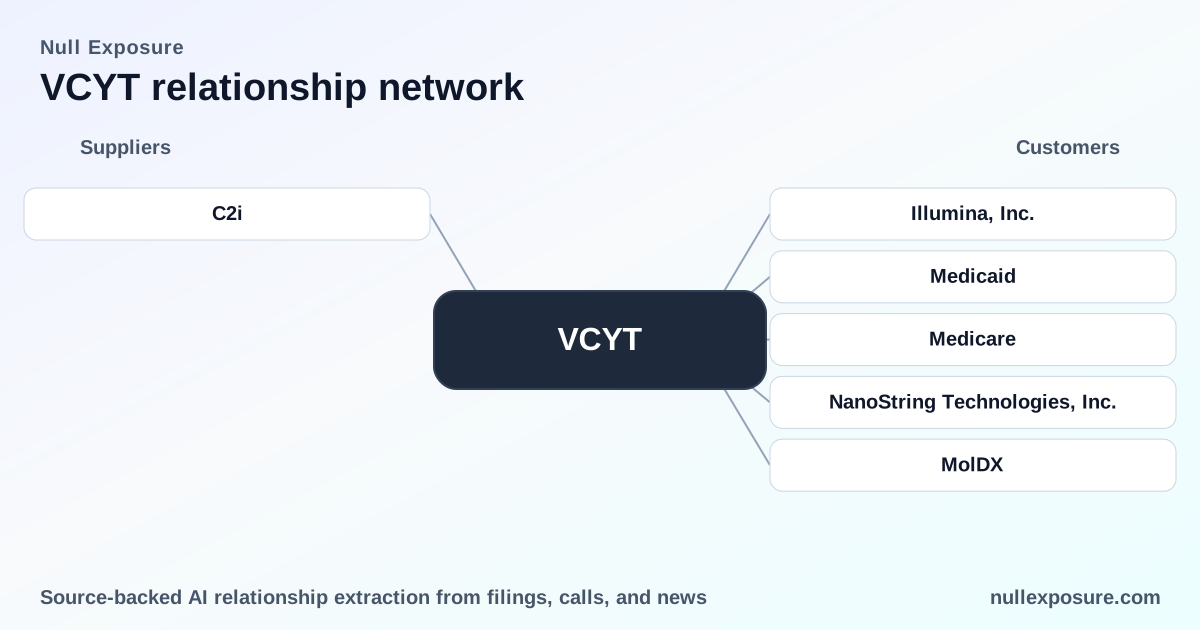
Veracyte (VCYT) — supplier posture, strategic moves, and what operators should watch
Veracyte is a clinical genomics company that sells diagnostic tests and related services to clinicians and health systems, monetizing through per-test revenues, recurring kit and reagent sales, and platform expansion into measurable residual disease (MRD) via targeted acquisitions. Revenue is driven by test volume, proprietary sample kits and reagents, and strategic tuck‑ins that broaden clinical addressable markets. For investors and operators evaluating supplier risk, the company combines high operational dependence on upstream suppliers with deliberate long‑dated purchase commitments intended to stabilize cost and availability. For a quick look at deeper supplier intelligence, visit https://nullexposure.com/.
How Veracyte’s supplier strategy underpins its business model
Veracyte operates a lab‑centric, throughput business where timely access to reagents, instruments, and reliable kit distribution is directly linked to revenue realization. The company sells diagnostic services that require collection kits and laboratory consumables, and it uses third‑party providers for logistics and claims transmission — functions that are operationally critical rather than peripheral. The firm’s approach is to lock in supply through longer purchase commitments and to absorb concentration risk in exchange for pricing and availability stability.
A company filing noted that non‑cancelable purchase commitments increased materially, signaling a deliberate move to secure supply and control input cost volatility: non‑cancelable commitments stood at approximately $43.2 million as of December 31, 2024. This commitment level places Veracyte squarely in a mid‑range spend class for supplier exposure and indicates meaningful ongoing cash obligations tied to suppliers.
A targeted acquisition to accelerate MRD: C2i
C2i — Veracyte’s most explicit supplier‑adjacent relationship in recent results — was acquired to accelerate the company’s MRD platform. According to Veracyte’s FY2026 earnings call transcript, management stated they acquired C2i “in order to drive our MRD platform.” This is a strategic, capability‑building acquisition intended to expand product breadth and capture higher‑value longitudinal testing revenue streams (InsiderMonkey, March 2026).
What the constraints reveal about operating posture and risk
The company‑level constraint signals from filings and disclosures present a coherent picture of how Veracyte sources and governs supply:
- Contracting posture — long‑term commitments. Management disclosed entering longer purchase commitments in the second half of 2024 to stabilize supply, manage inventory risk, and secure pricing, indicating a preference for supply security over nimble spot purchasing.
- Spend concentration — material but mid‑sized. Non‑cancelable purchase commitments of ~$43.2 million imply annual supplier spend in the $10m–$100m band, which is material to operations and creates leverage for suppliers while also exposing Veracyte to committed cash outflows.
- Criticality of suppliers. Filings emphasize reliance on sole suppliers for certain reagents and on third parties for claims transmission and kit assembly/distribution, signaling high operational criticality where supplier disruption would directly impact test delivery and cash collection.
- Relationship maturity and stage — active and operational. The narrative describes active procurement of reagents, instruments and components; these are ongoing, production‑level relationships rather than nascent pilots.
- Regulatory and substitution risk. Disclosures call out the possibility that reagents labeled RUO/IUO could be restricted by regulators, which would force difficult substitutions and potentially increase costs or pause testing.
Together, these constraints describe a company that has locked in supply through longer commitments to reduce price and availability volatility, while accepting concentration and regulatory substitution risk as tradeoffs for scale and product control.
Visit https://nullexposure.com/ for a supplier risk snapshot tied to these dynamics.
Why these supplier facts matter for investors and operators
- Revenue sensitivity to operational execution. Because claims transmission and kit distribution are handled by third parties, a disruption in those services would not only delay testing but also delay payer reimbursement and revenue recognition; filings explicitly link claims transmission delays to adverse revenue outcomes.
- Switching costs are real. The company’s own commentary highlights the risk and expense of changing suppliers if quality/specification issues arise or suppliers cease selling components; that increases the downside of supplier failure.
- Regulatory dependence raises tail risk. If regulators reinterpret RUO/IUO labeling rules or enforcement intensifies, some suppliers could withdraw components, creating immediate shortages and forcing costly replacements or slowdown.
- Strategic upside from acquisitions. The acquisition of C2i to accelerate an MRD platform is a positive strategic lever that brings in technology and potentially reduces dependence on external MRD suppliers going forward (InsiderMonkey, March 2026).
Actionable takeaways for investors and procurement leaders
- For portfolio managers: treat Veracyte as a supply‑sensitive growth name. Upside from MRD expansion is real, but operational outages could produce outsized earnings volatility relative to peers.
- For procurement and operations teams evaluating vendor relationships: prioritize dual‑sourcing for any single‑supplier reagent and negotiate contractual protections around supply continuity and price adjustments given existing long‑term commitments.
- For risk teams: monitor regulatory noise around RUO/IUO designations and counterparties that service claims transmission — both are direct levers on revenue timing.
Single‑line relationship summaries (complete list)
C2i — Veracyte acquired C2i to accelerate its MRD platform and integrate MRD capabilities into its testing roadmap; management announced this as a strategic step on the FY2026 earnings call (InsiderMonkey transcript, March 2026).
Closing perspective and next steps
Veracyte combines highly monetizable diagnostic services with concentrated supplier exposure. The company’s deliberate strategy of longer purchase commitments and targeted acquisitions like C2i reduces near‑term supply volatility and builds product capability, while leaving the business exposed to regulatory shifts and supplier concentration risk. Investors should weigh MRD expansion against supplier continuity risk; operators should prioritize redundancy in critical reagents and robust contracts with logistics and claims vendors.
For a concise supplier risk scorecard and ongoing monitoring, visit https://nullexposure.com/ — the supplier lens materially changes valuation and operational planning for clinical genomics companies like Veracyte.