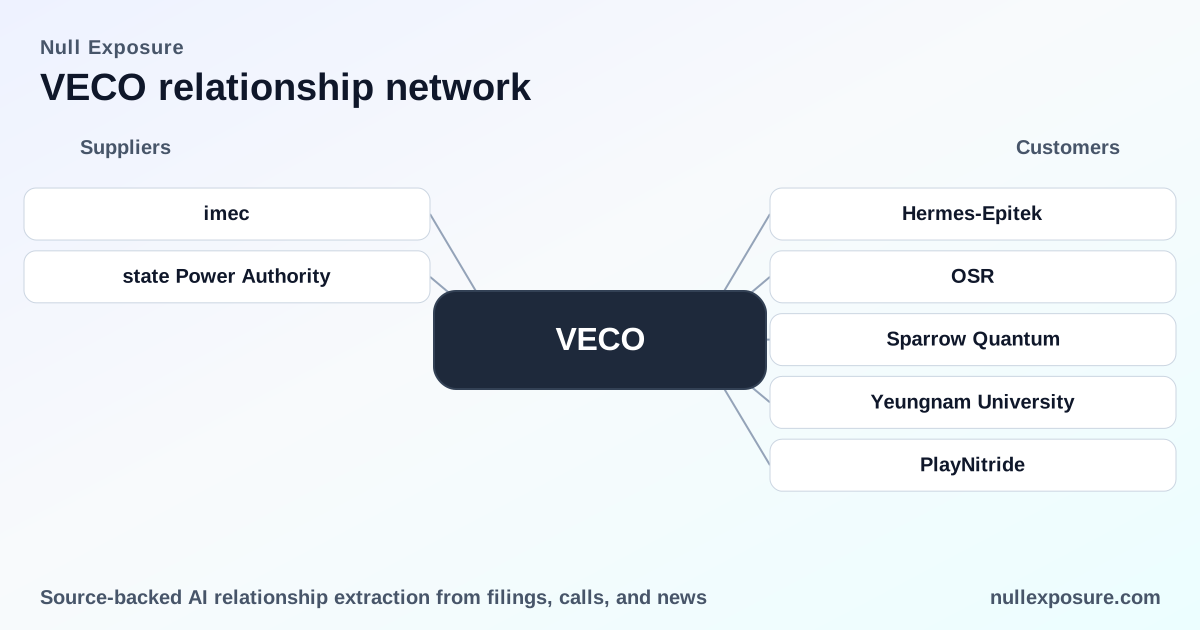
Veeco Instruments (VECO): Supplier relationships that shape the semiconductor equipment franchise
Veeco develops, manufactures and supports semiconductor and thin-film process equipment and monetizes primarily through system sales, aftermarket service and parts to chip and photonics manufacturers worldwide. Its business is capital‑goods driven: revenue converts when customers place equipment orders and when long tail service contracts and consumables recur; margin and valuation are sensitive to order cadence and the timing of supplier and power contracts that enable manufacturing. For investors, the critical lens is order flow, supplier commitments, and operational rigidity—not speculative product narratives.
Explore portfolio-grade supplier intelligence at https://nullexposure.com/ to see how these relationships affect operational risk and cash conversion.
Where the economics come from and why suppliers matter
Veeco’s reported revenue of about $664 million TTM and market capitalization near $1.9 billion position it as a mid‑cycle supplier to the semiconductor ecosystem rather than a pure-play OEM software vendor. The company’s margins are driven by equipment mix and aftermarket attachments: gross profit of $265 million TTM and an operating margin near 3.6% show tight operating leverage when sales soften. Supplier commitments and outsourced manufacturing directly affect delivery cadence and margin stability because a large portion of costs is contracted in advance and subject to near‑term cash outflow.
Veeco’s balance between internal assembly and third‑party manufacturing, combined with purchase commitments, amplifies supplier risk during demand troughs or when customers accelerate multi‑year replacement cycles.
What the public signals say about key relationships
Below I cover every supplier/partner mention surfaced in public reporting. Each relationship note is concise, investor‑focused, and sourced to the underlying press or reporting.
imec — delivery of MBE cluster system to enable silicon photonics work
Veeco delivered its first Molecular Beam Epitaxy (MBE) cluster system to imec as part of a collaboration to develop a 300mm‑compatible process for barium‑titanate silicon photonics, a move that strengthens Veeco’s position in advanced photonics tooling and validates equipment performance in a leading research environment. According to a The Quantum Insider report published January 28, 2026, this marks a milestone in the Veeco‑imec partnership and advances silicon photonics platform capabilities. (The Quantum Insider, Jan 2026)
state Power Authority — low‑cost electricity supply to headquarters operations
Local utility arrangements matter for cost control at Veeco’s manufacturing and HQ campus: Newsday reported in March 2026 that the state Power Authority supplies low‑cost electricity to Veeco’s Plainview headquarters, where about 170 employees work in an 80,000‑square‑foot facility. This is a micro but material operational input that supports facility economics and reduces variable cost pressure at the corporate site. (Newsday, Mar 2026)
What the constraint signals reveal about Veeco’s operating model
The filings and excerpts highlight three company‑level operating characteristics that investors should price into models:
- Short‑term contracting posture with concentrated near‑term cash commitments. Veeco reported $177.4 million of purchase commitments at December 31, 2024, the majority due within one year. This creates a compressed cash timing risk profile: revenue delays can quickly stress working capital if capex orders and supplier payables are out of sync.
- Outsourced manufacturing with in‑house assembly capability. Management outsources manufacture of several systems while maintaining some internal build capability, signaling a hybrid manufacturing model that balances flexibility and control. Outsourcing reduces fixed costs but elevates supplier dependency for quality and delivery.
- Material near‑term spend concentration. The magnitude of purchase commitments—placing the company in a >$100m spend band—means a small set of suppliers and service providers command large dollar exposure. That amplifies vendor concentration risk and gives suppliers pricing and scheduling leverage in a tight market.
These are company‑level signals; they are not assigned to a specific supplier unless the filing does so explicitly. For portfolio construction, treat Veeco as equipment OEM with high short‑cycle supplier exposure and moderate operational leverage.
Risk and opportunity through the supplier lens
- Risk: The sizable short‑term purchase commitments create a timing vulnerability where an order slowdown can leave Veeco carrying committed spend without offsetting receivables; outsourced manufacture magnifies operational dependence on third parties. The stock trades at a high trailing P/E (~52x) relative to current EBITDA, pricing in recovery; supplier‑driven execution failures would compress margins and extend the recovery timeline.
- Opportunity: Successful deployment of advanced tools (e.g., the MBE cluster for imec) validates technology and opens aftermarket and repeat orders for photonics and specialty thin films—areas with attractive ASPs and aftermarket service potential. Utility cost advantages at facilities provide a modest but persistent operating tailwind.
If you want a consolidated supplier risk dashboard and relationship timelines for VECO, see how we visualize these dynamics at https://nullexposure.com/.
How investors should act on this supplier intelligence
Position sizing should reflect the binary nature of capital‑equipment order cycles and concentrated supplier spend: if you prefer lower volatility, underweight until order backlog and cash conversion show multi‑quarter stabilization; growth investors can overweight only after clear evidence of recurring system orders and supplier contract renegotiations that extend payment terms.
For researchers and operators evaluating supplier counterparty risk, use the following checklist:
- Confirm order backlog dates vs. supplier payment schedules.
- Verify outsourcing partners’ delivery records and single‑source exposures.
- Quantify the impact of facility utility arrangements on unit costs.
For more tactical supplier analysis and model inputs, visit https://nullexposure.com/ to review platform tools and supplier timelines.
Bottom line: supplier dynamics drive the next leg of valuation
Veeco’s revenue engine is equipment sales and aftermarket support, but supplier contracts and short‑term purchase commitments are the operational levers that will govern near‑term margin and cash outcomes. The imec collaboration is a product‑validation positive that can unlock high‑margin photonics opportunities, while the state Power Authority relationship is a modest operational benefit. Investors should weigh the upside of validated advanced tooling against the downside of concentrated near‑term spend and outsourced manufacturing reliance.