Veea Inc. (VEEA): supplier relationships, operational constraints, and investor takeaways
Veea sells edge networking hardware and connected software services and monetizes primarily through device sales and associated edge services, augmented by third‑party intellectual property licensing. The company builds VeeaHub devices through contract manufacturers, licenses IP that underpins product functionality, and uses external professional services (legal, PR) to execute corporate transactions and market positioning. Investors should evaluate supplier concentration, IP licensing economics, and manufacturing continuity as primary drivers of near‑term operational risk.
For a broader supplier-risk view and benchmarking, visit https://nullexposure.com/.
A compact financial and ownership snapshot investors need first
Veea is a micro‑cap technology issuer with constrained top‑line scale and stretched operating metrics. Key signals:
- Market capitalization: $35.1M; Revenue (TTM): $265,590; EBITDA: -$27.78M — the business is pre‑scale on revenue and loss‑making on operations.
- Price-to-Sales (TTM): 132.15 and EV/Revenue: 193.31 — valuation multiples reflect extremely low revenue relative to enterprise value.
- Insider ownership: 60.46%, institutions hold ~2.98% — control is concentrated inside management/founders.
- Contract manufacturing footprint: reliance on two contract manufacturers in Taiwan and China (company disclosure).
These numbers frame supplier risk as materially consequential to operating flexibility and investor returns.
What the supplier footprints and constraints reveal about the operating model
Veea’s disclosed supplier profile creates a clear set of operational characteristics investors should treat as structural.
- Contracting posture: The company relies on a mix of licensing agreements (third‑party IP) and contract manufacturing. Qualcomm is explicitly disclosed as a licensor of IP to Veea under non‑exclusive agreements, which means product capability is intertwined with third‑party IP permissions and likely commercial terms such as royalties or usage restrictions. The company also discloses purchase commitments with contract manufacturers and suppliers, indicating multi‑year procurement commitments rather than purely spot buys.
- Concentration and criticality: Supplier concentration is high — two vendors together represented 37% and 36% of vendor purchases in 2024, and one supplier accounted for 39% of supplier purchases in 2023 — so a handful of counterparties control a large share of procurement. Combined with outsourced manufacturing in Taiwan and China, a single disruption will materially affect production and revenue delivery.
- Operational maturity: Presence of formal purchase commitments and contract manufacturing relationships signals that product production is established at scale levels meaningful to the business, but the company’s low revenue base means these commitments create leverage and cashflow pressure if demand does not scale.
- Service dependency: Veea depends on third‑party telecommunications and internet service providers to deliver its cloud and connectivity services, creating an operational dependency beyond physical manufacturing.
Together these constraints imply high counterparty risk, concentration risk, and IP dependency — all of which are direct inputs to supplier underwriting and insurance of tech hardware businesses.
The relationships you'll find in the public record
Below are the supplier/partner relationships surfaced in the source results, each summarized in plain English with citation.
-
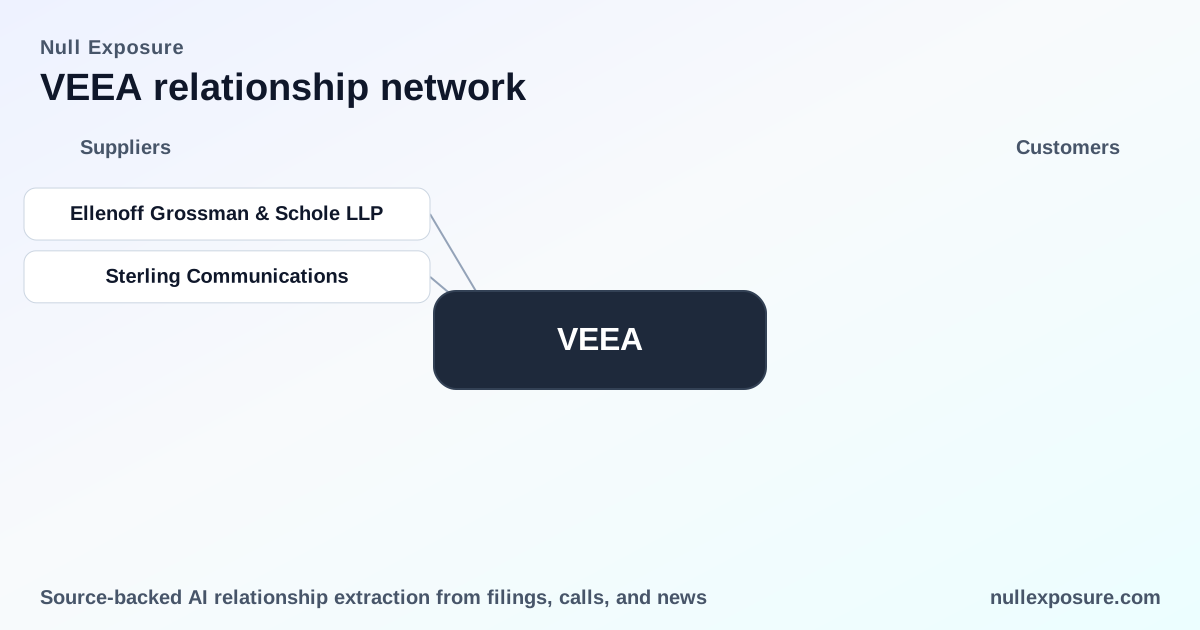
Ellenoff Grossman & Schole LLP — The firm served as legal advisor to Veea during the closing of the business combination; this relationship supports corporate transactions and regulatory work. According to the GlobeNewswire press release announcing the business combination closing (September 16, 2024): https://www.globenewswire.com/news-release/2024/09/16/2946641/0/en/Veea-Inc-and-Plum-Acquisition-Corp-I-Announce-Closing-of-Business-Combination.html.
-
Sterling Communications — External PR/media advisor for Veea, with James Christopherson listed as the media contact for the company in the same business‑combination announcement; this relationship governs corporate communications and investor messaging. See the GlobeNewswire press release (September 16, 2024): https://www.globenewswire.com/news-release/2024/09/16/2946641/0/en/Veea-Inc-and-Plum-Acquisition-Corp-I-Announce-Closing-of-Business-Combination.html.
These public disclosures confirm the company engages external professional services for transactional, compliance, and communications functions. For deeper supplier mapping and third‑party risk scoring, visit https://nullexposure.com/.
Risk implications for investors and operators — practical lens
Translate the constraints into decision‑grade items:
- Supply concentration is a top operational risk. When two vendors represent nearly three‑quarters of purchases, procurement negotiating leverage is reduced and business continuity planning becomes paramount.
- IP licensing is a structural cost and gating item. Qualcomm’s non‑exclusive licensing to Veea under multiple agreements means product design and go‑to‑market are tied to external IP economics; investors must examine whether royalties or licensing terms scale with unit volumes.
- Manufacturing location and single‑source exposure create geopolitical and logistical tail risk. Outsourced hubs in Taiwan and China accelerate vulnerability to shipping, tariff, and regional disruption.
- Capital structure and operating scale increase supplier negotiation risk. With extremely low revenue and negative EBITDA, Veea has limited bargaining currency beyond future orders and equity — suppliers and licensors can demand protective commercial terms or prepayments.
- Control concentration increases strategic opacity. High insider ownership reduces pressure for broad vendor disclosure; institutional investor participation is limited.
What to monitor next and recommended investor actions
For investors and operating managers, the following actions convert disclosure into oversight:
- Request or demand clearer disclosure of the names and contractual terms of the top vendors and contract manufacturers, including lead times, minimums, and termination provisions.
- Obtain the Qualcomm licensing schedules or a summary of royalty, term, and territory constraints that affect gross margins and product roadmaps.
- Stress‑test the manufacturing model for a single‑vendor outage, including alternate sourcing timelines and incremental cost to insulate supply.
- Monitor cash flows against purchase commitments; if revenue growth lags, supplier commitments will consume working capital and increase liquidity risk.
- For operators, prioritize supplier diversification and contingency logistics plans; for investors, insist on supplier KPI reporting as part of board oversight.
Bottom line: concentration and IP dependency are the defining supplier risks
Veea is a technology hardware company with significant supplier concentration, explicit third‑party IP licensing, and outsourced manufacturing, all layered on a very small revenue base and concentrated ownership. These structural facts define the company’s material operational risks and should frame both valuation and covenanting decisions for investors and counterparties.
If you want a concise supplier‑risk dossier or benchmarking against peers, start here: https://nullexposure.com/. For tailored supplier due diligence and scorecards, explore detailed supplier analytics at https://nullexposure.com/ — use that to convert disclosure into investment decisions.