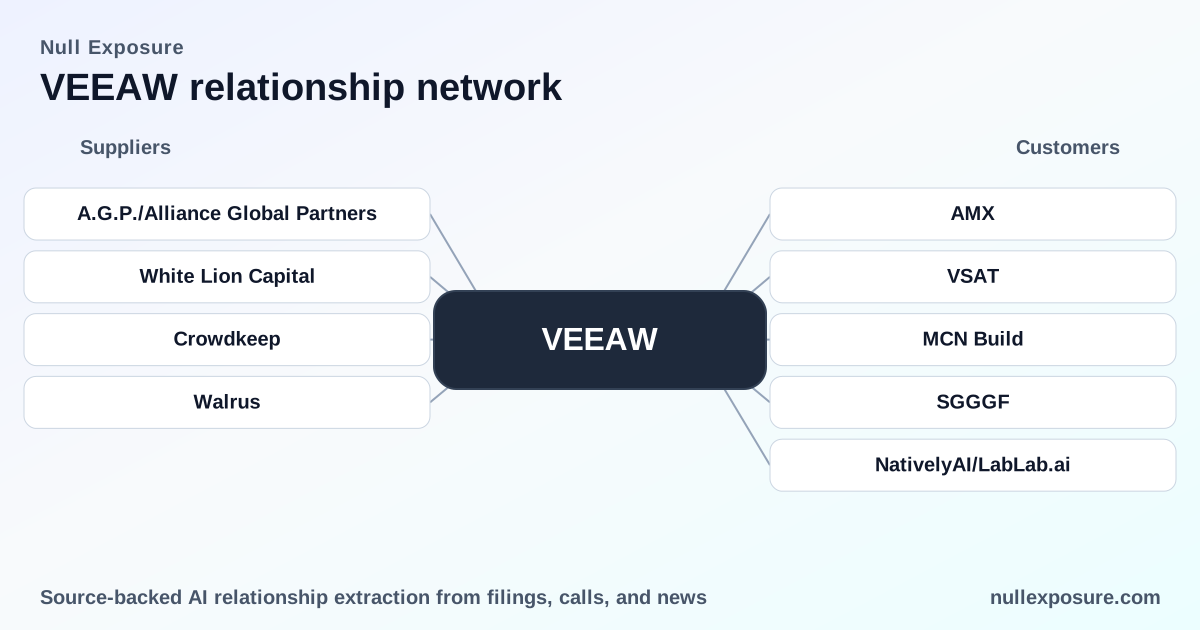
Veea Inc (VEEAW) — supplier relationships, financing partners and operational constraints
Veea Inc operates as an edge-computing and IoT connectivity provider that monetizes through a mix of hardware sales (VeeaHub devices and integrated solutions), recurring services on the VeeaONE platform, and capital markets activity to fund growth. Revenue today is small and product-led; financing events and strategic integrations are the company’s primary levers to sustain R&D and go-to-market expansion. For a quick platform-level snapshot and supplier-risk monitoring, visit https://nullexposure.com/.
How Veea makes money and why supplier relationships matter
Veea sells physical edge devices and software-enabled services that sit between enterprise customers and cloud infrastructure. The business model requires manufacturing scale for hardware, telco partners for connectivity, and third-party integrations to broaden solution applicability (construction tracking, decentralized storage, etc.). Given limited reported revenue and negative operating margins, capital markets relationships that provide financing or placement services are central to near-term liquidity.
Who Veea is working with (short, source-backed summaries)
A.G.P./Alliance Global Partners
Veea engaged A.G.P./Alliance Global Partners as the sole placement agent for its public offering that raised roughly $9.2 million, an explicit capital raise to shore up working capital and support operations. Source: GlobeNewswire press release (Aug 13, 2025) and related coverage including Yahoo Finance reporting the offering closing in early 2026 (https://www.globenewswire.com/news-release/2025/08/13/3132609/0/en/Veea-Inc-Announces-Pricing-of-Approximately-9-2-Million-Public-Offering.html; https://finance.yahoo.com/news/veea-inc-announces-closing-9-210000390.html).
White Lion Capital
Veea signed multiple financing agreements with White Lion Capital that include a Note Purchase Agreement for up to $2.5 million in unsecured convertible notes with warrants, plus registration rights and an equity-line amendment—transactions that increase near-term liquidity but introduce conversion and dilution risk for equity holders. Source: TradingView coverage summarizing the March 2026 financing package (https://www.tradingview.com/news/tradingview:927ec8b86a45d:0-veea-signs-multiple-financing-agreements/).
Crowdkeep
Veea integrated Crowdkeep’s tracking technology into its MetaLynx smart construction solution on the VeeaONE platform, demonstrating continued efforts to expand vertical solution capability for construction and asset-tracking customers. Source: StockTitan summary of the integration announcement (FY2026) (https://www.stocktitan.net/news/VEEA/).
Walrus (Mysten Labs)
Veea partnered with Walrus, a decentralized data storage protocol by Mysten Labs, to embed Walrus into the VeeaHub STAX™ edge solution, signaling a push toward distributed storage and on-device data resilience. Source: StockTitan item on the Walrus integration (FY2026) (https://www.stocktitan.net/news/VEEA/).
What these relationships tell investors about operating posture and risk
Across these interactions, two consistent themes emerge: financing dependence and solution diversification through partnerships. The capital raises and note financings show Veea is actively monetizing equity and debt-linked instruments to fund operations. The product integrations with Crowdkeep and Walrus highlight an effort to increase product-stickiness by embedding third-party technologies.
- Contracting posture: Veea relies on third-party placement agents and private capital providers to secure funding; those counterparties control access to capital markets and resale mechanics through registration rights and placement agreements.
- Concentration: Company-level disclosures show two vendors accounted for 37% and 36% of purchases in 2024, which is a high supplier concentration and elevates single- or dual-vendor supply risk.
- Criticality: Manufacturing partners in Taiwan and China are critical to device supply; telecommunication and cloud-related service providers are required to deliver recurring platform services, exposing Veea to external service disruptions and cybersecurity risks.
- Maturity and scale: Veea’s revenue base is small (reported roughly $265k trailing twelve months) with negative operating margins, implying an early-stage commercial profile reliant on financing and partnerships to scale.
For an ongoing supplier-risk scorecard and to track counterparties like manufacturers and placement agents, see https://nullexposure.com/.
Practical implications for investors and operators
- Dilution and financing cadence: The public offering placed through A.G.P. and the convertible note facility with White Lion increase liquidity but also increase equity dilution risk if conversions occur or if follow-on financings are required. Monitor registration rights and warrant strike mechanics for potential share issuance triggers.
- Operational continuity risk: High supplier concentration and reliance on two APAC contract manufacturers make hardware delivery and gross margin stability sensitive to supplier disruptions and geopolitical/chain shocks. Operators should prioritize multi-sourcing and inventory buffers.
- Product strategy validation: Integrations with Crowdkeep and Walrus are commercially sensible moves to broaden addressable markets in construction and decentralized storage, and they improve product differentiation—important for long-term adoption but not a substitute for scale economics.
- Security and service dependencies: Use of third-party telco and cloud services introduces cybersecurity and SLA risk; management has stated processes to assess third-party cybersecurity but investors should request evidence of contractual SLAs and incident-history transparency.
Actionable next steps for diligence
- Review the A.G.P. offering prospectus and note purchase agreement terms for covenants, conversion triggers, and warrant coverage (GlobeNewswire and Yahoo Finance releases provide starting links).
- Obtain manufacturing contracts or supplier risk disclosures to confirm lead times, pricing escalators, and termination rights given the 73% vendor concentration cited for 2024.
- Validate commercial traction for integrations (Crowdkeep and Walrus) by asking for pilot metrics, ARR contribution expectations, and go-to-market plans.
If you need a consolidated counterparty map or an alert set for future financing and supplier notices, start here: https://nullexposure.com/.
Final assessment
Veea is a product-led edge computing company operating with constrained revenue and a heavy reliance on external capital and a narrow set of suppliers. The recent financing activity with White Lion and the public offering placed by A.G.P. provide immediate runway but raise dilution and governance considerations. Strategic integrations with Crowdkeep and Walrus improve product breadth but do not materially reduce concentration or financing risk in the near term. For investors and operators, the priority is to validate supplier contracts, financing terms, and commercialization metrics to assess whether these relationships are stabilizing the business or simply funding the next development phase.
For deeper supplier intelligence and real-time tracking of these counterparties, visit https://nullexposure.com/.