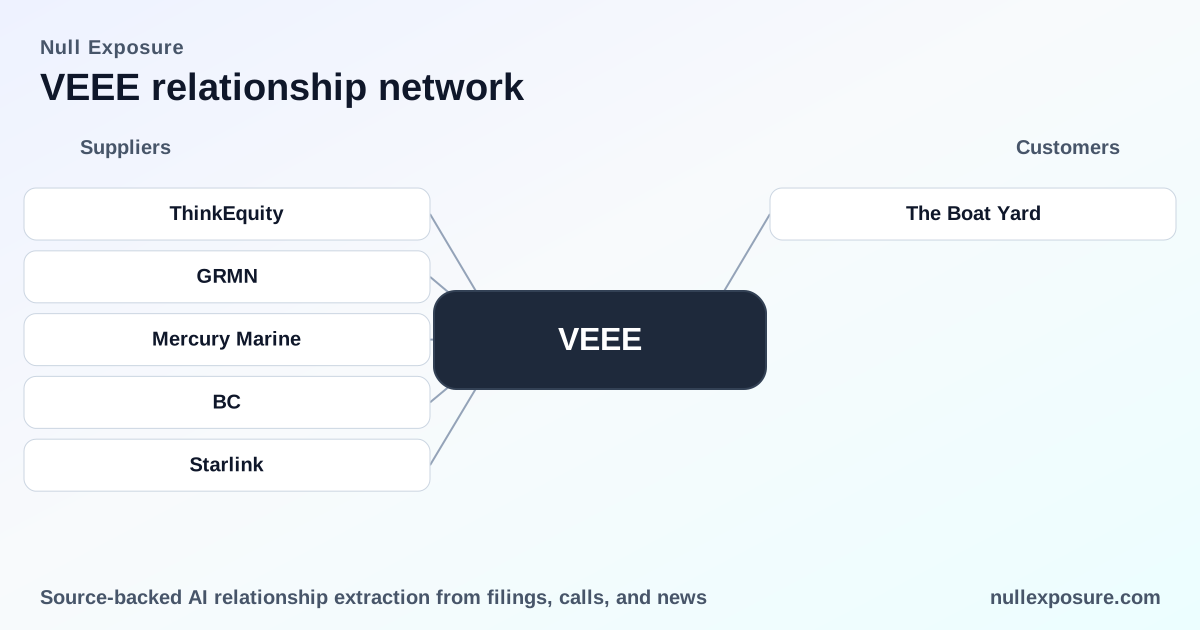
Twin Vee Powercats (VEEE): supplier landscape and strategic partner briefing
Twin Vee Powercats Co designs and manufactures high-performance power catamarans and monetizes through direct boat sales, branded monohull extensions, and capital markets activity—most recently a public offering where ThinkEquity served as the placement agent. Revenue derives from unit sales to retail and commercial buyers, while supplier relationships (engines, composites, electronics, and connectivity) determine gross margin, product feature sets and go-to-market speed. For investors and operators evaluating supplier risk and opportunity, the company’s recent partner announcements reveal a hybrid procurement posture: a long-term facility lease and concentrated engine sourcing combined with largely spot vendor relationships for many inputs. Learn more about how we track these relationships at https://nullexposure.com/.
Quick operational thesis: product-led, supplier-dependent, capital-enabled
Twin Vee’s product strategy layers premium hardware (hulls, composites) with branded components—engines, navigation, and connectivity—that function as both margin drivers and customer value propositions. The company funds growth via capital raises; ThinkEquity’s role in the FY2026 public offering is a clear example of capital markets monetization linked to product expansion. Operationally, Twin Vee is dependent on third-party manufacturers and suppliers for critical subsystems, which makes supplier selection a key determinant of competitive positioning and execution risk.
How contracting posture and spend profile shape risk
Company disclosures show a mixed contracting stance. Twin Vee operates under a 5‑year lease for its facility (renewed) with Visconti Holdings—a related‑party lessor—indicating a degree of long-term fixed cost commitment and potential insider concentration (company filings, FY2021–FY2025). Conversely, the firm states it does not maintain long-term contracts with preferred suppliers for many components and relies on off-the-shelf purchases (company filings, FY2023). Procurement reality: engine and composite purchases are material—$5.32M in 2024 and $9.25M in 2023 across primary engine suppliers—placing those vendors squarely in the company’s medium spend band ($1M–$10M annually). These signals imply operational leverage to supplier pricing and supply-chain availability, while the lease reduces location risk but increases related-party concentration.
Relationship roll call — what every named partner brings
Below I cover each relationship mentioned in the public reporting and news corpus, with concise plain-English takeaways and source references.
-
ThinkEquity
ThinkEquity acted as the sole placement agent for Twin Vee’s FY2026 public offering, underwriting the company’s capital raise and facilitating access to public investors. According to a Newswire release in March 2026, ThinkEquity served as sole placement agent for both the pricing and closing phases of the offering (Newswire, March 2026: https://www.newswire.com/news/twin-vee-powercats-announces-proposed-public-offering-of-common-4706925 and https://www.newswire.com/news/twin-vee-powercats-announces-closing-of-public-offering). -
Garmin (GRMN)
Garmin multifunction displays are specified as integrated entertainment and navigation screens within Twin Vee’s new Adventure Series, embedding a known electronics brand into the product feature set and consumer value proposition. The product announcement referenced Garmin displays and other onboard electronics in Newswire’s Adventure Series release (Newswire, March 2026: https://www.newswire.com/news/twin-vee-powercats-announces-new-adventure-series-model-line-entering-the). -
Mercury Marine
Mercury Marine is the chosen propulsion partner for Twin Vee’s newly acquired monohull brand, Bahama Boat Works, positioning Twin Vee to sell a complete, premium power-and-hull package to performance-focused buyers. BoatingIndustry and additional press coverage in January 2026 detailed the partnership and its channel and brand benefits (Boating Industry, Jan 2026: https://boatingindustry.com/news/2026/01/23/twin-vee-partners-with-mercury-marine/). -
Brunswick Corporation (parent of Mercury) (BC)
Brunswick’s broader dealer infrastructure and brand halo are cited as strategic advantages flowing through the Mercury relationship, enabling Bahama Boat Works to leverage established distribution and consumer trust. Industry coverage linked the Mercury partnership to Brunswick’s network and was noted in MarineIndustryNews and BoatingIndustry reporting (Marine Industry News, Jan 2026: https://marineindustrynews.co.uk/twin-vee-powercats-partnership-with-mercury-marine-a-strategic-growth-catalyst/). -
Starlink
Twin Vee plans to offer integrated Starlink connectivity as part of the Adventure Series’ feature set, which upgrades onboard communications and entertainment capabilities and addresses a premium buyer segment that values persistent broadband at sea. This feature was listed among other planned amenities in the Newswire product announcement (Newswire, March 2026: https://www.newswire.com/news/twin-vee-powercats-announces-new-adventure-series-model-line-entering-the).
What these partnerships mean for investors and operators
- Concentration on engine suppliers is a double-edged sword. Twin Vee’s repeated purchases from Mercury, Suzuki and Yamaha constituted multi‑million dollar flows (company filings for FY2023–FY2024), which secures quality powerplants but concentrates supply risk and bargaining power with a small set of vendors.
- Branded electronics and connectivity are margin and feature levers. Garmin and Starlink integrations raise perceived product value and support higher ASPs, but they also create dependencies on third‑party roadmaps and component lead times. The Garmin and Starlink references in the Adventure Series release signal deliberate product differentiation (Newswire, March 2026).
- Capital markets activity underpins growth but dilutes execution risk. The ThinkEquity-led offering funds inventory, development and distribution expansion, yet success ultimately hinges on supplier reliability and dealer execution.
If you want a consolidated supplier-risk score or a vendor-concentration heat map for VEEE, start here: https://nullexposure.com/.
Practical implications for supplier negotiations and diligence
- Negotiate contingency clauses for deadlines and parts backlog on engine and electronics supply given the company’s spot elements in procurement and the materiality of engine spend (company filings FY2023–FY2024).
- Prioritize warranty and service agreements with propulsion and electronics partners to protect resale value and reduce after-sale service costs, especially as Twin Vee pushes connectivity and multimedia features that increase post-sale support demands.
- Monitor related-party lease terms with Visconti Holdings to understand fixed-cost commitments and potential governance risk; the lease’s renewal history reflects a longer-term facility commitment that affects cash flow sensitivity.
Explore tailored supplier-insight products and ongoing monitoring at https://nullexposure.com/ to turn this briefing into actionable procurement strategy.
Bottom line
Twin Vee is executing a product‑led premium move that combines traditional marine supply chains (engines, composites) with consumer-facing electronics and connectivity to justify higher price points. The company’s supplier profile blends concentrated, material engine purchases with largely spot purchases for other inputs, creating a dependency profile that increases execution risk even as branded integrations enhance product appeal. Investors should weigh capital‑market momentum—evidenced by ThinkEquity’s placement role—against the operational reality of supplier concentration, related-party facility commitments, and the need for tight aftermarket and warranty controls. For ongoing monitoring and deeper vendor-level analysis, visit https://nullexposure.com/.