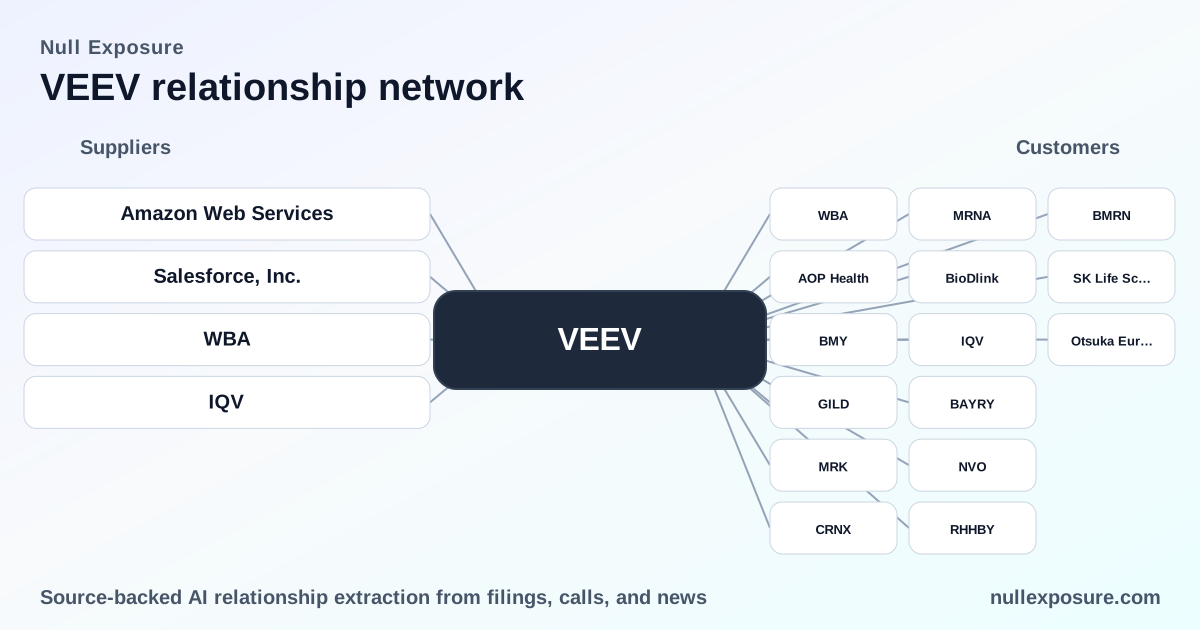
Veeva Systems (VEEV) — the supplier map investors need to underwrite recurring software economics
Veeva sells cloud software, data and related services to the life sciences industry and monetizes primarily through subscription and data revenues augmented by professional services. The business captures high-margin recurring cash flow from long-term customer relationships while outsourcing a portion of infrastructure and data acquisition to third parties; that combination creates scalable revenue with supplier-driven operational risk. For investors evaluating VEEV as a supplier to life sciences firms or as a counterparty, the critical questions are concentrated around hosting dependencies, data partnerships, and the commercial value the company extracts from aggregated healthcare data. Learn more at https://nullexposure.com/.
How Veeva makes money — an investor’s quick read
Veeva’s revenue mix centers on subscription software (Veeva CRM, Vault, Network) and data/analytics products (Veeva Data Cloud, Nitro). The company’s trailing revenue is $3.195 billion with operating margin near 29% and profit margin about 28%, indicating a high-margin SaaS profile supported by data products. Analysts project upside to the share price (consensus target ~$270.93) and the stock trades at a premium multiple consistent with durable subscription economics (forward P/E ~20.2). The economics are attractive for partners: Veeva drives recurring revenue while outsourcing capital-intensive elements of delivery.
What the corporate filings say about how Veeva operates
Company filings (FY2025 Form 10‑K) make Veeva’s operating posture explicit: it uses third parties for computing infrastructure and pays third-party fees that are recorded in cost of subscription services. The filing highlights personnel and data acquisition costs for hosting and running data solutions, signaling an operations model where core productization is internal but infrastructure and some data inputs are outsourced. This is a company-level signal about contracting posture and operational maturity — Veeva is vertically focused on product and data stewardship while leveraging external scale for infrastructure.
Supplier relationships that shape risk and value
Below are every supplier relationship surfaced in the review, with a concise, investor-focused summary and the source reference.
Amazon Web Services (AWS)
Veeva pays third-party providers for computing infrastructure and lists Amazon Web Services in its FY2025 10‑K as one of the infrastructure providers underlying subscription services costs. According to the FY2025 10‑K, these expenses are recorded in cost of subscription services and contribute to the variable cost base of delivering Veeva’s cloud products.
Salesforce, Inc.
Veeva discloses that fees paid to Salesforce for the Salesforce platform and associated hosting infrastructure are included in the cost of subscription services for Veeva CRM and multichannel CRM applications, per the FY2025 10‑K. This means parts of Veeva’s CRM stack run on and pay for Salesforce-hosted infrastructure and platform services.
Walgreens (WBA)
Veeva announced a strategic partnership with Walgreens to expand the breadth of data in Veeva Data Cloud, enabling life sciences clients to access richer retail pharmacy data to understand market trends and patient outcomes; the partnership was described in a Veeva press release covering FY2024 initiatives. The agreement strengthens Veeva’s data coverage in the U.S. pharmacy channel and underpins commercial analytics offerings.
IQVIA (IQV)
Veeva and IQVIA established master data and third‑party access agreements that allow each company’s data to be used in the other’s software instances, including use of IQVIA data in Veeva Network, Nitro analytics, and Veeva AI, according to a MedTechIntelligence report on the FY2025 collaboration. This is a reciprocal commercial-data arrangement that increases the utility of both firms’ products for life sciences customers.
What those relationships imply for contracting, concentration and criticality
These relationships collectively reveal a clear operating design:
- Contracting posture: Veeva outsources infrastructure and some data sourcing while retaining product ownership and data stewardship. That posture reduces capital intensity but increases dependency on third-party SLAs and pricing.
- Concentration risks: The FY2025 filing explicitly names major cloud/platform providers; reliance on a small set of infrastructure suppliers introduces concentration exposure in the cost of service layer that can compress margins if pricing power shifts.
- Criticality: Data partners like Walgreens and IQVIA are mission-critical to Veeva’s data products; those partnerships directly influence product differentiation and customer retention.
- Maturity and predictability: The company’s high margins and recurring revenues point to a mature SaaS model, yet the need for external infrastructure and purchased data inputs makes cost-of-revenue more variable than a pure-owned hosting approach.
Key investor takeaways and operational implications
- Upside engine: Veeva’s combination of high-margin subscriptions and proprietary-enriched data products supports durable cash flow and pricing power with life sciences customers. Institutional ownership is high (~88%), signaling broad investor confidence.
- Supplier-driven margin risk: Because Veeva records third-party hosting and data costs in cost of subscription services, margin pressure can occur through higher hosting fees or changes to data licensing economics.
- Strategic moat from data partnerships: Contracts with pharmacy chains and data aggregators increase the stickiness and value of Veeva’s Data Cloud, which underwrites cross-sell and pricing expansion. These are competitive advantages rather than purely operational costs.
- Monitoring priorities for investors and operators: track hosting cost trends, contract renewal cadence and termination provisions with major cloud/platform providers, and the expansion or exclusivity terms of data partnerships with firms like Walgreens and IQVIA.
For further supplier risk mapping and contract intelligence, see the platform at https://nullexposure.com/.
Due diligence checklist for investors and operators
- Confirm the contractual terms and renewal timelines for key infrastructure providers and whether expenses are fixed or variable.
- Validate data licensing scopes and exclusivity with partners such as Walgreens and IQVIA — the value of Veeva Data Cloud depends on breadth and timeliness of sources.
- Review service-level commitments and operational runbooks for customer-impacting events (outages, data breaches), noting that outsourced infrastructure shifts some operational risk to suppliers.
- Monitor operating leverage metrics (gross margin on subscription services) quarterly to detect supplier-driven cost pressure.
Final recommendation — where to focus next
Veeva’s model combines scalable subscription economics with third-party infrastructure and strategic data partnerships to deliver differentiated life sciences software. Investors should value the recurring revenue stream but actively underwrite supplier concentration and data-partnership health as leading indicators of margin durability and product differentiation. Operators negotiating with Veeva should prioritize clarity on data use, SLAs, and portability.
Assess Veeva’s supplier posture as part of broader counterparty diligence — and if you need structured sourcing intelligence or contractual insight, begin here: https://nullexposure.com/.