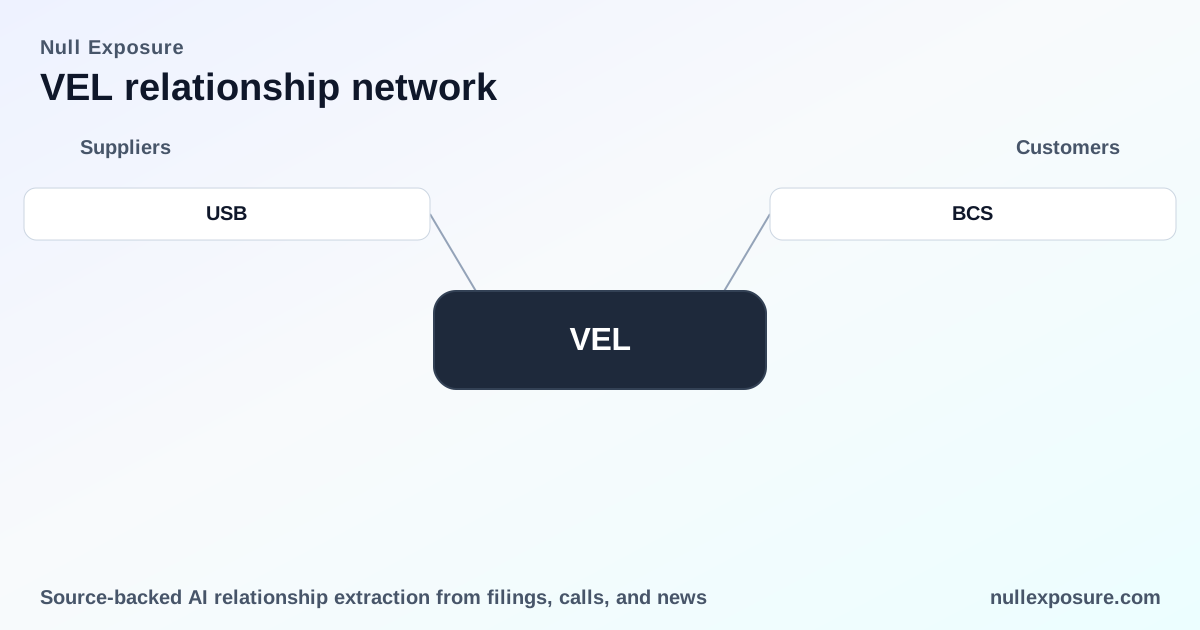
Velocity Financial (VEL) — Supplier relationships and operating model brief
Velocity Financial monetizes by originating and financing residential mortgage loans and capturing the spread between funding costs and loan yields, supplemented by fees tied to loan origination and servicing activities. The company funds loans using a mix of short-term warehouse facilities and longer-term syndicated debt, then either holds the loans or executes secondary market strategies to realize returns; this capital-intermediation model makes its counterparty and funding relationships central to credit and operational risk. For more structured supplier and counterparty intelligence on Velocity and peers, visit https://nullexposure.com/.
What the business actually does and why counterparties matter
Velocity is a focused mortgage finance platform headquartered in Westlake Village, California. The core operating dynamic is simple and capital-intensive: source loans through brokers, fund them with secured facilities, and monetize through net interest margin and ancillary fees. The company reported funding 4,328 loans sourced from 1,415 different mortgage brokers for the year ended December 31, 2024, demonstrating a broad origination footprint that relies on external funding lines to convert pipelines into cash loans.
Because the business is essentially a levered funding and distribution engine, relationships with banks and large financial institutions are not optional — they are mission-critical. The composition and tenor of those funding relationships directly determine underwriting capacity, balance-sheet leverage, and timing risk for securitizations or sales. If you are evaluating VEL as an investor or prospective partner, focus on counterparty strength, facility maturities, and available capacity more than origination volume alone. For a deeper look at supplier exposures and partner commitments, see https://nullexposure.com/.
Counterparty map: the relationship the data surfaced
The supplier-scope scan returned one explicit counterparty mention: U.S. Bank Trust Company. Below is the plain-English takeaway and the source.
U.S. Bank Trust Company — indenture/custodial role reported
Velocity signed an indenture with U.S. Bank Trust Company, positioning U.S. Bank in a trustee or administrative role for a financing or securitization arrangement reported in early March 2026. TradingView covered the announcement on March 10, 2026, noting U.S. Bank Trust as the relevant counterparty in the press summary. (TradingView, March 10, 2026: https://www.tradingview.com/news/tradingview:e926809567e9f:0-velocity-financial-signs-indenture-with-u-s-bank-trust-company/)
What the constraints disclosure reveals about contracting posture and maturity
Company-level disclosures supply several concrete, material signals about how Velocity structures its funding and supplier relationships:
- Mixed-tenor funding posture. Velocity combines long-term syndicated corporate debt with short-term warehouse facilities. The company entered a five-year $215 million syndicated term loan on March 15, 2022 that carries a fixed interest rate and matures March 15, 2027, while its warehouse facilities generally mature within one to three years. These disclosures indicate a deliberate mix of durable term financing to back permanent capital needs and short-tenor secured lines for loan turn — a common model in mortgage finance (company filings, 2022–2024).
- Substantive facility scale. As of December 31, 2024, Velocity reported $350.0 million borrowed under warehouse and repurchase facilities with $435.0 million of available capacity, signaling that funding relationships are large enough to drive current origination throughput and that the firm relies materially on external liquidity (company filings, FY2024).
- Counterparty profile leans institutional. Disclosures describe derivative counterparties and likely funding counterparties as “major institutions,” which is consistent with the U.S. Bank Trust relationship and with the banking counterparties typically required to support securitizations and trustee roles (company filing language).
- Active origination and supplier breadth. Funding 4,328 loans through over 1,400 brokers in 2024 reflects an active, distributed production model; however, capital providers remain concentrated relative to the broker base, implying single-institution events (repayment/credit shifts) can materially affect operations (company filings, FY2024).
These constraints combine into an operating model characterized by dependency on a small number of large financial counterparties for funding and administrative services, a deliberate split between short-term warehouse liquidity and longer-term debt to stabilize capital costs, and maturity concentrations that create a predictable refinancing calendar (notably the 2027 term-loan maturity).
What investors and supplier managers should watch next
The relationships and constraints above produce a focused set of monitoring priorities:
- Track the refinancing runway into 2026–2027: the March 15, 2027 term loan maturity is a discrete liquidity event that will determine longer-term leverage posture and interest expense profile. If facilities are extended or replaced by longer-term capital, credit risk falls; if not, refinancing risk rises.
- Monitor warehouse utilization and available capacity quarterly; movement in the $435 million of available capacity figure will directly influence origination throughput.
- Confirm the operational scope and indemnities U.S. Bank Trust holds in the indenture to understand administrative and legal counterparty risk in securitizations. The trustee role can bring operational continuity but also concentration risk when one institution handles multiple structural functions.
- Evaluate derivatives and hedging counterparties: the company’s designation of these as “major institutions” suggests exposure to counterparty credit events and collateral posting under stressed rates.
For investor-ready supplier intelligence and ongoing monitoring feeds, visit https://nullexposure.com/ to see how structured counterparty coverage fits into a broader risk view.
Bottom line: concentrated funding relationships with a clear maturity map
Velocity’s business model is capital intermediation at scale: origination breadth is broad, but funding is concentrated among large institutional counterparties and facility lines. That structure delivers scale and margin when markets function, yet it exposes the firm to refinancing cycles and counterparty funding dynamics. The U.S. Bank Trust Company role documented in March 2026 is consistent with Velocity’s reliance on established banking partners for trustee and administrative functions; the company’s term loan and warehouse disclosures are the primary levers that determine near-term liquidity and strategic optionality (company filings, 2022–2024; TradingView, March 10, 2026).
If you need ongoing counterparty monitoring or a tailored supplier-risk brief for Velocity and comparable mortgage financiers, start here: https://nullexposure.com/. For a custom partner-risk assessment or to integrate Velocity’s counterparty profile into your credit workflow, visit https://nullexposure.com/ and request a briefing.