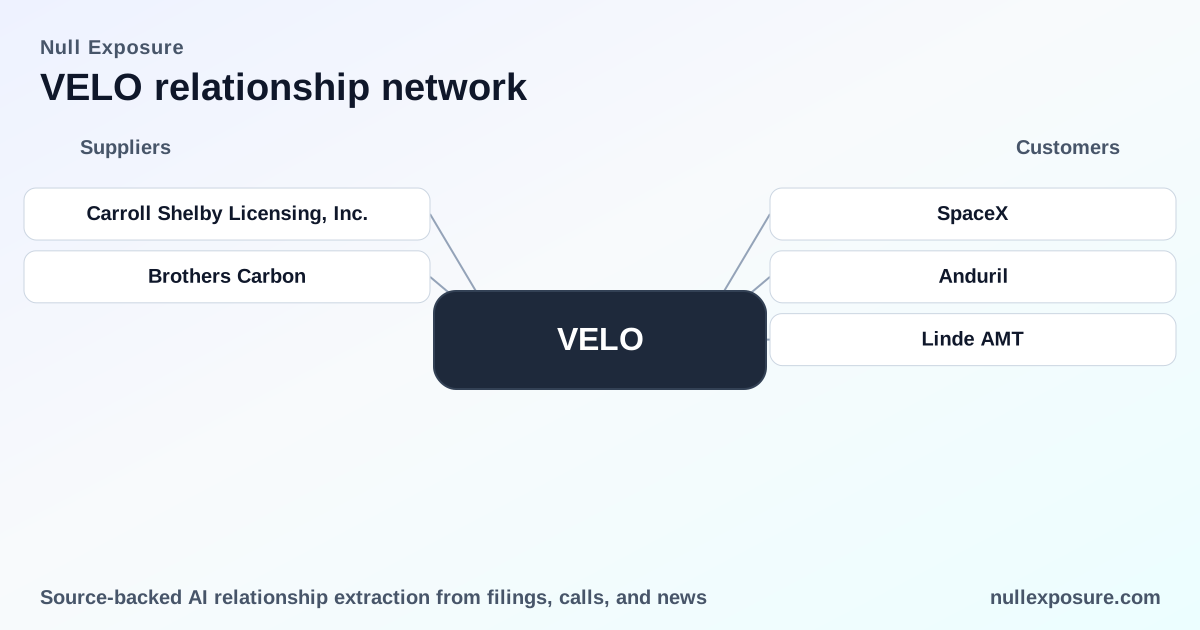
Velo3D (VELO) — supplier relationships and what they mean for operators and investors
Velo3D operates and monetizes as a producer of advanced metal additive manufacturing systems and related hardware; revenue is generated through machine sales, consumables and parts, and services that support machine deployment and uptime. Investors should evaluate the company’s supplier dependencies and contract posture because Velo3D’s cost of goods sold explicitly includes purchased components and subassemblies, giving suppliers direct influence over unit economics and delivery predictability. For an operator-focused supplier map and relationship scoring, see NullExposure’s collection at https://nullexposure.com/.
High-level framing: why supplier relationships matter for VELO now
Velo3D’s reported financials show modest revenue scale (approximately $49.2M TTM) and a gross profit that is negative on the trailing-twelve-month basis, signaling that supplier costs and manufacturing execution are immediate drivers of margin recovery. The company identifies multiple third-party vendors for core hardware and raw materials, so supplier performance is directly tied to product margin and delivery cadence. Given the firm’s capital-light public profile—market capitalization around $104M and elevated insider ownership—executing on a tight supply chain and favorable commercial terms is a top-line and liquidity imperative.
For a deeper vendor-risk profile and operational scoring, explore NullExposure’s supplier analytics: https://nullexposure.com/.
What company-level constraints reveal about operating model
- Velo3D contracts with third-party vendors for core hardware subsystems and components, which signals a vendor-dependent manufacturing model where assembly and subassembly procurement directly affect gross margins and lead times.
- The company discloses that the “Cost of 3D Printers” line includes vendor-purchased components, raw materials, shipping, and directly associated costs, indicating material cost pass-throughs and sensitivity to commodity or shipping price swings.
- The firm employs capital market service relationships (an ATM Sales Agreement with Needham) to execute equity raises; Needham receives a fixed commission (3.0%) on ATM sales, which is a recurring financing cost when management accesses equity for working capital.
Taken together, these constraints imply a contracting posture that is operationally dependent on external manufacturers, with cost concentration and criticality in supplier relationships and a financing posture that leverages agency-led equity sales rather than asset-backed credit.
Supplier concentration, criticality and maturity — an investor checklist
- Contracting posture: Outsourced manufacturing and significant purchased-component costs mean Velo3D negotiates both price and delivery terms rather than controlling full vertical supply chains.
- Concentration risk: When core subsystems are procured from a limited set of suppliers, any supplier disruption scales quickly into delivery and revenue risk.
- Criticality of partners: Suppliers that provide core hardware subsystems or unique materials occupy a strategic rather than commoditized role and therefore warrant heightened monitoring.
- Maturity of relationships: Evidence of letters of intent and licensing agreements in connected businesses shows an evolution toward formalized, potentially strategic supplier or partner commitments—but the company-level excerpts do not list long-tenured multi-year supply agreements.
Supplier relationship summaries (all disclosed partners)
Below are the relationships surfaced in the reporting set; each is covered with a concise investor-facing takeaway and source reference.
-
Carroll Shelby Licensing, Inc.
Velocity (the referenced operating entity in the disclosure) has secured a letter of intent for a licensing agreement with Carroll Shelby Licensing, Inc. to continue producing Shelby GT500 and Shelby Cobra vehicles that will be featured in the Shelby registry. This indicates a licensing relationship that supports product breadth and brand-aligned manufacturing activities. Source: PR Newswire release, March 10, 2026 — https://www.prnewswire.com/news-releases/velocity-stabilizes-restomod-industry-with-the-acquisition-of-classic-recreations-302527462.html. -
Brothers Carbon
The same PR Newswire release notes a partnership with Brothers Carbon for carbon-fiber manufacturing capabilities to expand parts, interiors and vehicle models, signaling an outsourcing relationship for composite components that can materially affect BOM cost and structural performance. Source: PR Newswire release, March 10, 2026 — https://www.prnewswire.com/news-releases/velocity-stabilizes-restomod-industry-with-the-acquisition-of-classic-recreations-302527462.html.
(These are the full set of supplier/partner relationships disclosed in the provided reporting.)
What these relationships mean for VELO’s risk-reward profile
The two disclosed partners indicate a mix of brand-licensing and manufacturing outsourcing exposure. For an investor or operator, this translates into three actionable implications:
- Margin sensitivity: Outsourced carbon-fiber production and purchased subsystems flow directly into the company’s Cost of 3D Printers, so supplier pricing and yield improvements are the fastest pathway to positive gross margins.
- Operational leverage: Licensing relationships tied to branded products expand revenue opportunity but require manufacturing partners that can meet quality and regulatory expectations; failure to secure robust supply could compress realized revenue.
- Strategic optionality: Partnerships like Brothers Carbon provide the ability to scale composite parts without heavy capital investment, but they also create vendor dependence that requires careful contract terms and contingency planning.
Tactical risk controls investors and operators should demand
- Contract terms that include price collars, volume discounts, and quality SLAs for key components.
- Redundancy or dual-sourcing for uniquely critical subsystems to lower single-supplier failure impact.
- Transparent inventory and lead-time reporting tied to supplier KPIs to anticipate margin shocks.
Key takeaways and next steps
- Supplier economics are central to Velo3D’s margin recovery. Purchased components and outsourced composite manufacturing directly influence gross profit dynamics.
- The company operates with vendor-dependent manufacturing and uses agency-led equity facilities to manage capital needs, creating both operational and financing levers investors must monitor.
- Two disclosed partner relationships — Carroll Shelby Licensing and Brothers Carbon — reflect licensing and manufacturing strategies that expand product scope but increase supplier criticality.
If you require a tailored supplier risk assessment or want to map contracts, obligations and concentration for VELO at the counterparty level, review NullExposure’s supplier intelligence at https://nullexposure.com/. For ongoing monitoring and alerts on supplier changes, visit https://nullexposure.com/ to subscribe.
Conclude your due diligence by requesting supplier-level contract snapshots, delivery performance history, and contingency plans from management; those documents quantify the operational exposure summarized above and convert the qualitative supplier map into investment-grade risk metrics.