VEM (Virtus Emerging Markets Dividend ETF) — supplier profile and relationship map for investors
Thesis: VEM is an actively managed exchange-traded fund launched by Virtus Investment Partners that monetizes through management fees and asset-gathering economics; its financial value to Virtus and to distribution partners depends on rapid asset accumulation, tradability, and fee capture rather than bespoke contracting. Investors and platform operators should treat VEM as a productized supplier offering—evaluate distribution, liquidity, and sponsor alignment rather than bespoke vendor-negotiation metrics.
Explore more supplier intelligence at https://nullexposure.com/
What VEM is, and why it matters to operators and investors
VEM is an ETF product that provides exposure to dividend-paying equities in emerging markets under Virtus’s management. As an ETF supplier the product’s commercial mechanics are built on scalable fee revenue (expense ratio), market liquidity, and distribution reach: the sponsor earns ongoing fees as assets grow while broker-dealers, RIAs, and platforms get a tradable instrument to offer clients.
This operating posture implies a productized contracting model: standard prospectus, exchange listing, and authorized-participant flows govern access and economics rather than bespoke service-level agreements. For platform operators, the relevant evaluation axes are liquidity, tracking/active strategy performance, fee competitiveness, and the sponsor’s capacity to seed and market the product.
Explore product and supplier coverage at https://nullexposure.com/
Every relationship revealed in public sources
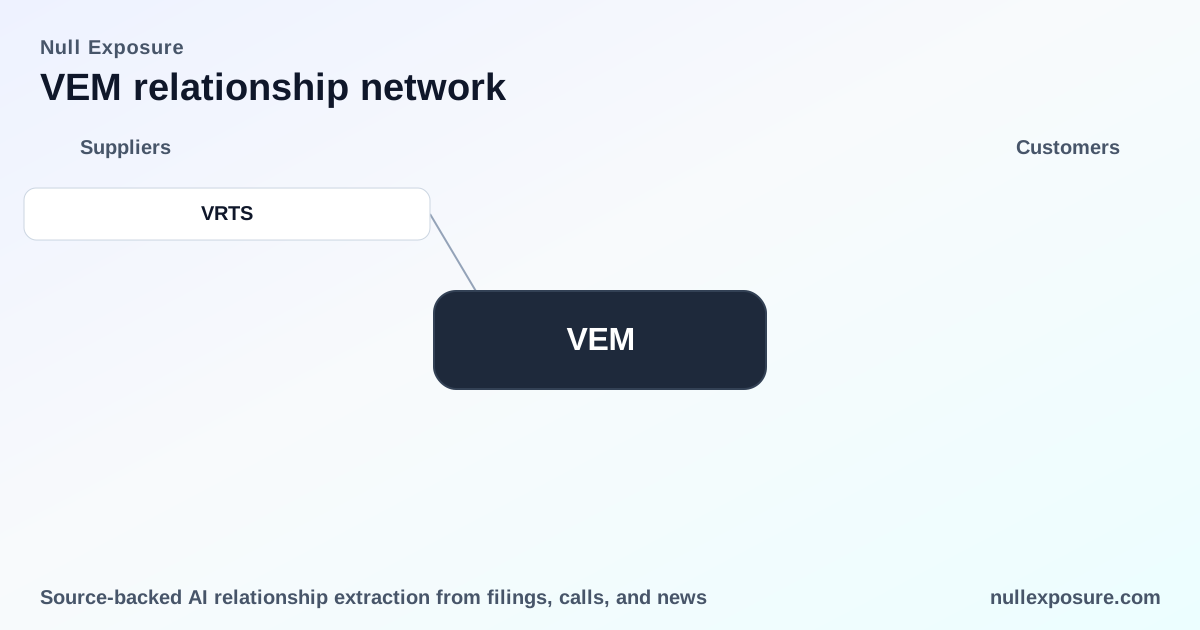
Virtus Investment Partners Inc (VRTS) — Virtus is the sponsor and manager that introduced the Virtus Emerging Markets Dividend ETF (NYSE: VEM) in FY2026, positioning itself as the listed fund’s operational and commercial counterparty. This makes Virtus the primary supplier relationship for the ETF’s distribution, portfolio management, and regulatory filings. Source: Sahm Capital news article, 2026-02-10 — https://www.sahmcapital.com/news/content/virtus-leans-on-etfs-for-growth-adds-emerging-markets-dividend-fund-amid-equity-pressure-2026-02-10.
How the available evidence shapes operating-model signals
No explicit constraints were reported in the available relationship data. Treat the absence of listed constraints as a company-level signal: the public feed does not disclose special contractual limitations, exclusivity clauses, or counterparty concentration flags tied to VEM. From the product and market context you can infer several consequential characteristics for decision-making:
- Contracting posture (company-level signal): Productized and standardized. ETFs operate under prospectus and exchange rules; third-party platforms typically onboard them via standard distribution agreements rather than negotiated bespoke contracts.
- Concentration (company-level signal): Concentration risk is higher at the sponsor level if VEM is a material new product for Virtus, but nothing in the provided results quantifies revenue dependence. Treat concentration as an operational metric to monitor through AUM disclosures and sponsor revenue breakdowns.
- Criticality (company-level signal): For distribution platforms, VEM is only critical if it gains sufficient scale and unique investor demand; as a new FY2026 launch it is not yet by definition a “must-have” product for most dealers.
- Maturity (company-level signal): The product launched in FY2026, indicating early lifecycle status; expect elevated sensitivity to seed liquidity, initial trading volumes, and marketing spend.
These company-level signals should guide diligence priorities—especially around liquidity provisioning, authorized participant relationships, and seed commitments—rather than being treated as contractual red flags in isolation.
Commercial implications and recommended due diligence
For investors and operators evaluating a supplier relationship with VEM and Virtus, prioritize the following assessments:
- Distribution and seed structure: confirm whether Virtus or an affiliate seeded the fund and which market makers/authorized participants support secondary-market liquidity.
- Fee economics and margin capture: review the prospectus for the expense ratio and any fee waivers or rebates that affect near-term revenue to the sponsor.
- Trading liquidity and spreads: monitor initial average daily volume and bid/ask spreads to understand execution cost for end clients and platform risk exposure.
- Sponsor capability and track record: evaluate Virtus’s ETF distribution infrastructure, marketing commitment, and historical success launching similar products.
- Regulatory and operational plumbing: validate clearing, custody, and creation/redemption arrangements to ensure operational resilience.
These checks convert high-level supplier signals into actionable vendor-management steps. Use trading and filings data to quantify the qualitative signals identified above.
Relationship-by-relationship quick takeaways
- Virtus Investment Partners Inc (VRTS): Sponsor and manager that launched VEM in FY2026; responsible for portfolio management, prospectus filing, and commercial distribution of the ETF. Source: Sahm Capital, 2026-02-10 — https://www.sahmcapital.com/news/content/virtus-leans-on-etfs-for-growth-adds-emerging-markets-dividend-fund-amid-equity-pressure-2026-02-10.
Key takeaways for investors and operators
- VEM is a productized supplier offering: treat onboarding as a product integration exercise focused on liquidity, fees, and distribution rather than a negotiated services contract.
- Early-stage commercial risk: launched in FY2026, VEM’s immediate value hinges on seed capital and market-making; absence of constraint disclosures is not a substitute for liquidity and AUM checks.
- Sponsor alignment matters: Virtus’s marketing and seeding commitment is the single most important determinant of whether VEM becomes strategically important to distributors.
If you want a concise supplier risk profile and ongoing monitoring for VEM, start a tailored supplier review at https://nullexposure.com/
Closing action items
For portfolio managers and platform operators: request the prospectus and initial SEC filings, obtain market-maker commitments, and track 90-day on-exchange volumes to convert these qualitative signals into measurable KPIs. For a unified supplier intelligence approach that tracks fund launches, distribution footprints, and liquidity signals, visit https://nullexposure.com/ for more.