Vera Therapeutics (VERA): Supplier relationships that underwrite a clinical-stage commercialization push
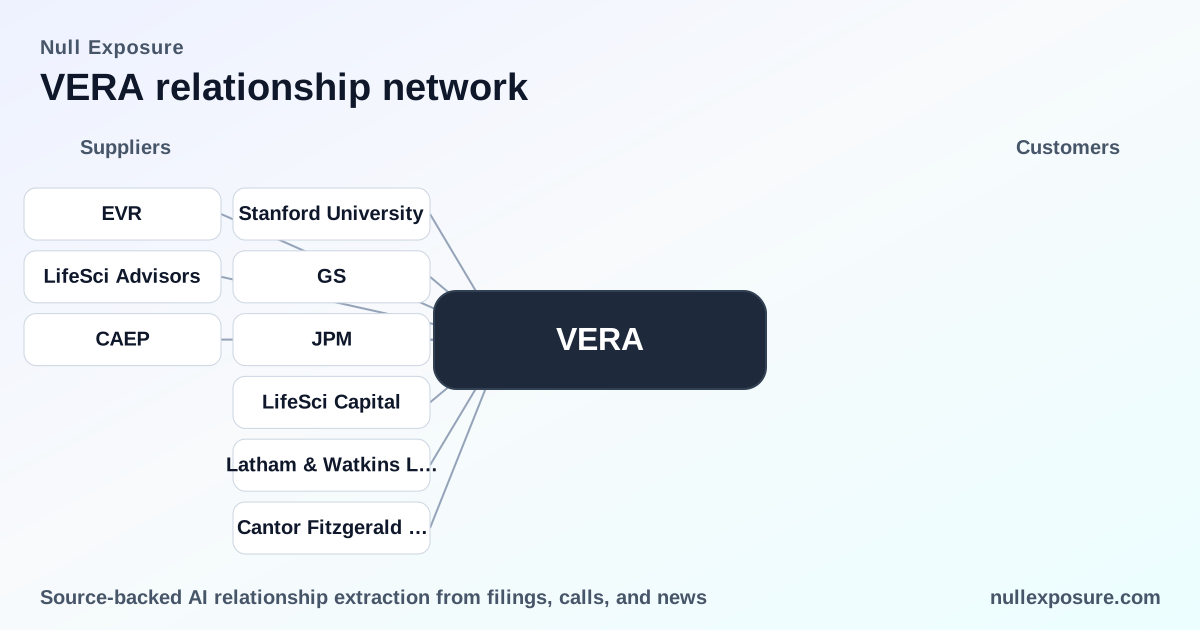
Vera Therapeutics operates as a clinical-stage biotechnology company focused on B‑cell mediated immunology and renal disease; it builds value by acquiring and licensing clinical assets (atacicept, MAU868, VT‑109), advancing them through regulatory milestones and ultimately monetizing via product commercialization, milestone payments and public capital markets transactions. The company’s supplier map is dominated by three functional buckets — academic licensors, capital markets and legal/advisory firms — each of which materially affects Vera’s capital runway, regulatory pathway and manufacturing scale-up. For a consolidated supplier-risk view and supplier intelligence, visit https://nullexposure.com/.
Capital markets and book-runners: who put up the sell‑side muscle
- Goldman Sachs & Co. LLC — Goldman was named a joint book‑running manager on Vera’s proposed public offering and on the pricing announcement that followed (FY2025 pricing disclosures). This places Goldman squarely in the execution layer of Vera’s equity capital raises (GlobeNewswire / BusinessInsider, Dec 2025).
- J.P. Morgan — Listed as a joint book‑running manager alongside Goldman, J.P. Morgan provided syndicate muscle for Vera’s FY2025 offering, signaling top‑tier distribution for the equity raise (BusinessInsider / GlobeNewswire, Dec 2025).
- Evercore ISI — Also a joint book‑running manager on the FY2025 offering, Evercore’s involvement indicates independent mid‑market underwriting and research depth across the life sciences syndicate (GlobeNewswire / BusinessInsider, Dec 2025).
- Cantor Fitzgerald & Co. (and Cantor / CAEP references) — Cantor participates in the underwriting syndicate as a joint book‑runner in the FY2025 offering filings, recorded in multiple press releases and syndicate lists (GlobeNewswire / BusinessInsider, Dec 2025).
- LifeSci Capital — Identified as lead manager for the proposed offering and a principal syndicate participant in the FY2025 raise, LifeSci Capital provided sector‑focused placement for institutional life‑science allocators (GlobeNewswire / BusinessInsider, Dec 2025).
Legal and investor‑relations advisors: governance, compliance and outreach
- Latham & Watkins LLP — Latham & Watkins acted as legal counsel for the FY2025 offering with a dedicated capital markets team, supporting transaction structuring and compliance documentation (Latham Web release / LegalDesire, Dec 2025).
- LifeSci Advisors — Listed as Investor Contact in Vera’s FY2026 board appointment release, LifeSci Advisors handled investor relations communications tied to corporate governance updates (QuiverQuant / press release, FY2026).
Academic and intellectual property relationships: the clinical engine
- Stanford University — Vera holds an exclusive license from Stanford for VT‑109, a next‑generation fusion protein targeting BAFF and APRIL with broad B‑cell disease potential; Stanford is the primary academic licensor referenced across multiple FY2025–FY2026 press releases (GlobeNewswire / Sahm Capital / QuiverQuant, FY2025–FY2026). This license represents foundational IP for Vera’s R&D pipeline and downstream commercial rights.
What this relationship map tells investors about operating posture Vera’s supplier profile is consistent with a clinical‑stage biotech executing a capital‑intensive regulatory strategy and preparing for commercialization. Key operating characteristics derived from disclosed constraints and the relationship set:
- Contracting posture — long‑horizon and licensed IP: Company filings document long‑term contractual commitments (non‑revolving loan extended into 2027 and facility lease through 2029) and multiple licensing agreements that transfer development and commercialization rights. These are structural, multi‑year commitments rather than short transactional engagements.
- Spend concentration — mid‑to‑high single digit to low‑hundreds of millions exposure: Contract excerpts reference milestone obligations up to tens of millions (for Novartis) and borrowings in the tens of millions, consistent with spend bands in the $1m–$100m range across licensing, milestone and financing activities. These are company‑level spend signals rather than an allocation to any single supplier.
- Role diversity — licensor, manufacturer and service providers: Vera acts as licensor and licensee in different deals (Ares/Novartis/Amplyx history), is scaling external manufacturing to meet clinical/commercial requirements, and relies on CROs for trial execution. This mix signals operational complexity and multiple third‑party dependencies ahead of a commercial launch.
- Maturity and criticality — active, near‑term regulatory inflection: Constraints mark relationships as active and the company reports FDA priority review activity for atacicept; this makes supplier continuity and manufacturing scale‑up mission‑critical to the company’s near‑term value realization.
Risks and value drivers that flow from suppliers
- Value driver — top‑tier syndicate access accelerates capital deployment. The combination of Goldman, J.P. Morgan, Evercore, Cantor and sector specialist LifeSci Capital gives Vera broad market reach and research coverage for follow‑on capital needs. (BusinessInsider / GlobeNewswire, FY2025.)
- Execution risk — manufacturing and CRO dependency. Vera explicitly scales external manufacturing and relies on third‑party R&D data, making supplier performance a direct lever on trial timelines and filing integrity. (Company filings; constraints evidence.)
- IP dependency — academic licensing underpins pipeline continuity. The Stanford VT‑109 license is core IP; any disruption to licensing terms or unmet milestone payments (Novartis milestone schedule referenced in constraints) would be material to the pipeline. (GlobeNewswire / Sahm Capital, FY2025–FY2026.)
- Legal and communications governance — counsel and IR matter during offerings. Latham & Watkins and LifeSci Advisors provided legal and investor communication support for the FY2025–FY2026 financing and governance announcements, reducing transactional execution risk. (Latham Web / QuiverQuant, FY2025–FY2026.)
Practical takeaways for investors evaluating supplier exposure
- Concentration is moderate but functionally critical: Suppliers are concentrated into a few high‑impact categories (academic licensors, underwriters, legal counsel, manufacturers/CROs), which concentrates execution risk despite diversified syndicate participation.
- Costs are contractually bounded but material: Milestone ceilings and loan balances create predictable capital demands in the near term; investors should model both milestone payouts and refinancing/raise scenarios.
- Active supplier relationships imply near‑term catalysts: FDA priority review activity and recent equity raises position the company for regulatory and commercial inflection points — suppliers will determine timing and quality of those outcomes.
Next steps and where to go from here
- Track delivery on the Stanford VT‑109 program and manufacturing scale‑up milestones; those are the primary operational dependencies for commercial upside. For an actionable supplier-risk dashboard and continuous monitoring of these counterparties, visit https://nullexposure.com/.
- Reconcile cash runway against milestone triggers and potential dilution paths from future offerings led by the identified syndicate; underwriter composition materially affects raise execution. For strategic supplier intelligence and relationship monitoring, see https://nullexposure.com/.
Bottom line: Vera’s supplier architecture supports an aggressive clinical‑to‑commercial transition but concentrates execution risk in a small set of academic licensors, manufacturers and capital‑markets partners. Investors should treat supplier continuity and milestone finance as first‑order determinants of near‑term valuation.