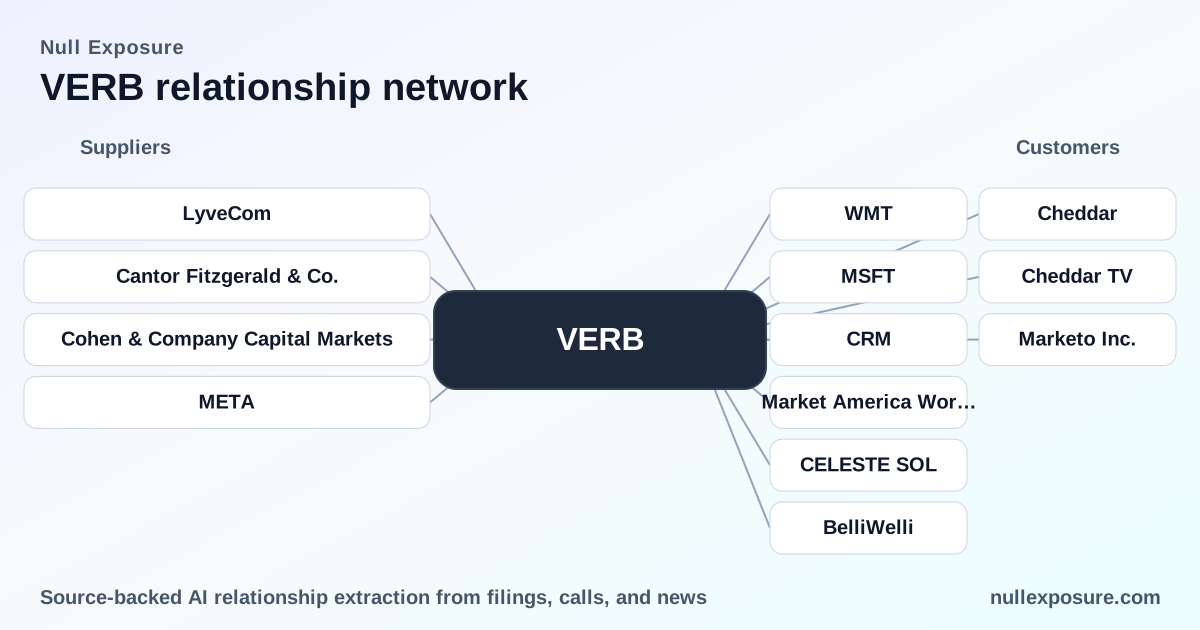
VERB supplier relationships: a focused lens for investors evaluating partner risk and upside
Verb Technology (VERB) operates a video-first sales and social-commerce platform, monetizing through software licensing, platform integrations, and the sale of value-added services tied to its MARKET.live product and related offerings. Revenue derives from a mix of licensing fees and strategic integrations that extend sales functionality into third‑party channels, while capital markets activity has been used to fund growth. For investors assessing supplier and capital relationships, the cap table and partner map tell a clear story about go‑to‑market leverage and financing posture.
For an at‑a‑glance vendor risk scan and tailored monitoring, visit the NullExposure homepage: https://nullexposure.com/
Why these supplier links matter to investors today
Verb’s partner list blends technology licensors, platform integrators, and capital markets intermediaries. Each relationship signals different operational dependencies: product innovation through licensing, distribution via platform integration, and balance‑sheet support via equity facilities. Collectively, these relationships influence gross margin potential, go‑to‑market scale, and dilution risk.
Company-level constraints and operating model signals
- Contracting posture: Verb relies on short- to medium-term commercial agreements (licensing and integration contracts) rather than multi‑decade exclusives; this produces flexibility but requires ongoing renewal and new partner wins to sustain growth.
- Concentration: The current publicly reported roster is small, indicating concentration in strategic vendors and distribution partners; that concentration increases the importance of each commercial interplay to top‑line execution.
- Criticality: Partnerships that enable native shopping or video commerce are operationally critical to the MARKET.live value proposition because they directly expand where customers can transact.
- Maturity and risk: Relationships combine early‑stage technology suppliers and global platform integrators. This mix accelerates feature capability but introduces integration and product maturity risk that falls on Verb to manage.
- Financing posture: Public equity facilities used to raise capital are a structural part of funding growth; investors should treat equity‑based facilities as ongoing liquidity mechanisms that affect share count and investor returns.
These are company‑level signals drawn from the available relationship disclosures and should guide monitoring priorities (contract renewals, integration KPIs, capital calls).
Partner-by-partner breakdown: what each supplier relationship actually says
LyveCom
LyveCom is a video‑based social commerce start‑up whose A.I. and social commerce technology has been licensed by Verb for integration into the MARKET.live platform, reflecting a deliberate move to augment live‑video shopping capabilities. According to a StockTitan post citing management remarks for FY2025, Verb executed a licensing agreement to incorporate LyveCom’s technology (reported March 2026, covering FY2025 commentary). https://www.stocktitan.net/news/VERB/verb-publishes-management-s-prepared-remarks-during-fourth-quarter-yf85kccmjct3.html
Cantor Fitzgerald & Co.
Cantor Fitzgerald & Co. is serving as an underwriter or placement agent in a Controlled Equity Offering Sales Agreement that Verb announced as part of a capital‑raising program; this establishes a standing pathway to raise equity capital under defined terms. The Globe and Mail reported the August 8, 2025 controlled equity offering agreement, which names Cantor Fitzgerald & Co. as a party to the sales agreement (press release, FY2025). https://www.theglobeandmail.com/investing/markets/stocks/VERB/pressreleases/34027869/verb-technology-announces-1-billion-equity-offering/
Cohen & Company Capital Markets
Cohen & Company Capital Markets joined Cantor Fitzgerald as a sales agent in the same Controlled Equity Offering Sales Agreement, providing parallel distribution channels for equity issuance and reinforcing Verb’s access to capital markets. The Globe and Mail’s August 2025 release lists Cohen & Company Capital Markets as a co‑agent in the offering (press release, FY2025). https://www.theglobeandmail.com/investing/markets/stocks/VERB/pressreleases/34027869/verb-technology-announces-1-billion-equity-offering/
Meta Platforms (META)
Meta Platforms provided native shopping integration that allows VIDEO commerce features to operate directly within Facebook and Instagram, extending Verb’s transactional surface and distribution reach into large social channels. TradingView’s coverage (citing an InvestorPlace piece) described a recent deal enabling Verb to natively integrate shopping with Meta apps; the reported activity is dated to FY2024 in the public commentary. https://www.tradingview.com/news/investorplace:d67c1b7fb094b:0-why-is-verb-technology-verb-stock-up-again-today/
What the relationship mix means for revenue, margin, and liquidity
- Revenue leverage: Integrations with major platforms like Meta translate directly to distribution leverage and the potential to scale transaction volumes without proportional increases in sales spend. Native shopping integrations are top‑line multipliers.
- Product complexity: Licensing tech from start‑ups such as LyveCom accelerates feature rollout but transfers integration and quality‑control responsibility to Verb—this influences R&D and professional services cost lines.
- Financing runway and dilution: The controlled equity facility with Cantor Fitzgerald and Cohen & Company creates a standing mechanism to raise cash, improving liquidity flexibility while imposing dilution risk if invoked frequently. Investors should price ongoing access to equity capital into valuation scenarios.
For a practical vendor monitoring playbook and to set alerts on partner events, see https://nullexposure.com/
Signals to watch and actionable metrics for investors
- Monitor renewal and expansion language in partnership announcements; extensions or exclusivity terms materially affect lifetime value and concentration risk.
- Track integration milestones and user adoption metrics post‑integration with Meta and third‑party licensors; adoption speed determines margin accretion.
- Watch sales‑agreement activity under the controlled equity facility—frequent draws increase share count and should be modeled as recurring capital actions.
- Evaluate the diversity of future supplier agreements to assess how quickly Verb can reduce concentration risk across technology and distribution partners.
Bottom line: where the risk/reward sits
Verb has constructed a compact, execution‑oriented partner map that accelerates product capability and distribution while leaning on public markets for growth capital. The positive tradeoff is faster feature deployment and reach; the negative tradeoff is supplier concentration and potential equity dilution. For investors and operators, prioritizing contract terms, integration KPIs, and the cadence of equity issuance is the fastest path to understanding the company’s trajectory.
If you want a tailored monitoring setup or regular alerts on these relationships and related filings, start here: https://nullexposure.com/
Final recommendation: treat the Meta integration and the LyveCom licensing as growth catalysts to be validated by adoption metrics, and treat the Cantor/Cohen equity facility as a recurring financing option that should be stress‑tested in your valuation scenarios. For firm-level tracking or to commission a supplier risk brief, visit https://nullexposure.com/