Veru Inc (VERU): supplier relationships and what they signal for investors
Veru is an oncology biopharma that monetizes through drug commercialization, licensing of patent estates, and periodic capital market transactions. The company develops and licenses proprietary candidates (notably enobosarm and sabizabulin), relies on third-party manufacturers and service providers to run trials and produce drug supply, and supplements operating cash through equity offerings and advisory-led transactions. For investors assessing supplier risk and strategic exposure, the mix of diagnostic and distribution partners, financial advisors and legal counsel, together with documented licensing positions and a material supplier settlement, defines both runway and execution risk.
Explore deeper supplier intelligence at https://nullexposure.com/ for a consolidated view of partner concentrations and contract signals.
How Veru’s supplier architecture shapes execution risk and upside
Veru’s operating model is outsourced and partnership-dependent. The company holds exclusive licenses over multiple patent families that underpin product value, but it does not vertically integrate manufacturing or many specialized services. That creates a classic biopharma profile: high IP leverage, high external execution dependency.
Key operating characteristics and constraints that drive investment judgment:
- Contracting posture — licensing-centric: Veru’s business is anchored in exclusive licensing of patent portfolios for its drug candidates, a structural revenue and valuation driver that also concentrates counterparty and enforcement exposure. (Company-level signal from licensing disclosures.)
- Execution dependency — third-party manufacturers and service providers are critical: R&D, clinical operations, packaging and storage are conducted by external vendors; continuity and quality of those suppliers directly determine commercialization timing and cost. (Company-level signal from manufacturing/service-provider disclosures.)
- Financial concentration and cash posture: The company maintains the majority of its cash in a single financial institution (Chicago), which is a liquidity-concentration consideration for treasury risk. (Company-level signal.)
- Material supplier liability already crystallized: Veru settled a disputed supplier claim for $8.3 million with staged payments through 2028 and contingent components tied to promissory notes; this places the supplier exposure in the $1m–$10m spend band and is an active contractual obligation. (Company-level signal from public filings.)
These characteristics imply that clinical and commercial progress hinges as much on external partnerships and capital markets as on internal science. Investors should price in concentration and counterparty continuity risk when modeling timelines or cash burn.
A detailed partner map follows; for an investor-grade supplier risk scorecard visit https://nullexposure.com/.
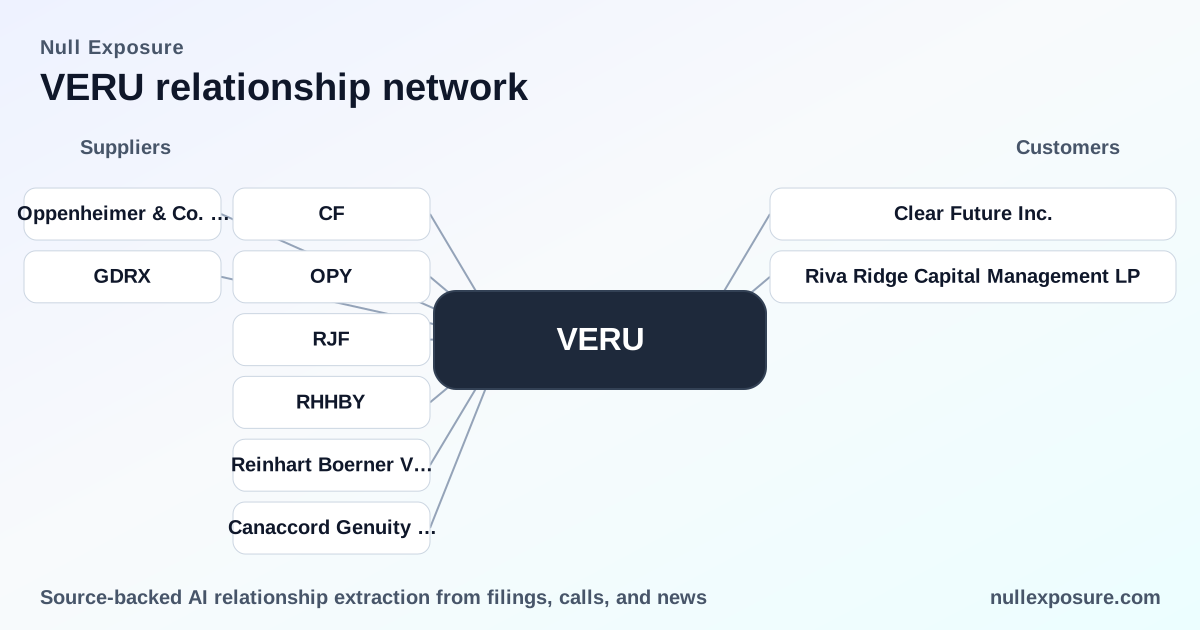
Who Veru is partnering with — every reported relationship and what it means
Canaccord Genuity LLC
Canaccord served as a joint book-running manager on Veru’s October 2025 public offering, underwriting capital that directly shores up liquidity for operations and commercialization. According to Veru’s press release via GlobeNewswire (Oct 29–30, 2025), Canaccord was named alongside Oppenheimer as a lead manager for the offering.
Oppenheimer & Co. Inc.
Oppenheimer acted as the other joint book-running manager on the same October 2025 equity transaction, executing the capital raise that supports near-term cash needs and R&D programs, per GlobeNewswire press materials (Oct 29–30, 2025).
Raymond James
Raymond James provided financial advisory services to Veru in connection with the sale of FC2 Female, a commercial transaction disclosed in a Yahoo Finance report covering the FY2024 sale process; the engagement positions Raymond James as a strategic advisor on non-core asset monetization (reported via Yahoo Finance, FY2024).
Reinhart Boerner Van Deuren s.c.
Reinhart Boerner Van Deuren served as legal counsel to Veru in the FY2024 transaction that involved the sale of FC2 Female, indicating the firm’s role in structuring and documenting commercial divestitures (cited in the same Yahoo Finance report covering FY2024).
Roche / Ventana Diagnostics
Roche/Ventana Diagnostics partnered with Veru to develop and, conditional on approval, commercialize a companion diagnostic for the AR test tied to Entadfi, aligning Veru’s therapeutic launch plan with an established diagnostic provider and strengthening market access and prescriber adoption pathways (reported in industry coverage referencing FY2021 partnership details).
GoodRx
GoodRx partnered with Veru to extend patient access by listing the treatment to GoodRx’s consumer-facing platform and offering a cash price to improve affordability and uptake among outpatient populations, as noted in the company’s commercialization commentary tied to FY2021 coverage.
What these relationships mean for valuation and downside
Together the partner list reveals a dual strategy: (1) shore up capital via investment banks and public offerings, and (2) execute commercialization through diagnostic and consumer-access partners while outsourcing manufacturing and clinical services. That strategy accelerates time-to-market but centralizes operational risk on third parties.
Primary investment implications:
- Upside drivers: Exclusive patent licenses and a Roche diagnostic partnership are value-accretive for launch potential; GoodRx can meaningfully improve early market penetration and cash sales.
- Key risks: Dependence on third-party manufacturers and service providers for clinical supply and cybersecurity advice, a material $8.3 million supplier settlement with extended payment terms, and cash held primarily at one institution all increase execution and liquidity risk.
- Capital sensitivity: Recent public offerings underwritten by Canaccord and Oppenheimer reflect active financing; investor returns will be sensitive to dilution and the company’s ability to convert pipeline milestones into revenue.
For a structured risk heatmap and counterparty concentration metrics, see the supplier intelligence tools at https://nullexposure.com/.
Practical takeaways for investor diligence
- Prioritize verification of manufacturing continuity, supplier credit risk, and the status of the $8.3 million payment schedule when modeling cash flows.
- Treat diagnostic commercialization with Roche as a de-risking event for market access, and GoodRx ties as a near-term demand channel that shortens reimbursement friction.
- Update valuation scenarios to reflect outsourced execution risk and periodic capital raises, rather than relying solely on clinical milestone probabilities.
If you want a tailored supplier risk assessment or a downloadable partner scorecard for VERU, visit https://nullexposure.com/ to request a briefing.
Conclusion: Veru’s commercial path is IP-driven and partnership-executed; the company has structured capital and commercial relationships to accelerate launch, but investors must underwrite the significant third-party operational dependencies and a crystallized supplier liability when sizing upside and downside.