Vertex (VERX): supplier relationships, integration footprint, and operational constraints investors should price in
Vertex provides enterprise tax automation and compliance software to large merchants and service providers, monetizing primarily through cloud-delivered software and implementation services that embed with major ERPs and commerce platforms. The company’s product strategy combines direct bookings with ecosystem-led distribution and partnerships that accelerate deployments inside existing Microsoft, Oracle, Salesforce and commerce stacks; these integration relationships are central to Vertex’s value capture and renewal economics. For a broader supplier-risk and partner-opportunity view, review full coverage at https://nullexposure.com/.
How Vertex makes money and why partner integrations matter
Vertex sells tax calculation and compliance technology that plugs directly into enterprise systems; this creates sticky, recurring revenue tied to transaction volumes inside ERP/commerce platforms. Company financials show Revenue TTM $748.4M with narrow but positive operating margins, which positions Vertex as a mature, subscription-first software business serving retail, communications, leasing and manufacturing clients (company disclosures, FY2025). The commercial logic is straightforward: deep integration into a customer’s ERP or commerce stack increases switching costs and drives ongoing usage-based revenue.
The partner map and what each relationship signals for investors
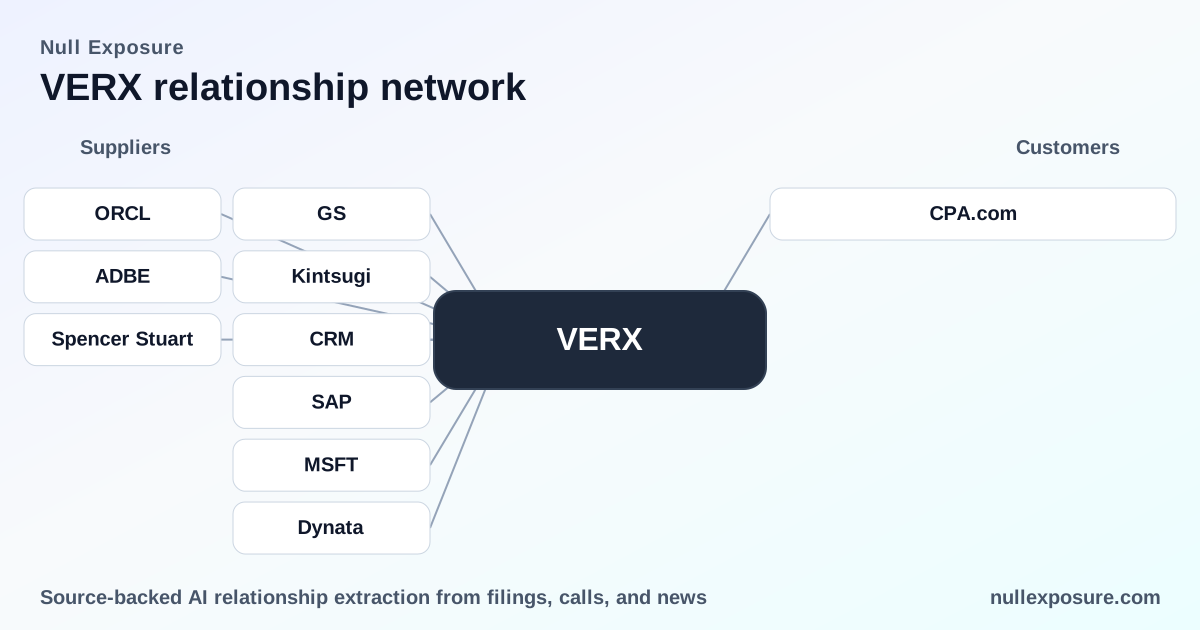
Below I cover every relationship listed in the collected results. Each entry is a concise, plain-English takeaway with a source reference.
Goldman Sachs
A 2020 press report noted banks led by Goldman Sachs arranged a sale of Vertex common shares (21.15 million shares at $14–$16) on Nasdaq under VERX, indicating Goldman acted as an underwriter on a market transaction (The Philadelphia Inquirer, FY2020, https://www.inquirer.com/columnists/vertex-westphal-south-mill-champs-roundtrip-20200722.html).
Kintsugi (partnership announcement)
Vertex launched “Kintsugi powered by Vertex,” an AI-native tax automation solution for SMBs developed with Kintsugi, signaling an expansion of Vertex’s addressable market through a white-label or co-branded product offering (StockTitan press release, FY2025, https://www.stocktitan.net/news/VERX/vertex-and-kintsugi-launch-ai-powered-tax-automation-solution-cux7kt9w34eh.html).
Kintsugi (expanded application with CPA.com)
A related announcement described an expanded application underpinned by Vertex and Kintsugi technology that delivers end-to-end sales tax compliance, showing the partnership extends beyond product launch to broader compliance workflows and channel distribution through professional services partners (StockTitan, FY2025, https://www.stocktitan.net/news/VERX/vertex-and-cpa-com-announce-ai-driven-expansion-of-tax-compliance-g7tzois4fowj.html).
Salesforce
Vertex’s software is documented to work with Salesforce, confirming a native integration route into CRM-led commerce and B2B quote-to-cash workflows that drives usage for tax calculation across customer invoices (The Philadelphia Inquirer, FY2020, https://www.inquirer.com/columnists/vertex-westphal-south-mill-champs-roundtrip-20200722.html).
SAP
Vertex is deployed alongside SAP systems, signaling enterprise penetration in SAP-centric finance and order management environments where tax calculation is functionally embedded (The Philadelphia Inquirer, FY2020, https://www.inquirer.com/columnists/vertex-westphal-south-mill-champs-roundtrip-20200722.html).
Microsoft (platform partnership)
Vertex announced a Configuration Agent for Microsoft Dynamics 365, reflecting a deeper technical integration aimed at simplifying tax automation for Dynamics customers and accelerating deployments inside Microsoft cloud stacks (Quiver Quant, FY2025, https://www.quiverquant.com/news/Vertex+Inc.+Launches+Configuration+Agent+for+Microsoft+Dynamics+365+to+Enhance+Tax+Automation+and+Compliance).
Dynata
Vertex used Dynata to field a consumer survey for a commerce study in June 2025, indicating reliance on third-party market research vendors to support product marketing and thought-leadership initiatives (StockTitan, FY2025, https://www.stocktitan.net/news/VERX/vertex-commerce-study-off-peak-shopping-trends-demand-smarter-tax-uxxyethjyovk.html).
Microsoft Dynamics (explicit integration mention)
The company’s public materials reiterate that Vertex integrates with Microsoft Dynamics, confirming multiple touchpoints and product efforts focused specifically on Dynamics customers and implementation partners (The Philadelphia Inquirer, FY2020, https://www.inquirer.com/columnists/vertex-westphal-south-mill-champs-roundtrip-20200722.html).
Oracle
Vertex explicitly supports Oracle integrations, which places Vertex inside large Oracle ERP and NetSuite implementations where tax logic is mission-critical for invoice processing (The Philadelphia Inquirer, FY2020, https://www.inquirer.com/columnists/vertex-westphal-south-mill-champs-roundtrip-20200722.html).
Adobe/Magento
Vertex lists compatibility with Adobe/Magento, reflecting a direct commerce-channel integration that captures tax calculation at checkout for digital merchants and omnichannel retailers (The Philadelphia Inquirer, FY2020, https://www.inquirer.com/columnists/vertex-westphal-south-mill-champs-roundtrip-20200722.html).
Spencer Stuart
Vertex engaged Spencer Stuart for CEO succession, a clear signal of formal executive-search activity and governance-level succession planning around the FY2025 leadership transition (StockTitan, FY2025, https://www.stocktitan.net/news/VERX/vertex-announces-ceo-retirement-and-succession-mx92lth4m63u.html).
NetSuite
NetSuite support is separately noted, underscoring Vertex’s footprint inside cloud ERP offerings that serve mid-market and enterprise customers and reinforcing its channel strategy into Oracle-owned suites (The Philadelphia Inquirer, FY2020, https://www.inquirer.com/columnists/vertex-westphal-south-mill-champs-roundtrip-20200722.html).
Operational constraints and what they imply for supplier risk
Vertex discloses that it relies on data centers and other third-party technologies and services to operate the business, which is a company-level signal of dependency on external infrastructure (company excerpts). From an operational and contracting perspective this implies:
- Contracting posture: Vertex operates as a purchaser of infrastructure and platform services, exposing it to provider SLAs and pricing risk rather than owning all stack components.
- Concentration risk: Public statements do not list specific data center vendors, making concentration an open diligence point for investors — contract concentration would increase counterparty risk.
- Criticality and maturity: The dependence on third-party hosting is standard for SaaS incumbents; the relationship is likely operationally critical but commercially mature, with negotiated SLAs and transition plans expected in enterprise contracts.
Investors should therefore treat third-party infrastructure as a material operational exposure that requires verification in contracts and filings rather than a speculative worry.
Explore deeper supplier risk analysis and relationship scoring at https://nullexposure.com/.
Investment implications — what to watch and next steps
Vertex’s partner map is a strategic advantage: integrations with Microsoft, Oracle/NetSuite, SAP, Salesforce and commerce platforms create high switching costs and recurring revenue channels. The Kintsugi collaboration signals product expansion into AI-driven SMB automation, while the Spencer Stuart engagement signals governance and leadership continuity focus.
Key risk checkpoints for investors:
- Confirm third-party infrastructure counterparty concentration and SLA terms in filings.
- Quantify revenue contribution from strategic platform integrations versus direct sales.
- Track how partnerships like Kintsugi move from marketing pilots to measurable ARR.
For a practical next step, review Vertex’s recent filings for counterparty disclosures, and monitor press releases for partnership monetization milestones. If you want an organized supplier risk profile and documented relationship scoring, start at https://nullexposure.com/.
Bottom line
Vertex’s business model is integration-dependent and channel-enabled, which underpins recurring revenue but creates identifiable supplier and operational dependencies. For investors, the core thesis is simple: integration breadth equals defensibility, and third-party infrastructure dependence equals an operational control point you must diligence. Use vendor contracts, ARR breakouts, and partnership revenue disclosures as the primary inputs to update valuation and downside scenarios.