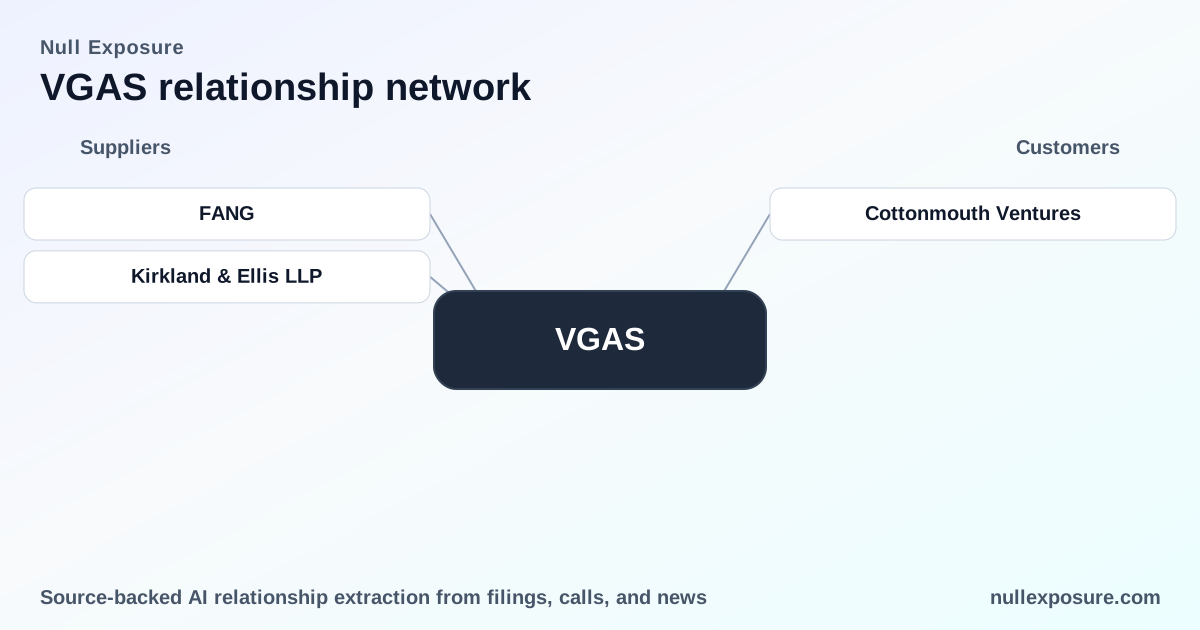
Verde Clean Fuels (VGAS): Partnerships, constraints, and what investors should track
Verde Clean Fuels converts renewable feedstocks and associated natural gas into fully refined gasoline using its proprietary STG+ process, monetizing through project development, equity partnerships, and sales of refined fuel produced at joint facilities. The company advances capital-light development through strategic partner investments and engineering contracts, while retaining technology value through licensing and joint-venture structures. For investors evaluating supplier relationships, the path to commercialization is defined by a small set of development partners, FEED/EPC arrangements, and financing tied to upstream natural gas producers. For background or to explore more supplier intelligence, visit https://nullexposure.com/.
How Verde organizes deals and where value flows
Verde pursues a project-driven business model: it sources feedstock (renewable waste streams and natural gas), deploys its STG+ conversion technology via project SPVs, and brings on engineering and construction partners to deliver plant capacity. Value is captured through plant equity, offtake of refined gasoline, and technology deployment across multiple sites. The company deliberately structures contracts to avoid sole-source dependencies and to attract upstream capital partners who provide feedstock and financing. This contracting posture supports rapid scale if projects reach FID but concentrates execution risk in a small number of large build partners and capital contributors.
For investors who want continuous monitoring of Verde’s supplier footprint and partner signals, see https://nullexposure.com/.
Who Verde is working with and what each relationship means
Diamondback Energy / Cottonmouth Ventures
Verde entered into a joint development and investment relationship with Cottonmouth Ventures, a Diamondback Energy subsidiary, to develop natural gas‑to‑gasoline plants in the Permian Basin using Verde’s STG+ process; Cottonmouth provided a $50 million equity investment to support the initiative. According to CityBiz and a company announcement covered by Yahoo Finance in March 2026, the plants were designed to convert associated natural gas from Diamondback operations into fully refined gasoline. A later report noted Verde suspended active development of the Permian project amid market changes, indicating a pause in the execution timeline rather than termination of the underlying agreement. (CityBiz / Yahoo Finance, March 2026; Intellectia.ai, 2026)
Kirkland & Ellis LLP
Kirkland & Ellis served as legal counsel to Verde around the completion of its business combination and transaction work in FY2023, providing corporate and transactional legal services during the company’s formative public-market steps. (Business Wire/FinancialContent, February 2023)
What the constraint signals tell investors about operating risk and supplier posture
-
Materiality: immaterial — Verde states it does not intend to be dependent on sole-source or limited-source suppliers for raw materials or chemicals, which signals a deliberate strategy to avoid supplier concentration and reduce single‑point supply risk. Treat this as a company-level policy that reduces counterparty concentration risk for feedstock and inputs.
-
Relationship role — manufacturer (Koch Modular Process Systems, LLC) — Koch is identified as an important EPC subcontractor and equipment manufacturer, which shows Verde relies on established modular process vendors for shop-built equipment and critical plant systems. This creates execution dependency on a specialist manufacturer for modular process integration and equipment delivery timelines.
-
Relationship role — service provider (Chemex Global / Shaw Group) — Verde contracted Chemex for a FEED study for the Permian Basin project and anticipates Chemex could perform EPC services if the project reaches FID, indicating Verde’s reliance on third‑party FEED-to‑EPC transitions to de‑risk engineering scope and contractor risk during project development.
-
Relationship role — seller (feedstock sourcing strategy) — Verde plans to contract broadly with renewable feedstock suppliers, commercial waste companies, agricultural participants, and landowners. This is an operational signal that feedstock sourcing is multi-channel and supplier-diversified by design, but it also implies a need for ongoing commercial management and price/quality controls across multiple supply relationships.
Together, these constraints paint a picture of a development-focused, partner-dependent operating model: Verde centralizes technology and project origination while outsourcing equipment manufacture and EPC execution. The company-level emphasis on non-sole-source supply reduces single-counterparty risk, but partner performance, FEED outcomes, and upstream feedstock contracting remain critical to project economics.
Risks, concentration, and governance cues investors should weigh
-
Execution risk is concentrated. A small number of FEED/EPC and upstream partners control the timetable for plant delivery, making project milestones binary triggers for value realization. The reported suspension of the Permian development increases short-term execution uncertainty.
-
Upstream alignment reduces capital pressure but transfers commodity exposure. The Cottonmouth/Diamondback equity and feedstock alignment de-risks feedstock access and provides project capital, but it links project economics to upstream natural gas dynamics and the strategic priorities of a larger energy producer.
-
Insider control and thin institutional ownership. Verifiable company figures show ~81% insider ownership and ~6.7% institutional ownership, which implies concentrated control of corporate decisions and limited institutional monitoring; governance and related-party dynamics are material for investors in this capital‑light development profile.
-
Early-stage economics and negative operating profit. Public filings report negative EBITDA and negative EPS through recent quarters, reflecting development-stage spend and the need for successful project execution or additional financing to reach positive cash generation.
Clear investor actionables
- Monitor FEED completion and any convert-to-EPC decisions from Chemex or Koch, since these are the immediate execution levers that convert technology value into build contracts.
- Track Diamondback/Cottonmouth funding and offtake agreements for any acceleration or termination signals; equity injections and offtake terms materially change project NPV.
- Watch insider transactions and any new institutional investor activity as indicators of governance shifts and financing readiness.
For direct supplier monitoring and to set up alerts on Verde’s partner moves, visit https://nullexposure.com/ for ongoing coverage.
Bottom line
Verde Clean Fuels operates as a technology-centric project developer that monetizes through plant equity, gasoline offtake, and technology deployment via partners. The company’s partner ecosystem — upstream capital from energy producers, FEED/EPC providers like Chemex, and modular equipment vendors like Koch — is central to execution. These relationships reduce capital intensity for Verde but concentrate execution risk with a few counterparties; investors should prioritize FEED-to-EPC milestones and partner funding actions when assessing short- to medium-term value realization. For continuous supplier and partner intelligence, go to https://nullexposure.com/.