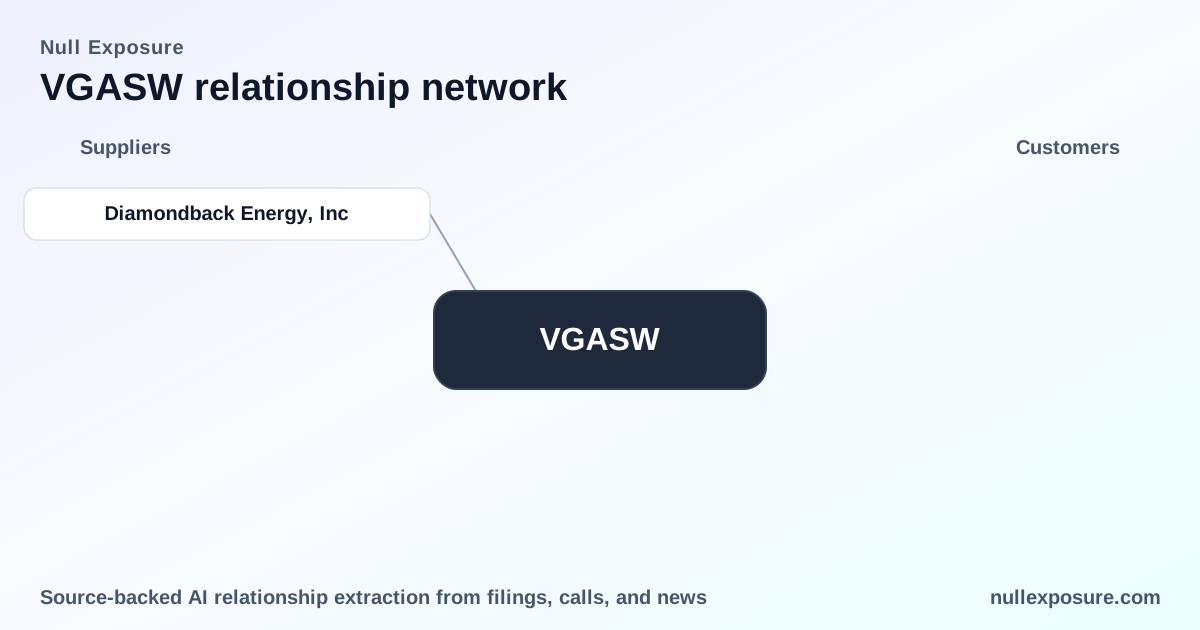
Verde Clean Fuels (VGASW): partner-heavy rollout of renewable gasoline with outsized execution risk
Verde Clean Fuels develops and intends to operate commercial plants that produce commodity-grade gasoline from renewable feedstocks or natural gas; the company monetizes through the sale of produced fuel and through technology licensing and project development arrangements tied to plant construction and operations. The business model is capital- and partner-intensive: Verde leverages joint development agreements, licensed technologies, and third-party EPC/manufacturing partners to move from concept to production. For investors assessing supplier risk, the question is not whether Verde can conceptualize product chemistry — it is whether its partner network, feedstock supply, and EPC chain can be synchronized to reach final investment decision (FID) and commissioning. Learn more at https://nullexposure.com/.
How Verde organizes delivery and revenue generation
Verde’s operating model is a classic project-development play in clean fuels: identify feedstock and technology, contract engineering and manufacturing capacity, then build and operate commoditized gasoline production and sell into wholesale markets. The company’s public filings show zero reported revenue and financial operating ratios through the latest quarter, underlining that this is a pre-revenue developer where partner contracts determine pathway to cash flow. According to the FY2024 Form 10‑K, Verde licenses third‑party intellectual property that is material to its operations and expects to enter additional licensing arrangements as part of commercialization activities.
Key commercial characteristics to note:
- High partner dependency. Verde’s model relies on joint development agreements, licensed technologies, and external EPC/manufacturers to deliver production plants.
- Concentration of feedstock and site risk. Project economics will be closely tied to feedstock sourcing, especially the Permian Basin arrangement described below.
- Early-stage maturity and execution risk. Public records show no revenue or operating earnings to date; the company must achieve FID and complete EPC milestones to realize value.
Explore supplier-risk intelligence and partner mapping at https://nullexposure.com/ for a structured diligence view.
Key supplier and partner relationships you must evaluate
According to Verde’s FY2024 disclosures, several named counterparties populate the project delivery chain. Below are the operative relationships disclosed in company materials and constraints, presented with concise, source-linked summaries.
Diamondback Energy, Inc. — Verde’s feedstock connection and regional supply
- In February 2024, Verde and Cottonmouth entered a Joint Development Agreement to develop, construct, and operate a commercial production plant that will use natural gas feedstock sourced from Diamondback’s Permian Basin operations. This positions Diamondback as the primary feedstock provider for the Permian project pipeline. According to the company’s FY2024 Form 10‑K, the JDA ties Verde’s Permian project economics to Diamondback’s gas supply and regional infrastructure.
Koch Modular Process Systems, LLC — equipment manufacturer and EPC subcontractor
- Verde’s disclosures identify Koch Modular as a planned equipment manufacturer and important EPC subcontractor; Koch’s modular mass‑transfer systems are the technology backbone Verde intends to use for its proposed plants. Company filings and disclosures list Koch as an expected supplier of modular process equipment and a key implementation partner for plant build‑out.
Chemex Global, LLC (a Shaw Group company) — FEED contractor and prospective EPC provider
- In June 2024 Verde contracted Chemex for a front‑end engineering and design (FEED) study tied to the Permian Basin project, and the company expects Chemex to perform EPC services if the project reaches FID. The June 2024 FEED agreement places Chemex in a pivotal role linking Verde’s project definition to executable construction scope.
Each of the above relationships is documented in Verde’s public disclosure record (FY2024 filing and subsequent company statements) and informs where execution risk concentrates: feedstock contracts, FEED-to-EPC transition, and modular equipment delivery schedules.
What the constraints and disclosures signal about Verde’s contracting posture
Verde’s disclosures and extracted constraint signals show a defined contracting posture rather than ad hoc supplier selection:
- License-heavy technology posture. The company explicitly licenses third‑party IP that is important to the business, indicating Verde is not owning all core process IP and will depend on license terms and royalties as part of its cost structure.
- Module-based manufacturing strategy. Naming Koch Modular signals a preference for modular, prefabricated plant components that reduce on‑site complexity but concentrate reliance on a single modular supplier’s delivery cadence.
- FEED-first execution. The Chemex FEED contract demonstrates Verde’s classic sequential development approach — secure FEED scope, then advance to EPC and construction following FID.
These constraints together imply material counterparty and schedule risk: license terms, modular equipment lead times, and successful FEED completion are gating items for project cash flow.
Investment implications — what matters to operators and investors
Verde’s value creation path is binary in the near to medium term: either projects achieve FID and transition to construction, or the company remains a development-stage entity with limited intrinsic cash flow. Investors and operators should weigh the following high‑impact factors:
- FID and financing cadence. Track capital commitments and off‑take or offtake‑equivalent agreements; the presence of feedstock supply from Diamondback improves project bankability but does not replace project financing.
- EPC certainty and equipment delivery. Confirm the scope and timing of Koch and Chemex contracts, and whether back‑to‑back supplier guarantees or liquidated damages are in place.
- Licensing economics. Understand license durations, royalty structures, and exclusivity (if any) that affect long‑term margin.
- Regulatory and permitting milestones. Project schedule is sensitive to permitting in the Permian and feedstock transport approvals.
Practical monitoring checklist for near‑term diligence:
- Public announcements of FID, construction notices, or ground‑breaking.
- Finalized EPC contracts and equipment delivery schedules from Koch/Chemex.
- Detailed feedstock supply agreements and price indexing with Diamondback.
- Any off‑take or marketing agreements for produced gasoline.
For a structured supplier-risk map and ongoing monitoring, visit https://nullexposure.com/ to see how partner exposures translate to valuation scenarios.
Bottom line: partner network is the investment locus
Verde Clean Fuels is a developer that derives potential enterprise value from its ability to align feedstock supply (Diamondback), licensed technologies, modular equipment suppliers (Koch), and EPC execution (Chemex) into a financed, permitted project that reaches commercial operation. The partnerships are not ornamental — they are the product. For investors and operators, the path to value requires focused diligence on contractual robustness, timing of FEED-to‑EPC transition, and feedstock economics. If those nodes are secured, Verde’s production model can convert technical scope into commodity cash flow; if not, the company remains an option on execution.
If you want a partner‑level exposure report and risk matrix for Verde and comparable developers, start here: https://nullexposure.com/.