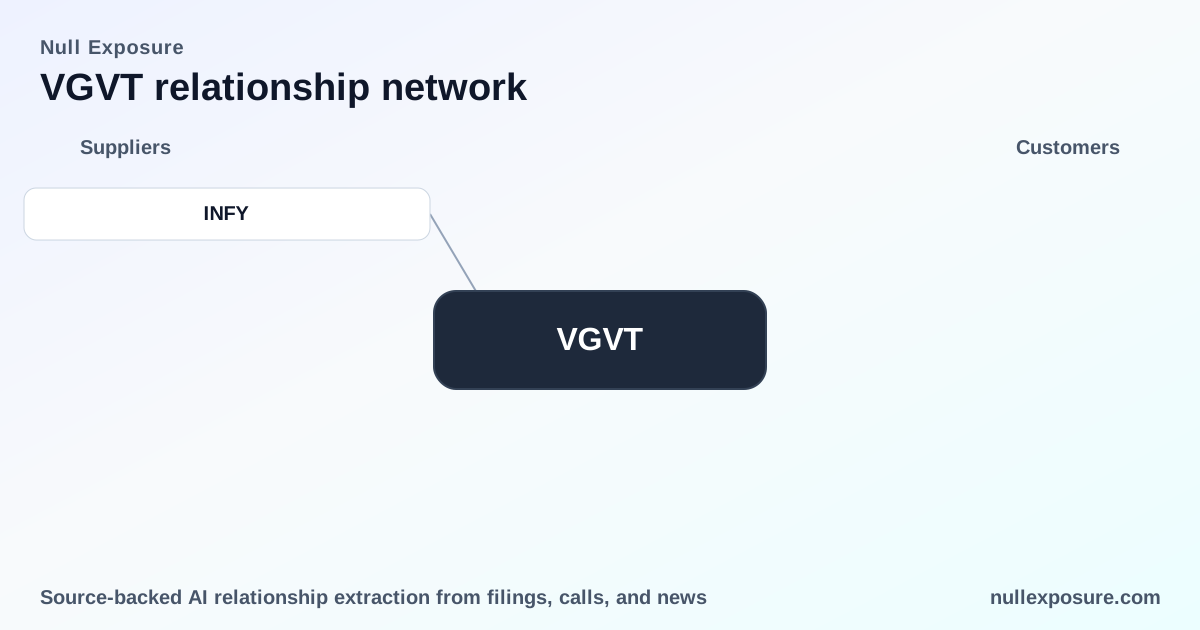
VGVT supplier profile: what investors need to know about third‑party exposure and the Infosys reversal
VGVT operates by contracting and coordinating third‑party providers to deliver critical technology and back‑office services to investor‑facing businesses; it monetizes by retaining service margins, negotiating scale discounts with suppliers, and protecting operating continuity that supports fee generation across its client base. Key value comes from supplier leverage, contract management, and the ability to re‑insource work when labor, regulatory or strategic priorities change. For investors and operators evaluating VGVT supplier risk, the most important signals are supplier concentration, contracting posture, and the real operational criticality of any single provider.
Explore supplier tracking and deeper dossier work at https://nullexposure.com/ — the quickest way to convert raw supplier events into strategic action.
A single, material relationship surfaced in our monitoring — here’s what it means
Infosys — a formerly outsourced provider loses ground
A February 2025 report in Vista.Today documented that Vanguard Group reclaimed hundreds of local jobs that had previously been outsourced to Infosys, indicating a deliberate insourcing move at the Malvern location; that item entered our monitoring on March 10, 2026. This is a clear operational reversal of an earlier outsourcing posture and signals an active decision by VGVT to reduce reliance on that offshore/third‑party arrangement (Vista.Today, Feb 2025; monitored Mar 2026).
- The relationship is classic supplier provisioning: Infosys served as an outsourced technology/back‑office supplier; the news documents a material shift as work returns onshore.
- Source: Vista.Today coverage of Vanguard reclaiming local jobs from Infosys (Feb 2025), captured in monitoring on 2026‑03‑10.
What the headline action reveals about VGVT’s operating model
The Infosys item is short but revealing. When a supplier that has been delivering labor and services is deconsolidated through insourcing, it signals an active procurement and operational strategy rather than passive vendor decay. For investors, that has several implications:
- Contracting posture: VGVT demonstrates an assertive contracting posture — it will re‑negotiate or reverse outsourcing when control, cost, or strategic priorities demand it. That posture reduces the long‑term tail risk of vendor lock‑in but increases near‑term execution risk during transition.
- Concentration and criticality: Even single‑vendor relationships for large enterprise functions are critical because interruptions or transitions affect operations. The Infosys reversal implies that the supplier relationship was operationally material at the Malvern site; replacing or repatriating labor suggests the function was both concentrated and important.
- Maturity of the supplier engagement: The move from outsourcing to insourcing reflects a mature buyer calculus — VGVT has operational experience and the organizational capability to bring functions back in‑house, which is a defensive control against escalating third‑party costs or geopolitical/labor risks.
These are company‑level signals drawn from observed supplier behavior, not an exhaustive audit of all VGVT supplier contracts. For more granular supplier scoring and exposure maps, visit https://nullexposure.com/ to commission a tailored relationship risk assessment.
Constraints and disclosure: what the record does (and does not) show
The available constraints metadata for VGVT contains no explicit constraint excerpts. That absence is itself informative: there are no publicly lodged contractual constraints, regulatory holds, or supplier dispute filings surfaced in this record. In practice, that means:
- Visibility into negotiated termination windows, service‑level offset clauses, and indemnity constructs is limited based on public signals alone.
- Investors should treat the lack of documented constraints as a signal that detailed contractual leverage and exit costs must be validated directly with management or through supplier diligence.
- The insourcing action reported for Infosys, while operationally decisive, was not accompanied by a public constraint filing in the dataset — so the contractual mechanics of the change (termination fees, transition services agreements, staffing rehiring terms) remain to be confirmed.
Practical investment and operational implications
For portfolio managers, operating partners, and risk teams, the Infosys event combined with the lack of public constraints implies a tighter set of follow‑ups:
- Operational continuity is now the prime risk to monitor. Transitioning hundreds of roles onshore typically stresses HR, IT, and service continuity; investors should seek evidence of phased transition planning and third‑party contingency arrangements.
- Cost and margin impacts are imminent. Insourcing often increases near‑term operating costs (recruiting, facilities, training) while preserving long‑term control and potentially improving quality; forecast sensitivity around FY+1 operating margins should be updated accordingly.
- Supplier concentration relief and governance improvement are positives. Reclaiming work reduces single‑vendor dependency and increases bargaining power for future contracts, improving resilience across the cost base.
If you want a structured checklist to stress‑test VGVT’s supplier transitions or to model P&L sensitivity to insourcing, start here: https://nullexposure.com/.
Final takeaways and recommended next steps
- Primary takeaway: VGVT is executing an active supplier strategy — evidenced by the Vanguard‑Infosys reversal — that prioritizes control and local labor retention over pure outsourcing economics. This reduces strategic vendor dependency but introduces short‑term execution and cost risks.
- Disclosure gap: No explicit contractual constraints were returned in the record; investors should treat public signals as incomplete and request direct contractual or transition‑planning disclosure from management.
- Actionable next steps: Validate transition timelines and contingency service levels, stress‑test near‑term cost impacts on margin forecasts, and update supplier concentration metrics to reflect insourcing actions.
For deeper supplier dossiers, impact modeling, and bespoke monitoring solutions that translate supplier events into investment signals, visit https://nullexposure.com/ and request the VGVT supplier package.