VHUB (Vapor Hub International Inc): supplier relationships and what they mean for investors
Vapor Hub International Inc (ticker VHUB) designs, sources and sells smokeless electronic cigarettes and monetizes primarily through hardware and consumable sales to retail channels and direct-to-consumer outlets. The company is a micro-cap, PINK-listed cigarette-electronic supplier with historically thin liquidity and a modest revenue base; strategic supplier relationships that enable payments, distribution or platform integrations have outsized operational impact relative to the company’s enterprise value. For a concise vendor-risk and relationship intelligence feed, visit https://nullexposure.com/.
Quick company profile investors must register
Vapor Hub International is publicly quoted on the PINK market, head‑quartered in Simi Valley, California, with fiscal year-end in June. Reported TTM revenue was $7.03M and gross profit $2.95M, while diluted EPS was negative (-$0.482) on the most recent available snapshot; market capitalization is reported at roughly $236k in the same data extract. The equity base is small (shares outstanding ~472k) with nearly 49% insider ownership, which concentrates control and amplifies the significance of any supplier or platform agreements on cash flows and go‑to‑market execution.
- Key financial signal: low market cap and concentrated insider ownership increase the materiality of supplier and platform relationships.
- Operational signal: reported financials in the snapshot are dated relative to current markets, so active commercial partnerships can be the primary observable lever for near-term revenue growth.
Explore supplier intelligence and relationship summaries at https://nullexposure.com/.
How VHUB’s operating model shapes supplier dependence
VHUB’s business model is a merchant model — it designs and sells physical vaping products and therefore relies on third-party suppliers and commercial platforms for payments, distribution, and scaling retail endpoints. From an investor standpoint, important operating characteristics are:
- Contracting posture: VHUB behaves like a small merchant that requires flexible, modular vendor agreements rather than enterprise, multi-year locked contracts; this reduces fixed commitments but increases execution risk if a key partner changes terms.
- Concentration: the company’s modest revenue base and small equity footprint create outsized dependence on a small set of commercial partners for payment processing, retail access, and distribution.
- Criticality: partners that enable payments or global retail integrations are functionally critical — a change in payment processing or platform access would materially affect order flow and conversion.
- Maturity: corporate scale and public reporting cadence suggest an early-stage commercial profile; supplier relationships are therefore strategic entry points to scale rather than routine procurement line items.
These are company-level signals derived from the supplier-focused record; explicit contractual constraints were not surfaced in the supplier data extract.
Supplier relationships uncovered in the record
The supplier-scope results returned a single counterparty repeatedly: Stripe. Below is the plain-English coverage investors need.
Stripe — expanded payments integration (multiple press entries, Feb–Mar 2026)
News coverage documents an expanded integration between VenHub (reported in press releases) and Stripe, positioning Stripe as the primary payments infrastructure to enable a global rollout of AI-driven smart stores and flexible retail payment options. Several press releases and syndications characterize the arrangement as a formalization of Stripe as the payments backbone to accelerate global expansion and support regional payment requirements (GlobeNewswire, Feb–Mar 2026; Manila Times, Mar 2026; StockTitan aggregation, Mar 2026).
Sources: GlobeNewswire press releases (Feb–Mar 2026), Manila Times coverage of GlobeNewswire (Mar 10, 2026), StockTitan news aggregation (Mar 2026).
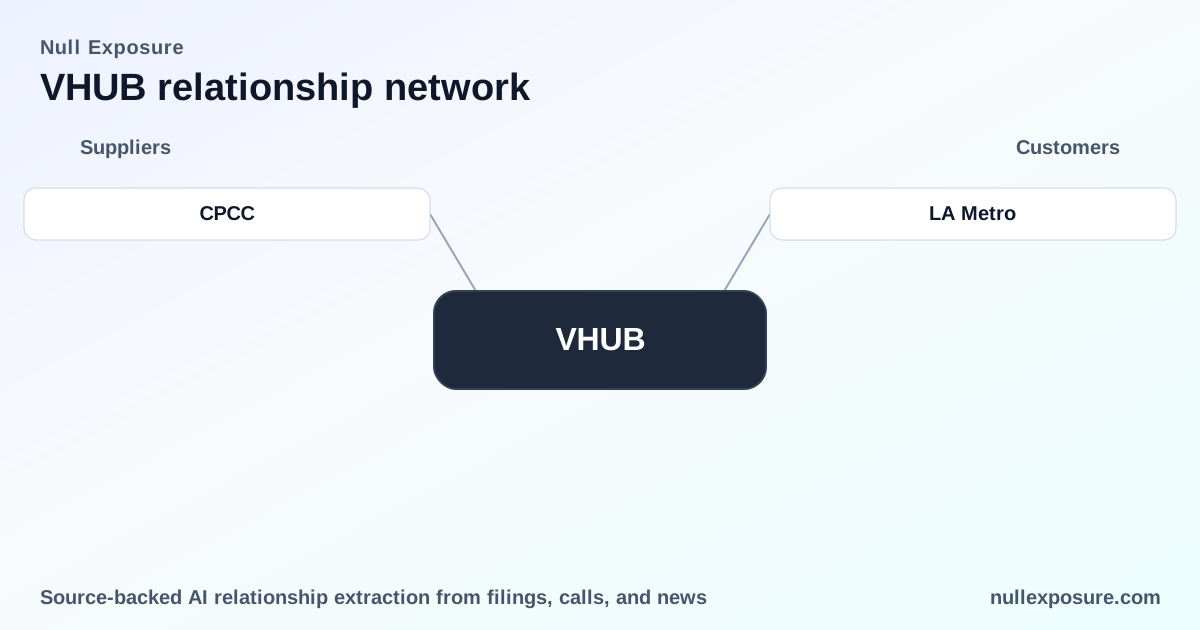
Note: the aggregator metadata associated with these items infers a symbol (CPCC) for the reported counterparty in some feeds; the human-readable articles uniformly reference Stripe as the payments partner.
What the Stripe relationship implies for VHUB investors
The presence of a payments partnership described in public press channels has several clear strategic implications for a small merchant like VHUB:
- Payments infrastructure is operationally critical. If VHUB leverages a single payments partner to process a large share of online or in-store transactions, that partner’s stability, fees and global coverage directly affect unit economics and ability to enter new geographies.
- Scalability lever. A formal Stripe integration is a growth enabler: it lowers friction to accept international card rails and alternative payment methods, which is important given VHUB’s limited internal resources to build payment stack capabilities.
- Concentration and negotiation power. VHUB’s small scale and high insider ownership reduce its bargaining power; terms with a dominant payments partner will materially affect margins and capital allocation.
- Reputational and compliance vector. Payment providers enforce strict compliance for regulated product categories; reliance on a major processor externalizes compliance burden but also introduces a single point of enforcement that could constrain sales if regulatory posture changes.
Key takeaway: an established payments relationship can be a positive growth accelerator, but for a micro‑cap like VHUB it is simultaneously a concentration and compliance risk that investors must monitor closely.
(Additional business intelligence and relationship monitoring services are available at https://nullexposure.com/.)
Tactical investor actions and monitoring checklist
For investors underwriting VHUB’s upside or assessing downside scenarios, prioritize the following actions:
- Verify scope and contract terms for any named payments integration — fee schedules, termination clauses, and regional coverage are the material levers for revenue conversion.
- Monitor regulatory enforcement trends for vaping products in key target markets; payment partners often act as effective gatekeepers.
- Track press-calendars and filings for updates; in thinly traded micro-caps, new supplier announcements move revenue expectations rapidly.
Suggested next step: For continuous, supplier-level monitoring and relational intelligence, see the research portal at https://nullexposure.com/.
Closing assessment
Vapor Hub International operates with a compact financial base and concentrated ownership, which makes supplier relationships disproportionately influential on near-term performance. The records show multiple press entries linking Stripe as a primary payments partner in early 2026 — a meaningful operational development that can materially affect route-to-market economics. Investors should treat payments integrations as both an enabler and a single point of systemic risk and restrict valuation upside assumptions until contract terms and compliance posture are public and verified.
For curated supplier intelligence and ongoing monitoring of VHUB and comparable micro-cap suppliers, visit https://nullexposure.com/.