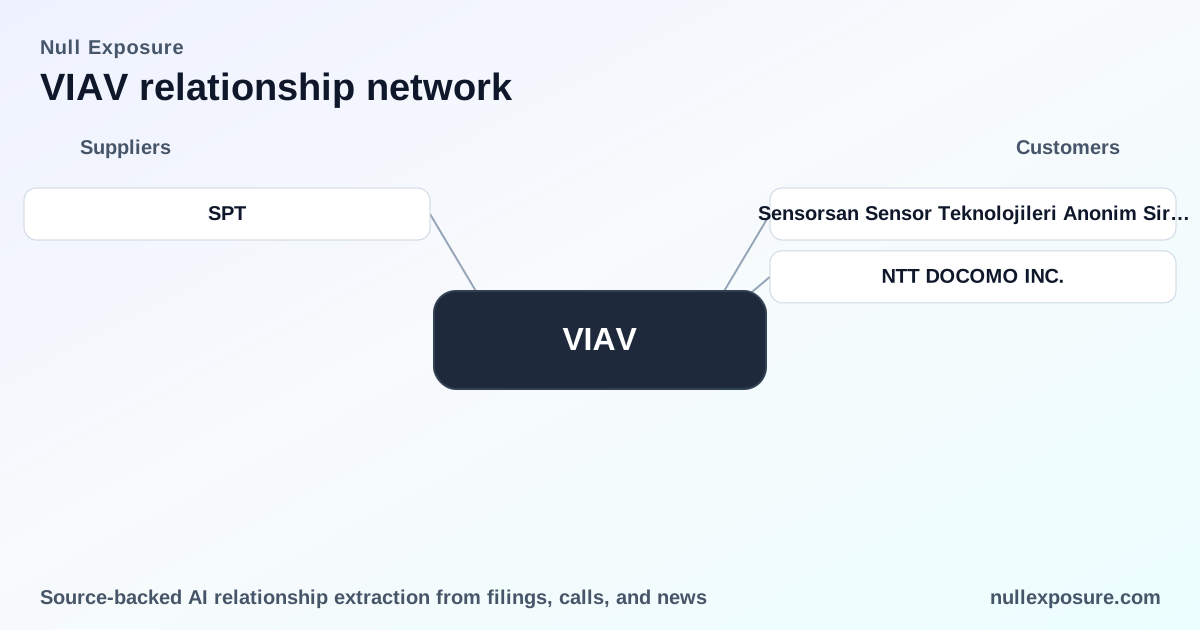
Viavi Solutions (VIAV): Supplier posture, strategic moves, and what investors must price in
Viavi is a specialty telecommunications equipment and software provider that monetizes through sales of network test, monitoring and assurance hardware and software, plus services and maintenance contracts to carriers, equipment manufacturers and government customers; the company generates roughly $1.24 billion in trailing twelve‑month revenue and converts gross margins into mid‑single digit operating profitability today. Revenue comes from product sales and follow‑on service/maintenance relationships, and M&A activity is an explicit lever to expand addressable markets in high‑speed validation.
For active diligence on supplier exposure and partner dynamics, visit https://nullexposure.com/.
How Viavi runs the supply side and how that affects revenue durability
Viavi’s operating model blends proprietary test equipment and software with outsourced manufacturing and third‑party sub‑assemblies. The company discloses that it relies on a limited set of suppliers and contract manufacturers for key components and subassemblies, and it maintains significant manufacturing capacity across multiple regions. This hybrid model supports product breadth while keeping fixed manufacturing investment light, but it creates concentration and operational dependency that investors must underwrite.
Key financial context: Viavi reports $1.2437B revenue TTM, $740.4M gross profit TTM, and an operating margin around 10.3% TTM. These figures reflect a business that is profitable at the operating level, but exposed to supply‑side swings because margin stability depends on input continuity and timely contract fulfilment.
Supplier relationships in the public record (what the research finds)
Below I cover every supplier/partner relationship surfaced in the results for Viavi.
- Spirent (inferred SPT): Viavi acquired Spirent’s H‑S Testing business, positioning Viavi as a leading player in high‑speed Ethernet validation, an acquisition used to expand product capability and market share in validation tools. This was reported in March 2026 commentary noting the strategic fit following outperforming consensus forecasts. Source: a March 10, 2026 news piece on InsiderMonkey discussing the Spirent H‑S Testing acquisition.
What the company filing reveals about contracting posture and concentration
The company’s public filings and disclosures give clear signals about procurement practices and supplier risk:
-
Contracting posture is short‑term. Viavi states that it generally purchases single or limited‑source products via standard purchase orders or one‑year supply agreements and has no significant long‑term guaranteed supply agreements with such vendors. This structure preserves flexibility but increases exposure to spot price and availability shocks. Source: company filing disclosures (as of June 28, 2025).
-
Manufacturing footprint is geographically diversified but APAC‑heavy for partners. Viavi lists significant manufacturing facilities for its NSE and OSP segments in China, France, Germany, the UK and the U.S., while naming China and Thailand as locations for its most significant contract manufacturing partners. That mix reduces single‑country operational risk for finished assembly but concentrates critical subcontracting in APAC. Source: company filing (June 28, 2025).
-
Supplier role is critical: manufacturer dependency. Viavi relies on a limited number of suppliers and contract manufacturers for key components and sub‑assemblies contained in its products, which makes those supplier relationships highly critical to product delivery. Source: company filing (June 28, 2025).
-
Spend and commitment level are nontrivial. Of $160.7 million of purchase obligations as of June 28, 2025, $75.7 million relate to inventory and $85.0 million to non‑inventory items—indicating >$100 million in committed procurement and a sizable near‑term cash exposure to suppliers. Source: company filing (June 28, 2025).
What these constraints mean for investors: risk and optionality
The combination of short‑term contracting, concentrated manufacturing partners in APAC, and meaningful purchase obligations shapes Viavi’s risk profile and strategic optionality:
-
Execution and continuity risk is elevated. Short contracts and supplier concentration create vulnerability to supplier disruptions, capacity rationing, or price inflation—factors that can compress gross margins quickly in capital‑equipment cycles.
-
M&A and product expansion are compensating drivers. The Spirent H‑S Testing acquisition expands Viavi’s product set into high‑speed Ethernet validation—a move that strengthens competitive positioning and could raise long‑term revenue per customer if integration preserves cross‑sell economics. Source: InsiderMonkey, March 2026.
-
Supply diversification is in place but bears watching. Manufacturing locations across multiple countries provide resilience for finished assembly, yet reliance on contract manufacturers in China and Thailand leaves the company exposed to APAC labor, logistics and geopolitical dynamics.
For further scenario work on how supplier concentration affects valuation, see research and tools available at https://nullexposure.com/.
Practical investor takeaways and monitoring checklist
-
Monitor supplier contract terms and duration. Short‑term purchasing gives management agility, but investors should track whether contracts lengthen or firms hedge through inventory or long‑lead purchases. Company filings as of June 28, 2025 explicitly describe the one‑year supply posture.
-
Track integration milestones for the Spirent H‑S Testing business. Integration success will determine whether the acquisition lifts market share and margin mix in high‑speed validation. News coverage in March 2026 highlighted the transaction as a capability boost.
-
Watch APAC supply signals. Shipping costs, capacity utilization at Chinese and Thai contract manufacturers, and regional policy developments will flow directly to gross margin volatility.
Bottom line: a supplier‑dependent equipment business with strategic growth levers
Viavi operates a capital‑equipment and services business that scales via technical breadth and targeted acquisitions while retaining supplier and manufacturing exposure that requires active monitoring. The Spirent H‑S Testing acquisition strengthens product breadth and addresses higher‑value validation markets; however, short contract tenors and concentrated contract manufacturing in APAC are the principal supplier risks that should factor into any investment thesis.
Explore deeper supplier analytics and monitoring tools at https://nullexposure.com/ to convert these risks into actionable investment signals.
For investors allocating to communications test and assurance, Viavi presents a clear trade‑off: attractive product expansion and healthy operating margins today versus execution risk tied to short supplier contracts and APAC manufacturing concentration. Closing diligence should focus on contract term evolution, inventory strategy, and integration metrics for announced acquisitions.