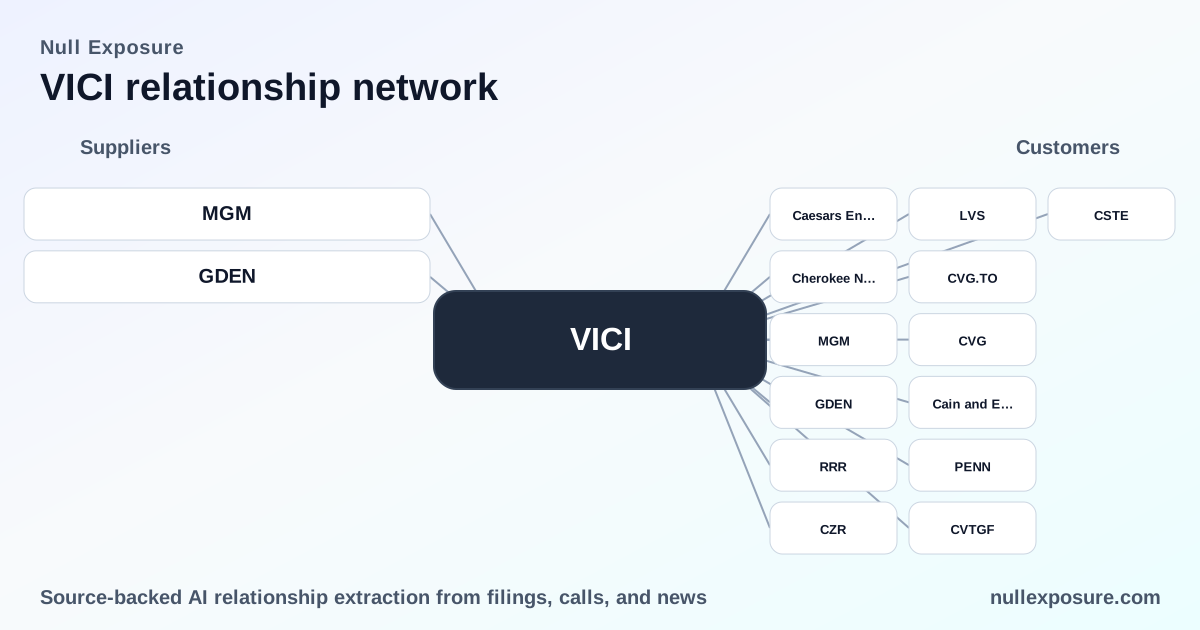
VICI Properties: Real estate cashflow anchored to casino operators and strategic Nevada acquisitions
VICI Properties operates as an experiential real estate investment trust that owns and leases market-leading gaming, hospitality and entertainment assets to operating partners, generating rent and fee income primarily through long-term leases and property sales/repurchases. The company monetizes by converting operating casino real estate into stable, predictable lease cash flows supported by high-quality tenants, and by strategically acquiring complementary assets—most recently a portfolio of Nevada casinos—to expand its revenue base and geographic footprint. If you evaluate landlord-operator exposure in gaming real estate, VICI’s contract terms, tenant concentration, and recent M&A activity warrant focused due diligence. For deeper supplier and relationship intelligence, visit https://nullexposure.com/.
How VICI’s model produces predictable yield for investors
VICI is a capital allocator and landlord: acquire real estate tied to gaming and hospitality, execute long-term leases (often triple-net), and collect staggered, contractual rental streams. The REIT reports strong margins and cash generation—FY TTM revenue of roughly $4.0 billion and EBITDA of $3.65 billion—supporting a dividend yield north of 6% on reported metrics. Contractual lease structures produce high operating margins and profit conversion; institutional ownership is very high (99.65% institutions), underscoring investor reliance on stable payout mechanics and landlord risk profiles rather than direct gaming operations.
What the relationships tell investors about concentration and counterparty risk
VICI’s business is counterparty-dependent: tenant credit and regional tourism flows drive landlord cash flow. The company itself discloses that a concentrated subset of assets on the Las Vegas Strip account for a material share of lease revenue—this has implications for tail risk if Strip demand weakens or a major operator faces distress.
- According to VICI’s 2024 Form 10-K, properties on the Las Vegas Strip generated roughly 48% of lease revenue in 2024 (49% in 2023, 45% in 2022), underscoring meaningful concentration in one regional market.
Relationship coverage — what each reported link means for investors
MGM Resorts International
- VICI’s 2024 filing highlights that Las Vegas Strip properties are a material source of lease income, which is driven in part by relationships with major operators such as MGM Resorts; this concentration implies both strong cash conversion when Strip demand is healthy and amplified downside if Strip revenues compress. (Source: VICI Form 10-K, FY2024)
Golden Entertainment — The Globe and Mail press release
- VICI agreed to acquire 100% of the land, real property and improvements of seven Golden Entertainment casino properties in Nevada for $1.16 billion, a transaction that expands VICI’s Nevada footprint and shifts those assets onto VICI’s balance sheet. (Source: The Globe and Mail press release, reported March 2026)
Golden Entertainment — Bitget summary
- Coverage from Bitget reiterated that VICI will purchase land, buildings and improvements of seven Nevada casino properties from Golden Entertainment for $1.16 billion, confirming the transaction terms and the strategic acquisition emphasis on Nevada gaming real estate. (Source: Bitget news article, March 2026)
Golden Entertainment, Inc. — StockTitan reporting
- StockTitan’s report noted the broader corporate restructuring at Golden, including a pending sale of operating assets to Golden’s leadership and the sale of seven casino real estate assets to VICI, contextualizing the deal as part of Golden’s larger recapitalization and asset-cycle activity. (Source: StockTitan, March 2026)
Golden Entertainment — Travel and Tour World analysis
- Travel and Tour World framed the sale of Golden’s casino real estate to VICI and operating-asset changes as a potential reshaper of Nevada tourism impact, indicating the transaction’s regional economic significance beyond a simple landlord-tenant transfer. (Source: Travel and Tour World, March 2026)
Contracting posture, concentration, criticality and maturity — constraints that shape VICI’s risk profile
VICI’s filings and public descriptions reveal company-level constraints that define its operating posture:
- Contracting posture: VICI employs a risk-based approach to third‑party oversight and typically structures long-term, landlord-friendly lease agreements that transfer operating risk to tenants, while retaining asset-level control and protections. This is reflected in its diligence and vendor/governance practices described in corporate disclosures.
- Concentration: Material exposure to the Las Vegas Strip (nearly half of lease revenue recently) creates a concentrated revenue base that amplifies macro or regional tourism risk.
- Criticality: Tenant operations are critical to cashflow; VICI’s revenue is operationally dependent on tenant performance rather than direct hotel or casino operations, making counterparty credit and operational continuity essential.
- Maturity: As an established REIT with significant institutional ownership and repeatable acquisition activity, VICI’s operating model is mature—growth is execution-driven via acquisitions and lease restructurings rather than early-stage organic expansion.
Additionally, VICI states it uses vendor questionnaires and ongoing due diligence for third-party service providers, indicating formalized vendor risk management as part of its control environment (company-level signal from corporate governance disclosures).
Investment implications and what to watch next
- Upside thesis: The Golden Entertainment acquisition for $1.16 billion increases scale in Nevada and is consistent with VICI’s strategy of buying high-quality gaming real estate to generate stable rent. Higher institutional ownership and attractive valuation multiples (trailing P/E ~10.97, P/B ~1.1) support yield-focused investor demand.
- Key risks: High Strip concentration, reliance on tenant operating health, and potential regional volatility in tourism/casino revenues are principal vulnerabilities. Contractual protections in leases reduce but do not eliminate operational contagion risk.
- Operational signals to monitor: tenant cash flow and covenant compliance, occupancy/lease renewal cadence, and the integration of newly acquired assets into VICI’s lease portfolio.
For detailed, transaction-level supplier and relationship intelligence that supports underwriting and operational risk assessment, explore the platform at https://nullexposure.com/.
Final takeaways and next steps
VICI is a yield-first REIT that leverages long-term leases with top-tier gaming operators to produce predictable cash flow; recent Nevada acquisitions broaden that base but also reinforce geographic concentration. Investors and operators should focus on tenant credit, lease terms, and Strip demand cycles when evaluating VICI exposure. For curated relationship intelligence and supplier analytics tailored to institutional underwriting, learn more at https://nullexposure.com/.
Key takeaway: VICI’s cash flows are robust and contractual, but concentration and tenant-criticality are the clearest single-source risks for investors assessing downside scenarios.