Vicor Corporation (VICR): Supplier posture and partner map for investors
Vicor designs, develops and manufactures modular power components and power systems used across industrial, data center, telecom and advanced computing applications; it monetizes by selling high-margin proprietary converters and power modules and by retaining intellectual property control over packaging and integration. With FY‑TTM revenue of roughly $408 million and a market capitalization near $8.4 billion, Vicor operates a high-margin, capital‑intensive manufacturing model whose economics depend on specialty component sourcing, outsourced wafer and packaging partners, and consistent investor communications to support a premium valuation.
Explore more supplier intelligence at https://nullexposure.com/.
Why supplier relationships matter for Vicor's valuation and risk profile
Vicor’s business model is manufacturing-led with concentrated critical inputs. The company’s own disclosures highlight that certain semiconductor devices for Advanced Products are produced by a limited number of wafer foundries and that some key components are single‑sourced. That structure creates three linked characteristics for investors: high supplier concentration, operational criticality of a small supplier group, and limited substitutability for specific advanced components. These are company-level signals drawn from Vicor’s regulatory disclosures.
- Contracting posture: Vicor operates as a specialized OEM with long-term supplier dependencies for advanced process nodes and packaging/test services; procurement leverage is meaningful for commodity parts but limited for single‑source, wafer‑dependent items.
- Concentration and criticality: A small number of third‑party foundries and packagers represent potential single points of failure for product ramps and quality control.
- Maturity and mitigation: The business shows established manufacturing capability and strong gross margins, but supplier concentration requires active mitigation through inventory strategy, dual sourcing where possible, and contractual safeguards.
These operating characteristics should be weighed against the company’s financial profile—~29% net margin and 15% operating margin with elevated valuation multiples (trailing P/E ~71, EV/EBITDA >70)—which price in durable performance and low execution risk. Any supplier disruption therefore has outsized implications for near-term earnings and longer-term multiple compression.
Publicly visible supplier and service relationships
Below are every relationship surfaced in public records for the supplier scope. Each entry is summarized in plain English with a source note.
-
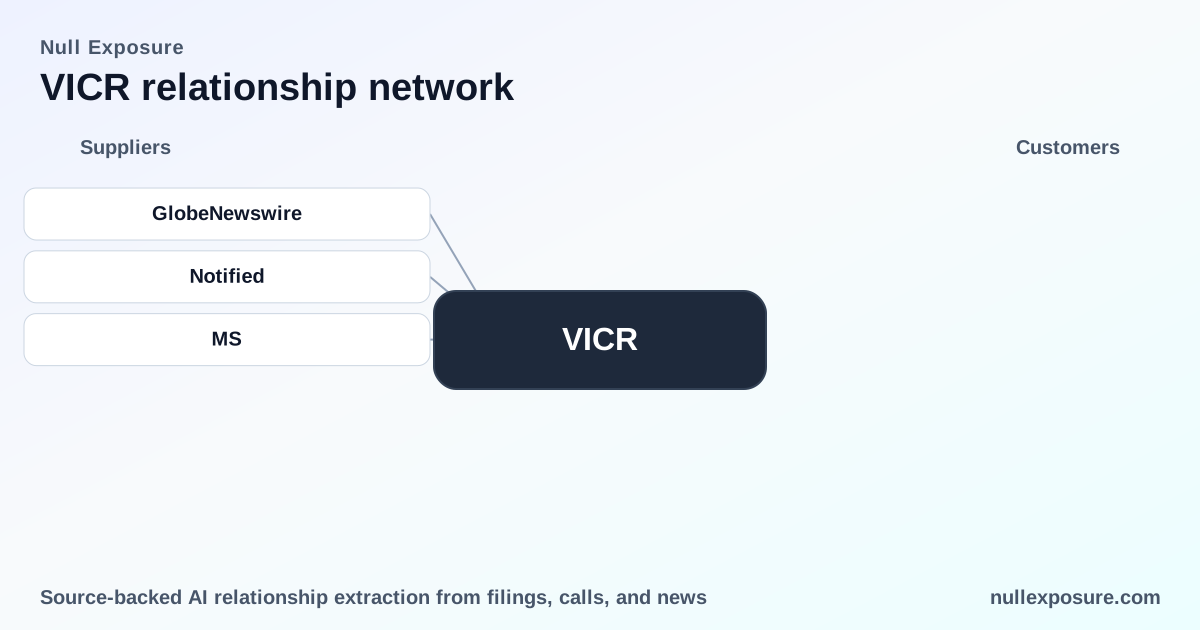
GlobeNewswire — Vicor uses GlobeNewswire to distribute investor releases and host its earnings announcement; the company disclosed that fourth-quarter results will be released via GlobeNewswire and posted to the Investor Relations page. Source: GlobeNewswire press release (distributed via The Manila Times, February 2026).
-
Notified — Vicor directs investors and analysts to register questions and participate in its earnings conference calls through Notified, the service provider hosting the call registration and webcast. Source: Company conference call notice (distributed via The Manila Times and The Globe and Mail, February 2026).
-
Morgan Stanley Smith Barney LLC — Brokerage execution for disclosed stock transactions was routed through Morgan Stanley Smith Barney LLC, indicating use of established institutional brokers for cash consideration execution in reported trades. Source: SEC filing reporting execution details (published via StockTitan summary, FY2026).
What each relationship means for operations and investor monitoring
GlobeNewswire and Notified are communication and IR service providers rather than material operational suppliers; their importance is to ensure transparent, timely disclosure and to support liquidity by facilitating analyst and investor access. Expect routine vendor switching for distribution services, but also expect Vicor to standardize on providers that can handle NASDAQ-level disclosure and webcast requirements. Source context: press release distribution and conference call registration notices (Feb 2026).
Morgan Stanley Smith Barney LLC’s appearance in filings reflects brokerage execution for equity transactions—a normal operational detail for institutional trading, insider sales, or block trades. This is not a manufacturing dependency but is relevant to governance and market‑access monitoring because the choice of broker can affect block execution timing and reporting. Source: SEC transaction filing (FY2026).
Key takeaway: Operational risk centers on semiconductor foundries and packaging/test service providers documented in company disclosures, not on IR vendors or retail brokers; however, investor-facing vendors are material for communications reliability and market perception.
Explore supplier concentration analysis and counterparty risk services at https://nullexposure.com/.
Constraints that drive vulnerability and strategic priorities
Company-level disclosures state: "Certain Advanced Products and semiconductor devices used in our production are manufactured by a limited number of wafer foundries, with packaging and test services provided by a limited number of third parties," and that "some key components for certain Advanced Products... are supplied by single vendors." These statements translate to actionable constraints:
- Single‑source dependency for advanced components increases supply interruption risk during demand spikes or geopolitical events.
- Limited third‑party foundry/packaging capacity elevates the likelihood of production bottlenecks during product ramps.
- Procurement leverage is asymmetric: Vicor controls design and IP, but for specific process nodes and packaging capabilities it relies on a few external providers.
Investors should monitor contract disclosures, inventory days, lead times, and any supplier diversification programs disclosed in quarterly filings. These are the direct levers management can use to reduce execution risk.
Practical monitoring checklist for operators and investors
- Track supplier mentions in each 10‑Q/10‑K and earnings call for changes to foundry or packaging partners.
- Watch lead-time commentary and backlog details for Advanced Products as an early indicator of sourcing stress.
- Review insider transaction filings and broker execution channels to detect large stake moves that could presage strategic capital actions.
- Evaluate gross margin trends against supplier cost pass‑throughs; sustained margin pressure points to sourcing or pricing issues.
Priority risks: supplier concentration for advanced semiconductors, capacity limits at wafer foundries and packagers, and potential single‑vendor interruptions for critical components.
Bottom line and recommended investor actions
Vicor’s manufacturing-led model delivers high margins and a premium valuation, but it is structurally exposed to a narrow set of manufacturing suppliers for Advanced Products. Investors should treat supplier disclosures as a first-order risk and incorporate supplier-concentration scenarios into valuation stress tests. For active monitoring and counterparty exposure analysis, consider conducting periodic checks of Vicor’s regulatory filings, earnings transcripts, and vendor announcements.
For deeper supplier-mapping and continuous monitoring, visit https://nullexposure.com/. If you want tailored supplier risk scoring for Vicor and comparable electromechanical suppliers, start here: https://nullexposure.com/.
Final note: Vicor’s growth profile and profitability justify premium multiples only if the company sustains reliable sourcing for advanced components; track supplier-related language in each quarterly report as a leading indicator of execution risk.