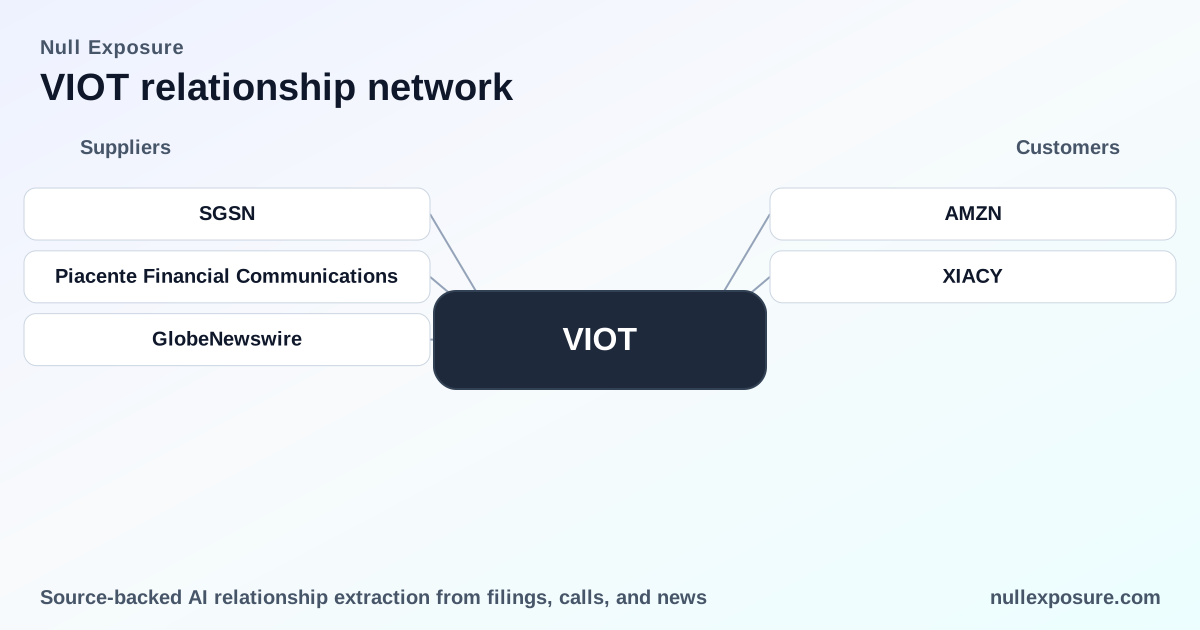
Viomi Technology (VIOT) — supplier relationships, certifications, and what they mean for investors
Viomi Technology develops and sells IoT-enabled smart-home appliances in China and monetizes primarily through hardware sales of devices (water purifiers, kitchen and home appliances) and the associated after‑sales ecosystem that drives recurring consumable replacement and platform engagement. With industry‑level gross margins and a low market capitalization relative to revenue, the firm’s valuation profile depends on product credibility, third‑party validations, and investor communications that support adoption and channel distribution.
Want a deeper supplier-risk and certification view for procurement and investment teams? Visit https://nullexposure.com/ for structured supplier intelligence.
Financial snapshot that frames supplier importance
Viomi reports Revenue (TTM) of ~RMB 2.76 billion and a market capitalization around USD 101 million, producing a trailing P/E of ~3.7 and an operating margin near 8%. The combination of high revenue scale and low market cap signals a business where product credibility and third‑party trust validators (like testing houses and press distribution partners) materially affect revenue durability and pricing power. For investors and operators, certification and media control are value multipliers: they protect unit sell‑through, justify pricing on premium models, and underpin after‑sales consumable spending.
How the supplier relationships found in public sources map to Viomi’s business
Below I cover every relationship documented in the public results set; each entry is presented as a concise, plain‑English summary with the source referenced.
-
SGS — (news item focused on filtration testing, FY2025) Viomi’s 9‑Stage Filtration System is described as tested by SGS to reduce contaminants including TDS, PFOA, PFOS, chlorine, lead, and microplastics, a credential that supports product claims and retail positioning. Source: Yahoo Finance coverage of Viomi product claims (first seen Mar 10, 2026) — https://sg.finance.yahoo.com/news/pure-water-pure-love-viomi-164500294.html.
-
SGS — (product certification claim, FY2025) The VORTEX V6 purifier is promoted with SGS certification against NSF/ANSI 372, 53, and 42 standards, which is an explicit trust signal for water‑quality buyers and channel partners. Source: StockTitan press coverage (first seen Mar 10, 2026) — https://www.stocktitan.net/news/VIOT/viomi-unveils-black-friday-transform-your-tap-water-with-ai-water-xej0p0xsutc2.html.
-
Piacente Financial Communications — (investor relations contact, FY2026 announcement) Viomi distributed a routine earnings‑release notice advising investors and media to route inquiries to Piacente Financial Communications (with contact details for China and the U.S.), demonstrating outsourced investor‑relations support for its FY2025 results announcement. Source: Quiver Quant news aggregation of a Viomi release (first seen Mar 10, 2026) — https://www.quiverquant.com/news/Viomi+Technology+Co.%2C+Ltd+to+Announce+Financial+Results+for+2025+on+March+25%2C+2026.
-
GlobeNewswire — (distribution channel for corporate press release, FY2026) The same earnings announcement was distributed via GlobeNewswire, and the aggregator noted a disclaimer that the release summary was AI‑generated, highlighting modern distribution practices and the presence of auto‑summarization in investor communications. Source: Quiver Quant’s repost noting the GlobeNewswire distribution and disclaimer (first seen Mar 10, 2026) — https://www.quiverquant.com/news/Viomi+Technology+Co.%2C+Ltd+to+Announce+Financial+Results+for+2025+on+March+25%2C+2026.
Why these relationships matter operationally
The relationships above are clustered around two functional roles: product validation/certification (SGS) and investor/media distribution (Piacente, GlobeNewswire). Each plays a different operational role:
-
Certifications are a commercial lever. Third‑party testing (SGS) converts product engineering into retailer and consumer trust, which directly affects sell‑through in appliances where safety and performance are purchase determinants. SGS validations against NSF/ANSI standards are particularly meaningful in water purification, where regulatory credibility reduces buyer friction.
-
Communications partners scaffold investor access. Outsourced PR/IR distribution through Piacente and GlobeNewswire standardizes messaging and broadens reach to North American and Chinese investor communities, which matters for capital access and secondary market liquidity.
If you want supplier‑level due diligence and certification lineage mapped into procurement risk scores, see https://nullexposure.com/ for tailored supplier reports.
Company‑level operational signals and constraints
There were no explicit constraints listed in the results set; that absence is itself a signal: Viomi’s public disclosures emphasize product testing and regular investor communications rather than complex supplier‑contract footnotes. From a company‑level perspective:
-
Contracting posture: Product delivery appears anchored in standard B2C hardware agreements and certification pipelines rather than bespoke manufacturing alliances. This implies repeatable sourcing and a predictable certification cadence.
-
Concentration and criticality: Certification bodies (like SGS) are critical for market acceptance; a small number of recognized testing partners can have outsized influence on distribution and retail placement.
-
Maturity: The use of established certifiers and professional IR distributors indicates commercial maturity—Viomi runs mainstream product validation and investor‑relations practices rather than experimental go‑to‑market channels.
-
Visibility risks: Reliance on public certifications and press distribution means reputation and results‑timing are visible levers; negative test results or miscommunicated earnings could disproportionately affect short‑term investor sentiment.
Investment and operational takeaways
- Trust anchors growth: SGS certifications are not cosmetic; they are core to maintain price realization in higher‑margin product lines (water purifiers). Monitor certification renewals and any scope changes.
- Communications discipline matters: Professional IR distribution is in place; investors should read releases on primary channels (GlobeNewswire) rather than second‑hand summaries.
- Valuation disconnect: Given Revenue TTM ≈ RMB 2.76bn and market cap ≈ USD 101m, Viomi’s multiples imply the market prices meaningful execution risk—investors should track certification and channel execution as leading indicators of revenue retention.
- Operators should prioritize supplier verification: Procurement and category managers should require proof of current SGS/NSF certifications for water products before scaling channels.
Ready to convert supplier and certification signals into actionable risk scores? Explore tailored supplier intelligence at https://nullexposure.com/.
Bottom line
Viomi’s public footprint shows two complementary operational pillars: robust third‑party product validation (SGS) that underpins consumer trust and professionalized investor/media distribution (Piacente, GlobeNewswire) that manages capital‑market narratives. For investors, certification continuity and clear, timely earnings communications are the highest‑leverage signals to watch next; for operators, those same items determine channel acceptance and pricing power. For more structured supplier analysis and to monitor these relationships continuously, visit https://nullexposure.com/.