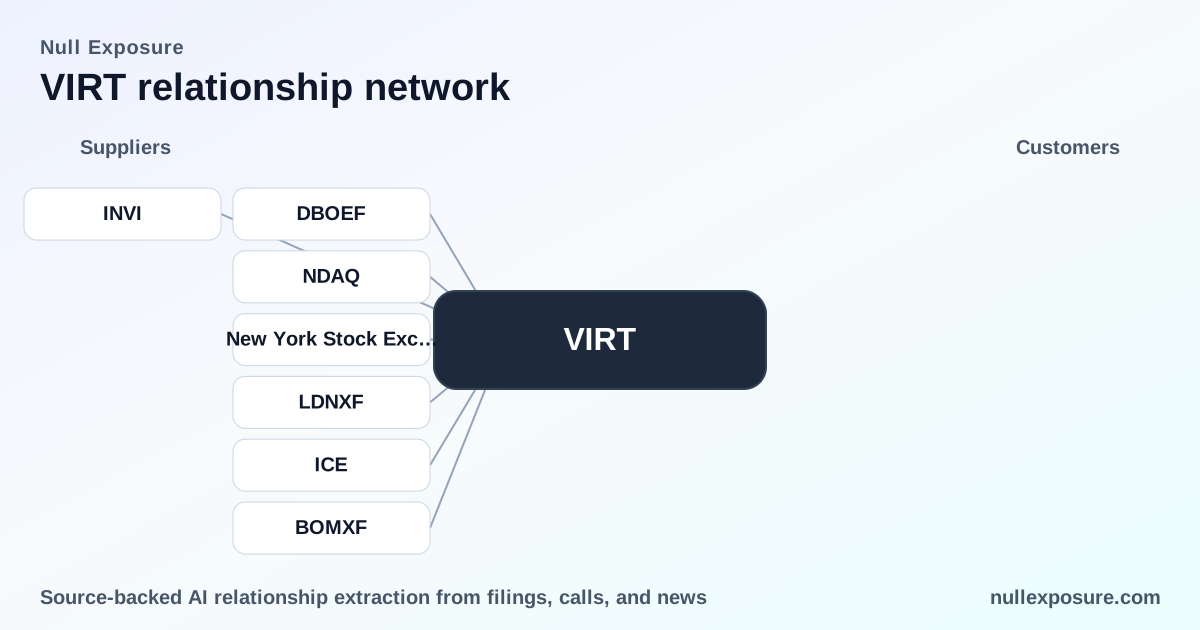
Virtu Financial (VIRT) — supplier relationships and what they mean for counterparties
Virtu Financial operates as a global electronic market maker and execution services provider, selling liquidity, execution technology, data and connectivity to institutional clients while earning revenue from trading profits, execution fees and subscription-style connectivity products. The firm monetizes through a mix of market-making spread capture and platform services, supported by scale across venues and high-frequency execution capacities, producing multi-billion dollar revenue and mid‑teens net margins. For counterparty managers evaluating Virtu as a supplier, the key questions are venue footprint, clearing and prime-broker dependencies, and the operational posture implied by those relationships. For a deeper view into counterparties and venue linkages visit https://nullexposure.com/.
How Virtu shows up in public coverage
Virtu’s public relationship mentions in the sources reviewed are dominated by exchange listings and market-structure partners, plus an emerging digital-asset liquidity role. The aggregated signals show Virtu as a global, B2B service provider that relies on established clearing infrastructures and partners with multiple exchanges and market utilities. Below I list each relationship captured in the source set with a concise, plain-English summary and the cited source.
Supplier relationships identified
Deutsche Boerse AG
Simply Wall St records a Deutsche Boerse AG entry tied to class A common stock listings dated April 2015, indicating Virtu's historical linkage to European venue listings. According to Simply Wall St (entry first seen March 10, 2026), Deutsche Boerse is recorded in Virtu’s venue list.
Nasdaq Stock Market LLC
A news release covering Virtu’s planned transfer of its listing thanked Nasdaq for a decade of partnership since the IPO, signaling an established operational relationship with Nasdaq as its prior listing exchange. The fxnewsgroup report covering Virtu’s listing move (first seen March 10, 2026) quotes Virtu thanking Nasdaq for support.
New York Stock Exchange
Simply Wall St includes the New York Stock Exchange as a listed venue for Virtu’s class A shares, reflecting the company’s current or target primary listing status in the U.S. market. This venue entry is recorded on Simply Wall St (accessed March 10, 2026).
New York Stock Exchange (NYSE) — market reception
Separate coverage quotes the NYSE welcoming Virtu as an NYSE-listed company and notes Virtu’s long-standing partnership with the exchange, underscoring the strategic significance of the transfer to NYSE for market access and branding. The fxnewsgroup article reporting the listing transition and NYSE statements was first seen March 10, 2026.
London Stock Exchange
Simply Wall St lists the London Stock Exchange in Virtu’s cross‑market footprint (entry dated April 2015), indicating historic or administrative ties to LSE venue listings for its class A shares. This listing is shown on Simply Wall St (accessed March 10, 2026).
Bolsa Mexicana de Valores
The Bolsa Mexicana de Valores is recorded in Simply Wall St as part of Virtu’s international venue map for class A common stock, pointing to a broad cross-border registration or listing presence. The Bolsa Mexicana entry appears in Simply Wall St (accessed March 10, 2026).
Integral (crypto prime brokerage PrimeOne)
Integral’s PrimeOne launch lists Virtu as one of the live customers and liquidity providers for a stablecoin-based crypto prime brokerage, placing Virtu into the clearest public evidence of active participation in digital-asset liquidity provisioning. The fxnewsgroup report on Integral PrimeOne (first seen March 10, 2026) names Virtu among initial liquidity providers.
Constraints and what they imply about Virtu’s operating posture
The disclosure excerpts and metadata offer company-level constraints that clarify how Virtu contracts and where operational risk concentrates:
-
Global footprint and service-provider posture. Management states that Virtu “continually monitor[s] the credit quality of our prime brokers and rely on large multinational banks for most of our execution and clearing needs globally,” which is a direct company signal that Virtu operates as a global service provider and depends on large banks for clearing and execution. This is a company-level characteristic sourced from Virtu’s own disclosures and reflected in the constraints summary.
-
Contracting and counterparty concentration. Reliance on large multinational prime brokers and banks implies a B2B contracting posture with long-standing, institutional counterparties rather than retail or fragmented vendor relationships; counterparty concentration and credit monitoring are therefore material operational risks.
-
Criticality and maturity. Virtu’s role as a liquidity provider across major exchanges and its listing transitions indicate mature, systemic counterparty relationships that are operationally critical for both market access and execution quality. The company’s sizable revenue base and institutional ownership (more than 90% institutional holders) further support the profile of a systemically integrated supplier.
-
Implication for counterparties. For counterparties evaluating exposure, the combination of multi-exchange participation, prime-broker reliance, and active involvement in crypto liquidity provisioning means operational resilience, counterparty credit, and venue access are the principal diligence vectors.
Key takeaways for investor and operator diligence
-
Venue diversification reduces single‑exchange dependency but increases operational complexity. Virtu’s presence across NYSE, Nasdaq, LSE, Deutsche Boerse and Bolsa Mexicana de Valores spreads market access but requires robust cross‑jurisdictional clearing arrangements (source: Simply Wall St listings and management commentary).
-
Prime-broker credit quality is a first-order risk. Management explicitly monitors prime-broker credit and relies on multinational banks for clearing, making prime-broker counterparty health a governance focus for counterparties (company disclosures summarized in constraints).
-
Expanding into digital assets creates new counterparty dynamics. Participation as a liquidity provider in Integral’s PrimeOne stablecoin prime-brokerage shows Virtu is extending from classical venues into crypto markets, which introduces different custody, settlement and operational risk profiles (fxnewsgroup coverage of Integral PrimeOne).
For practical next steps, counterparties should verify clearing and netting arrangements with Virtu, request prime broker and collateral terms, and map venue-level failover processes. For a structured, counterparty-focused investigation toolkit and deeper supplier maps, visit https://nullexposure.com/.
Conclusion — what to watch and how to act
Virtu is a high‑scale, institutional service provider whose value to counterparties rests on speed, venue breadth and clearing relationships. The most material supplier risks are prime-broker credit, cross‑venue settlement complexity, and the operational controls that support new digital-asset activities. Investors and operators should prioritize counterparty credit checks, ask for SLAs around execution and settlement, and confirm continuity plans for cross‑venue trading.
To explore a comprehensive counterparty map and prioritize your due diligence agenda, see the platform resources at https://nullexposure.com/. For bespoke supplier relationship reviews and exchange-level exposure analysis, get started at https://nullexposure.com/.