Vital Farms (VITL) supplier relationships: what investors need to know
Vital Farms operates as a branded consumer food company that buys eggs under long-term buy‑sell contracts from a network of family farms, outsources manufacturing of several product lines to co‑manufacturers, and relies on third‑party logistics and cold storage providers to move finished goods to market. The company monetizes by packaging and selling higher‑margin branded egg and egg‑adjacent products, capturing value through brand premium and scale while locking supply through multiyear contracts with producers. For deeper supplier analytics and counterparty mapping, visit https://nullexposure.com/.
The investment thesis in one paragraph
Vital Farms’ supply chain is contractually anchored and capital‑intensive: long‑term supply agreements create predictable input access, while co‑manufacturing and concentrated packaging sourcing concentrate operational risk. That structure supports stable gross margins in a commodity category by protecting branded product availability, but it also creates material operational exposure to manufacturing compliance, cold‑chain interruptions, and a small number of critical suppliers — factors that should shape supplier diligence and counterparty limits.
[Explore supplier risk profiles at https://nullexposure.com/]
Named counterparty relationships — the short list
Below are the specific counterparties surfaced in the relationship data set. Each is summarized in plain English with its cited source.
-
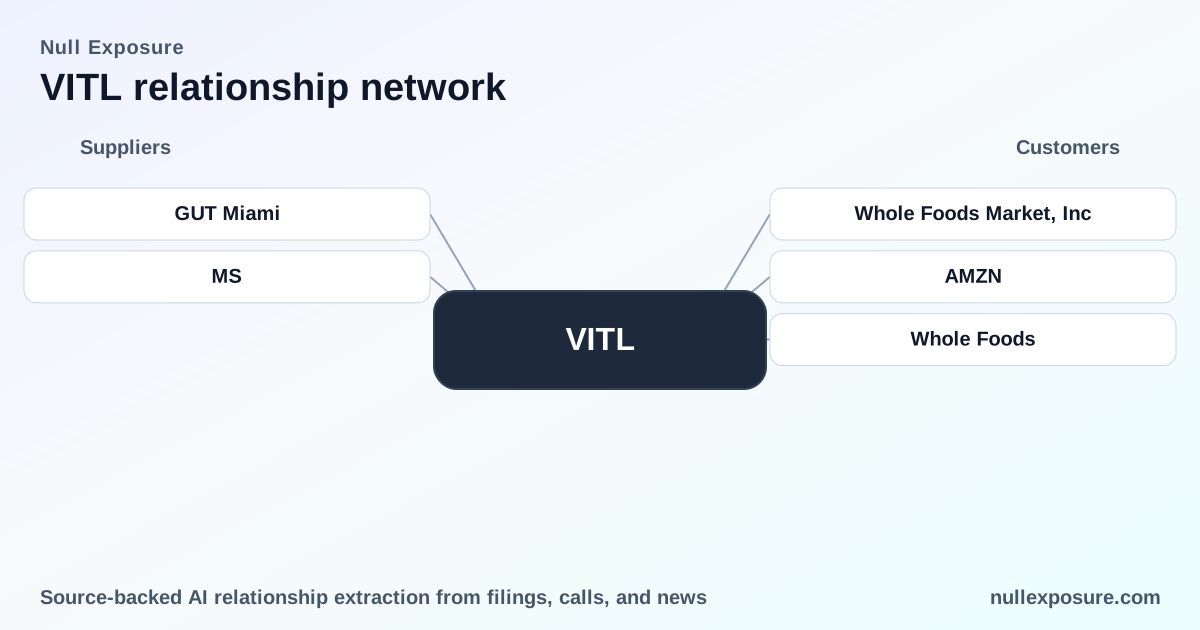
GUT Miami — Vital Farms developed a 60‑second advertising spot in partnership with GUT Miami, reflecting a vendor relationship for creative services and brand marketing execution. Source: a StockTitan news item documenting the campaign (published March 10, 2026): https://www.stocktitan.net/news/VITL/vital-farms-finally-answers-the-age-old-question-which-came-first-4169ssw7erye.html
-
Morgan Stanley Smith Barney LLC — Morgan Stanley Smith Barney LLC is named in a FY2026 SEC‑related filing context, indicating the bank’s role as a listed securities/financial services counterparty in Vital Farms’ disclosure materials (likely related to a 144A or similar filing). Source: FY2026 filing republished on StockTitan referencing Morgan Stanley Smith Barney LLC: https://www.stocktitan.net/sec-filings/VITL/144-a-vital-farms-inc-sec-filing-7e6883c2a3bd.html
What the constraint signals reveal about operating posture
Company disclosures and filing language produce a coherent operating profile that investors should read as structural features, not transitory quirks.
-
Contracting posture — long‑term, buy‑sell orientation. Vital Farms purchases egg inventory under long‑term supply contracts with terms that range from one to seven years, and many buy‑sell contracts run four to five years. That legal structure favors supply predictability and gives the company visibility into procurement costs and availability over multiyear horizons.
-
Concentration and geography — focused supplier footprints with international touchpoints. Packaging inputs such as corrugated boxes and egg cartons are sourced from a small number of suppliers across the U.S., Canada, and Europe, implying single‑source or limited‑source exposure for key packaging lines that are part of the finished‑goods cost stack.
-
Role complexity — buyer + reliance on co‑manufacturers + logistics dependency. Vital Farms acts primarily as a buyer of raw eggs from a network of over 425 family farms, while several finished products (butter, hard‑boiled eggs, liquid whole egg) are produced by co‑manufacturers — a dual role that combines upstream procurement risk with downstream manufacturing dependency. The company also depends on a limited number of third‑party cold storage and carrier providers for distribution.
-
Materiality and regulatory criticality. Filings explicitly warn that manufacturing failures or co‑manufacturer noncompliance with FDA/USDA rules could materially impact the ability to market products and damage the brand, elevating supplier oversight from operational priority to a financial control issue.
-
Spend scale and commitment. A financial note reports variable lease cost associated with long‑term supply contracts shown as 225,390 (amounts in thousands), a figure consistent with a $100M+ spend band classification and indicative of material contractual commitments in the supply portfolio.
These are company‑level signals drawn from public disclosures; none of the constraint excerpts explicitly tie a single supplier entity to a given constraint unless the excerpt names the party.
Why these constraints matter for investors and operators
- Liquidity and covenant risk: Long‑term contracts create locked‑in cost exposure; in a rising input cost environment the company bears the margin risk unless contracts contain pass‑throughs.
- Concentration shock vulnerability: Single‑source carton or cold‑storage failures can cause SKU outages and retail delistings, directly hitting revenue stability for branded SKUs.
- Compliance as a value driver: Strong quality assurance over co‑manufacturers is a de‑risking lever that preserves the brand and prevents recall costs that would be both financial and reputational.
How named relationships fit into that picture
The two named counterparties from the relationship data help color the perimeter of Vital Farms’ partner ecosystem:
-
The GUT Miami creative engagement signals active brand investment and the use of specialized creative agencies to drive demand, which supports revenue mix and retail velocity (StockTitan news, March 10, 2026). https://www.stocktitan.net/news/VITL/vital-farms-finally-answers-the-age-old-question-which-came-first-4169ssw7erye.html
-
Morgan Stanley Smith Barney LLC’s presence in filing materials indicates capital markets and distribution relationships — an institutional banking counterparty visible in FY2026 SEC‑related documentation, which connects to financing, investor distribution, or placement activities (FY2026 filing). https://www.stocktitan.net/sec-filings/VITL/144-a-vital-farms-inc-sec-filing-7e6883c2a3bd.html
These specific relationships are complementary: one supports demand creation, the other sits in the securities/financial services perimeter that matters for capital access and investor engagement.
Practical investor checklist
- Require evidence of contract provisions that allocate input‑cost inflation risk and termination rights for single‑source packaging suppliers.
- Prioritize audits and evidence of cGMP compliance for co‑manufacturers and a contingency plan for cold‑storage or carrier disruptions.
- Reconcile reported spend commitments to free cash flow sensitivity: the documented $225,390 (amounts in thousands) variable lease cost tied to long‑term supply contracts is a high‑visibility line item.
For a consolidated view of supplier dependency and counterparty exposure, go to https://nullexposure.com/ and see how these signals map into risk scores and concentration analytics.
Bottom line and next steps for investors
Vital Farms’ supplier profile is characterized by multiyear purchase contracts, concentrated sourcing for packaging, significant reliance on co‑manufacturers, and material spend commitments — a set of attributes that beget both stable supply and concentrated operational risk. Active diligence should center on contract clauses, co‑manufacturer audit results, and contingency planning for the cold chain. For tailored supplier risk reports and counterparty continuity planning, visit https://nullexposure.com/ to commission a focused review.
Bold, documented supplier relationships and explicit contractual spend are investable signals; they require active governance to convert operational certainty into durable shareholder value.