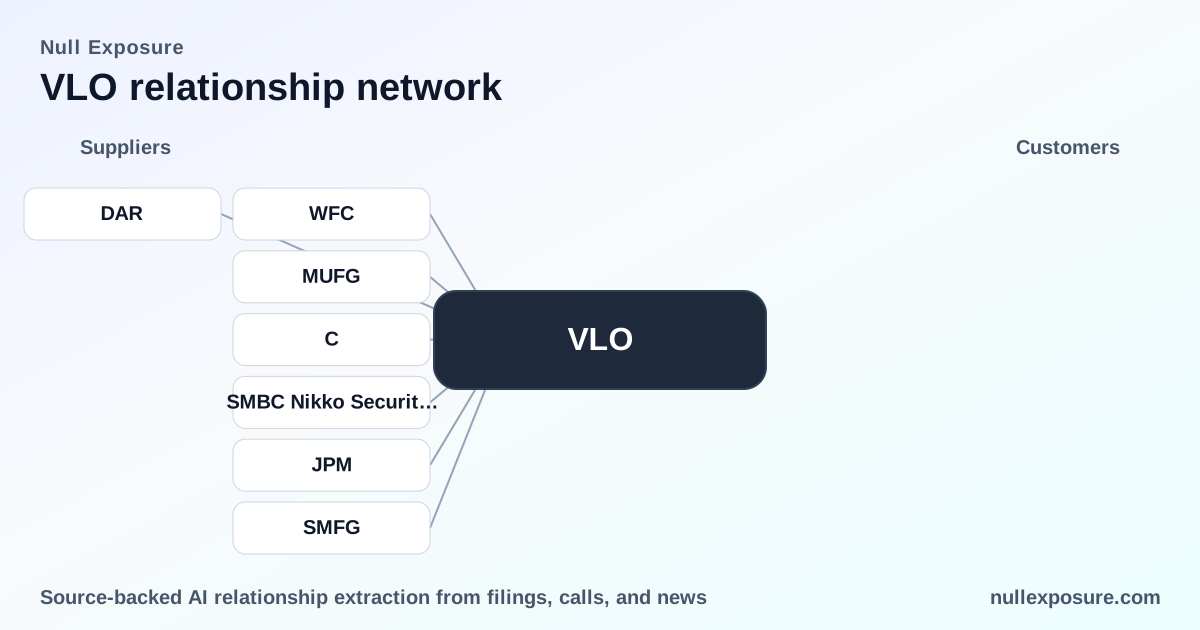
Valero (VLO) — Supplier and Capital Markets Relationships: What Investors Need to Know
Valero Energy Corporation refines and markets transportation fuels, petrochemical products and power, monetizing through refinery margins, wholesale and retail fuel sales, and integrated logistics; the company supplements operational cash flow with capital markets issuances and a committed revolving credit facility to fund working capital and strategic flexibility. Valero’s commercial footprint is defined by a mix of spot and term feedstock purchases and an active hedging program, while its financing relationships are broadly syndicated across major global banks. Learn how these counterparties influence liquidity, funding cost and operational optionality at https://nullexposure.com/.
How Valero structures procurement and financing in practice
Valero purchases crude oil and feedstocks through a combination of term and spot contracts, and acts as a buyer that uses commodity derivatives to lock in prices for forecasted purchases and sales. That dual posture—spot responsiveness paired with hedging—reduces immediate procurement concentration but keeps the company exposed to market-driven margin compression when refining spreads tighten. The firm also maintains a large syndicated revolving credit facility and taps public debt markets for longer-dated financing, reflecting a mature treasury program that balances near-term liquidity with capital markets access.
- Contracting posture: mix of spot and term procurement supports operational flexibility while requiring disciplined hedging.
- Counterparty breadth: broad underwriting and bank agent relationships reduce single-party concentration in capital markets.
- Criticality: feedstock supply arrangements and the revolving credit line are operationally critical to ongoing refinery throughput.
- Maturity: use of standard commercial instruments and established banking partners indicates an institutionally mature funding model.
If you evaluate supplier counterparty exposure as part of corporate credit or procurement diligence, this overview and the linked relationship entries are a practical starting point: https://nullexposure.com/.
Capital markets counterparties tied to the March 2026 notes offering
Valero used a syndicate of global banks as underwriters for a debt offering announced in March 2026; multiple market outlets reported the same roster of book-runners. Each relationship below is summarized with the original reporting context.
- Wells Fargo Securities — Wells Fargo acted as one of the representatives/joint book-running managers on Valero’s March 10, 2026 note offering, providing underwriting and distribution support. A TradingView item dated March 10, 2026 listed Wells Fargo among the underwriters, and StockTitan’s report on the note pricing echoed that role in FY2026 coverage.
- MUFG Securities Americas — MUFG served as a book-running manager for the March 2026 offering, participating in syndication and placement functions; TradingView and StockTitan referenced MUFG Securities Americas in their coverage of the transaction on March 10, 2026.
- Citigroup Global Markets / Citigroup Global Markets Inc. — Citigroup is named as a joint book-running manager for Valero’s debt issuance, executing underwriting responsibilities and syndicate coordination, as reported on March 10, 2026 by TradingView and corroborated by StockTitan’s notes on pricing.
- SMBC Nikko Securities America / SMBC Nikko Securities America, Inc. — SMBC Nikko is listed among the underwriters and joint book-runners in the March 2026 news items, supporting distribution into investor accounts per TradingView and StockTitan coverage.
- Wells Fargo Securities, LLC — Listed specifically as the LLC entity in StockTitan’s pricing notice, this entry confirms the operational underwriting vehicle Wells Fargo used in the transaction as reported in FY2026.
- MUFG Securities Americas Inc. — The corporate entity MUFG Securities Americas Inc. is cited in the pricing announcement, duplicating the role MUFG played as a joint book-running manager in the March 2026 offering as covered by StockTitan.
- SMBC Nikko Securities America, Inc. (SMFG) — StockTitan’s announcement names the SMBC Nikko corporate entity in the note pricing release, reinforcing SMBC’s underwriting role noted across March 2026 reports.
(TradingView published the initial market notice on March 10, 2026; StockTitan’s FY2026 reporting repeated the same manager roster in its pricing announcement.)
Credit facility counterparty: JPMorgan Chase Bank, N.A.
JPMorgan Chase Bank, N.A. is the administrative agent on Valero’s amended and restated revolving credit agreement that extends maturity to October 16, 2030 and provides up to $4.0 billion in revolving commitments with a letter of credit subfacility and capacity to increase commitments. The amended facility sets interest pricing tied to Term SOFR or an alternate base rate with margins calibrated to Valero’s credit ratings and includes standard covenants, as disclosed in Valero’s FY2026 filings via StockTitan’s SEC filing summary.
Operational supplier: Darling
Valero disclosed in its 2024 Form 10‑K that a Valero‑owned entity (DGD) is party to a raw material supply agreement with Darling under which Darling offers a portion of its feedstock production at market pricing, while Valero (DGD) is not obligated to buy. This arrangement provides Valero optional feedstock access without purchase commitment, preserving supply flexibility, as detailed in the 2024 10‑K (reported FY2024).
What these relationships mean for investors
Valero’s counterparty set shows deliberate diversification across underwriting and banking relationships and a measured approach to feedstock sourcing:
- Underwriting diversity reduces execution risk on public offerings. Multiple global banks serving as joint book-runners limits dependence on any single syndicate member for distribution or pricing.
- A long-dated revolving facility under JPMorgan’s administration strengthens liquidity runway. Extension to October 2030 indicates management’s focus on funding stability through business cycles.
- Supply optionality through arrangements like the Darling agreement lowers lock‑in risk. The feedstock offer structure described in the 10‑K keeps procurement flexible and keeps downside purchase obligations limited.
Mid-deal diligence benefit: if you model counterparty stress scenarios, treat underwriting relationships as liquidity enablers rather than ongoing cost centers; consider the credit facility’s covenant package and termination triggers as primary governance levers for lender risk.
If you want a consolidated view of how these suppliers and financial counterparties interact with Valero’s balance sheet and procurement flows, explore the platform at https://nullexposure.com/ for a structured supplier map.
Final takeaways and investor actions
- Valero combines market-facing procurement (spot) with hedging and term buys, which preserves operational flexibility but keeps margin sensitivity to crude spreads. That is a company-level signal grounded in the 10‑K procurement language.
- Bank syndication for debt and a JPMorgan‑administered credit facility provide funding depth and maturity, reducing the probability of near-term liquidity stress.
- Feedstock agreements such as the one with Darling deliver optionality without purchase obligation, lowering supply lock-in risk.
For investors assessing counterparty concentration, operational criticality, or financing resilience, these relationships represent diversified execution partners and a measured commercial posture. For deeper supplier-level analysis and to map these relationships into exposure scenarios, visit https://nullexposure.com/ and start a focused review.