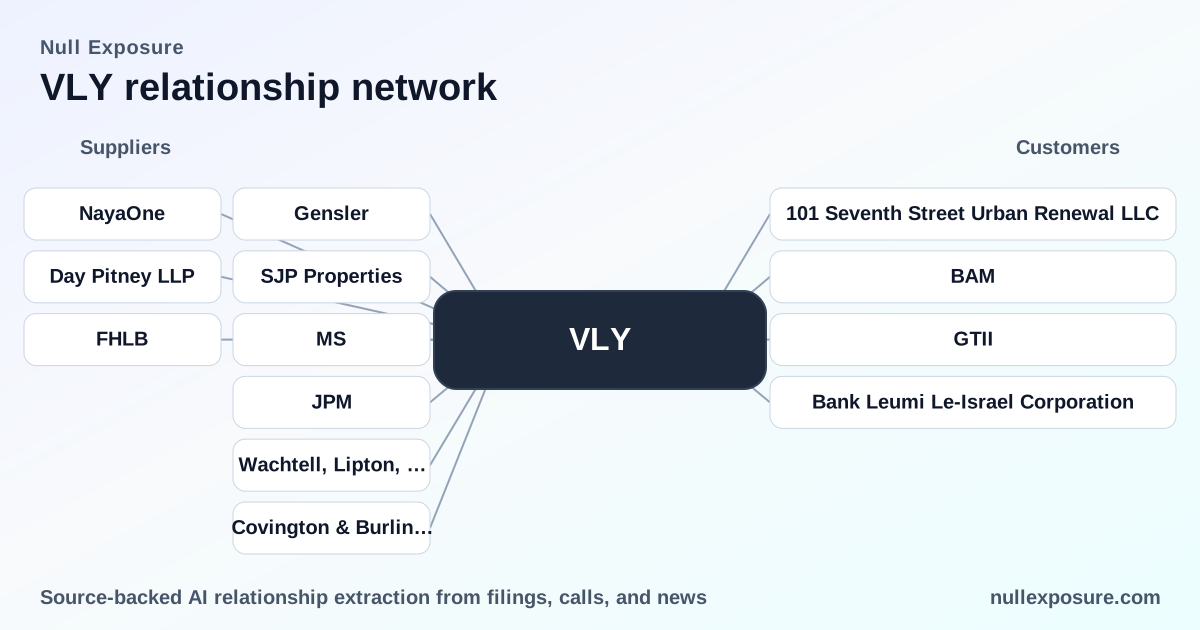
VLY supplier map: who advises Valley National and how that shapes risk and opportunity
Valley National Bancorp (VLY) operates as a regional commercial bank that monetizes through lending margins, fee income and strategic balance-sheet actions such as portfolio sales and acquisitions. Its supplier footprint—legal counsel, investment bankers, fintech integrators, development partners and short-term liquidity providers—directly supports M&A execution, franchise relocation and product distribution. Understanding these supplier relationships clarifies where Valley outsources critical execution, where funding and legal risk concentrate, and how the bank scales distribution and fintech capabilities.
Learn more about supplier analytics at NullExposure.
What the supplier list implies for investors: execution posture, criticality and maturity
Valley’s supplier roster shows a conventional but important pattern for an acquisitive regional bank. The bank uses major investment banks for deal execution, a mix of national and boutique law firms for transaction counsel, and specialist vendors for compliance, fintech integration and risk-monitoring. The firm also maintains short-term funding lines with government-backed or quasi-government entities.
- Contracting posture: Valley leans on established advisors (Morgan Stanley, J.P. Morgan) for fairness opinions and deal structuring, indicating a posture that outsources high-stakes execution to large-cap partners.
- Concentration and criticality: Legal and advisory relationships are diversified across multiple firms, limiting single-provider legal concentration. Funding exposure to the Federal Home Loan Bank (FHLB) and holdings of Ginnie Mae securities create funding and interest-rate sensitivity that investors must monitor.
- Maturity and stage: Several supplier ties are multi-year and active (consulting agreement amendments are recorded), signaling ongoing, not one-off, vendor dependency.
The supplier relationships you need to know now
Gensler — The bank hired global architecture firm Gensler to design its new six‑story Morristown headquarters, a project tied to Valley’s strategic relocation and real estate footprint expansion. According to the Daily Record (June 11, 2022), the building was expected to complete in spring 2023. Source: Daily Record, FY2022.
SJP Properties — SJP is the developer building the new Morristown headquarters that will replace Valley’s Wayne offices, anchoring downtown retail/office presence. The Daily Record reported SJP’s role in the development (June 11, 2022). Source: Daily Record, FY2022.
Morgan Stanley & Co. LLC — Morgan Stanley served as financial advisor to Valley in the Bank Leumi USA acquisition announced in 2021 and acted as sole advisor on a near‑$1 billion commercial real‑estate loan sale to Brookfield Asset Management in 2024, reflecting a recurring advisory role on both M&A and portfolio sales. Source: GlobeNewswire releases, FY2021 and FY2024.
J.P. Morgan Securities LLC — J.P. Morgan provided a fairness opinion and acted as financial adviser to Valley in the 2019 Oritani acquisition, validating third‑party valuation and transaction governance. Source: RE-NJ, FY2019.
Wachtell, Lipton, Rosen & Katz — Wachtell acted as Valley’s legal counsel for acquisitions, including the Bank Leumi USA transaction, supplying top‑tier transactional legal support on major deals. Source: GlobeNewswire, FY2021.
Covington & Burling LLP — Covington served as legal counsel to Valley on the Westchester Bank Holding Corporation acquisition, signaling reliance on large national law firms for complex regulatory and transactional work. Source: NJB Magazine, FY2021.
NayaOne — Valley launched a fintech innovation platform powered by NayaOne; the platform integrates products from hundreds of fintech companies for onboarding and distribution, supporting the bank’s digital product channel strategy. Source: NJB Magazine, FY2023.
Day Pitney LLP — Day Pitney acted as counsel to Valley in the Oritani acquisition, complementing the bank’s legal advisory mix with regional transactional counsel. Source: RE-NJ, FY2019.
FHLB (Federal Home Loan Bank) — Valley reported FHLB advances and short‑term borrowings in its filings; the bank reduced short‑term borrowings by $111.2 million to $51.1 million at September 30, 2025, largely by repaying $100 million of maturing FHLB advances, underscoring the role of FHLB funding in short-term liquidity management. Source: Valley’s Third Quarter 2025 results, GlobeNewswire, FY2025.
Operating constraints and what they tell investors
Valley’s public filings and disclosures surface several operational constraints that shape supplier risk.
-
Government counterparty exposure (company signal): Valley purchased approximately $2.5 billion of residential mortgage‑backed securities mainly issued by Ginnie Mae within its available‑for‑sale portfolio during the year ended 2024, indicating material exposure to government‑issued mortgage securities that drive interest‑rate and prepayment sensitivity. This is a company‑level funding and asset‑quality signal drawn from Valley’s disclosures.
-
Service provider posture (company signal): Filings describe multiple third‑party vendors and consulting agreements used for compliance, insurance monitoring and credit modeling; Valley’s operating model relies on external service providers to run non‑core but critical functions such as regulatory compliance and expected‑credit‑loss estimation.
-
Active consulting relationship with Alrem LLC (relationship signal): Valley’s Form 10‑Q filings show a Consulting Agreement with Alrem LLC dated May 1, 2022, with First and Second Amendments effective May 1, 2023 and May 1, 2024, indicating an ongoing, amended multi‑year advisory engagement that is active and contractual in nature.
Investment implications: what to watch and why it matters
-
Execution quality is delegated to elite advisors. Valley’s use of Morgan Stanley and J.P. Morgan for fairness opinions and transaction execution reduces deal execution risk but creates counterparty concentration to major investment banks for strategic deals. Monitor whether these advisors remain engaged as Valley scales acquisitions.
-
Funding profile and interest‑rate sensitivity are active risks. The combination of FHLB advances and Ginnie Mae holdings creates liquidity and market‑rate exposures that influence earnings volatility under rate shocks. Stress scenarios should account for both short‑term borrowings and AFS MBS valuation swings.
-
Fintech integration accelerates product distribution but increases third‑party dependency. The NayaOne platform expands distribution channels and product innovation capability, yet it raises operational reliance on an external partner for onboarding and integrations.
If you want a consolidated signal map of these supplier dependencies, visit NullExposure for an investor‑grade supplier view.
Investor action checklist
- Validate ongoing advisor relationships (Morgan Stanley, J.P. Morgan) in deal filings ahead of any announced acquisitions.
- Quantify Ginnie Mae and FHLB exposures within stress models to capture funding and price‑mark volatility.
- Assess third‑party operational controls around NayaOne and other service providers to understand concentration of compliance and onboarding functions.
For more on supplier risk intelligence tailored to financial institutions, see NullExposure.
Bold takeaway: Valley’s supplier network is conventional for an acquisitive regional bank—big‑bank advisors and large law firms for deals, fintech partners for distribution, and FHLB/Ginnie Mae exposure that creates tangible funding and market‑risk vectors. Investors should focus diligence on advisor continuity, short‑term funding strategy and third‑party governance when evaluating VLY’s next strategic moves.