VMCAU (Valuence Merger Corp I units): an investor-focused supplier map and implications
Valuence Merger Corp I units trade under the ticker VMCAU as a special purpose acquisition company (SPAC) listed on the Nasdaq Global Market; the firm’s economic model is built on IPO proceeds held in trust and sponsor economics realized through a future business combination and warrant/unit mechanics. Revenue and investor returns for VMCAU originate from capital raised at IPO and subsequent transaction economics (sponsor promote, warrants, and any earnouts), not from operating cash flow, so supplier and underwriting relationships matter for deal execution, distribution and regulatory disclosure. Learn more about supplier and underwriting relationships at the Null Exposure hub: https://nullexposure.com/
Why the underwriting and listing partners matter for SPAC investors
SPACs are simple legally but complex commercially: the quality of listing venues, bookrunners and distribution partners directly affects deal velocity, market reception and the pool of potential targets. For VMCAU, the relationships in the public record show an underwriting syndicate and a Nasdaq listing that together establish a credible go-to-market for the IPO proceeds and for future combination activity.
How to read the relationship signals
- Listing venue (Nasdaq) signals market access and regulatory standards for the units; a Global Market listing elevates visibility to institutional buyers.
- Lead and bookrunning managers (Baird; SVB Leerink / SVB Securities) indicate the distribution strategy and the quality of investor placement for both the IPO and potential follow-on steps related to the SPAC lifecycle.
- Public prospectus availability through underwriter channels points to conventional underwriting documentation and investor relations processes.
Explore detailed relationship records and analysis at Null Exposure: https://nullexposure.com/
The relationships you need to know (complete coverage)
Below I list every supplier/partner referenced in the public record for VMCAU, each followed by a concise, plain-English summary and the source.
-
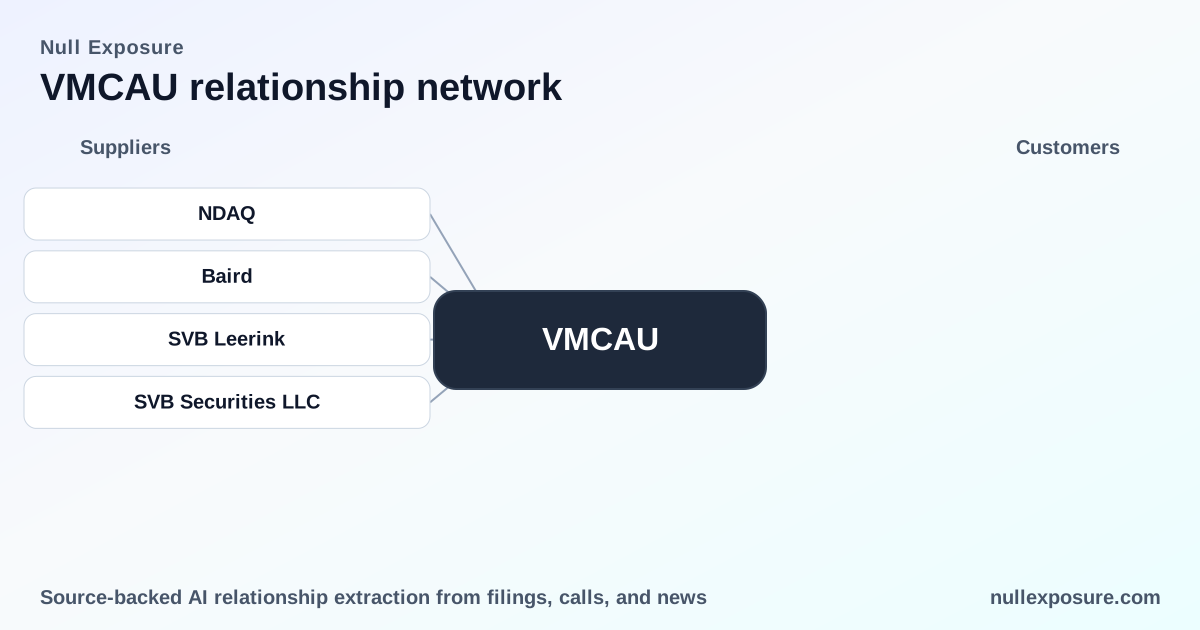
Nasdaq — The units for Valuence Merger Corp I were listed on the Nasdaq Global Market and started trading under the ticker VMCAU on March 1, 2022, giving the SPAC a mainstream U.S. exchange venue and the attendant market visibility. According to the company press release (GlobeNewswire, Feb. 28, 2022), Nasdaq was the listing venue for the units.
-
Baird — Baird acted as the lead manager for the IPO offering, signaling the bank’s role in organizing distribution and coordinating the underwriting syndicate. The GlobeNewswire release confirms Baird’s role in the offering (Feb. 28, 2022).
-
SVB Leerink — SVB Leerink served as the sole bookrunning manager on the transaction, taking primary responsibility for order book management and allocation decisions during the IPO process. The GlobeNewswire prospectus announcement and a Renaissance Capital note both identify SVB Leerink’s bookrunner role (GlobeNewswire, Feb. 28, 2022; Renaissance Capital IPO Center).
-
SVB Securities LLC — Prospectus copies were made available through SVB Securities LLC’s syndicate desk, reflecting the operational distribution channels investors could use to obtain offering materials and placing the syndicate’s compliance and investor communication path through SVB Securities channels. This contact and prospectus availability is documented in the GlobeNewswire filing (Feb. 28, 2022).
What these supplier ties tell investors about VMCAU’s operating posture
These relationships form a clear commercial posture for a SPAC that completed an IPO:
- Contracting posture — conventional and institutional. The use of Nasdaq plus an investment-bank syndicate reflects a traditional institutional underwriting and listing approach rather than an alternative or retail-first distribution strategy.
- Concentration — moderate single-event concentration. The supplier footprint is concentrated around a small number of underwriting and exchange partners, which is typical for an IPO-focused vehicle: the business outcome (a successful de-SPAC) depends heavily on a limited set of capital markets relationships.
- Criticality — high for deal execution, low for ongoing operations. These supplier relationships are critical during IPO and transaction execution windows because they control market access and investor placement; they are less critical for ongoing operating cash flow because SPACs do not have typical operating businesses before the business combination.
- Maturity — established capital markets practices. Working with established managers and Nasdaq implies mature capital markets processes (prospectus distribution, syndicate management, SEC filing channels), which reduces execution novelty risk.
Risk and opportunity implications for investors and operators
- Risk: concentration around bookrunner/lead manager. When a SPAC’s IPO distribution and bookrunning are concentrated with a few banks, allocation decisions and aftermarket support depend on those partners’ willingness to place and promote the units.
- Risk: execution-dependency on listing and regulatory readiness. A Nasdaq Global Market listing imposes specific listing rules and ongoing disclosure expectations that the SPAC must maintain through the combination process.
- Opportunity: professional distribution infrastructure. Having an institutional bookrunner and lead manager gives the SPAC access to established investor networks and improves credibility with target companies and institutional buyers, which accelerates deal sourcing and syndication.
If you want a concise supplier map and risk score for other tickers or SPAC vehicles, Null Exposure builds tailored supplier intelligence for investors: https://nullexposure.com/
Actionable next steps for research teams and allocators
- Validate the underwriting agreements and prospectus language in SEC filings to confirm fee schedules, sponsor economics, and lock-up terms that are material to post-combination economics.
- Monitor liquidity and post-listing trading patterns on Nasdaq to assess market reception and potential retail versus institutional holder mix.
- Track future press releases and filing updates on bookrunner activity for follow-on offerings or PIPE placements; these events materially change the SPAC’s capital profile.
For investor-grade supplier intelligence and ongoing tracking of underwriting relationships, visit Null Exposure: https://nullexposure.com/
Final takeaway
VMCAU’s public record shows a conventional, institutionally underwritten SPAC launch: Nasdaq listing, Baird as lead manager and SVB Leerink (SVB Securities syndicate) as the bookrunner/distribution channel. Those relationships are pivotal to the SPAC’s ability to deploy capital and complete a de-SPAC transaction; they represent both the primary execution engine and the main concentration of counterparty risk for investors evaluating the vehicle.