VMGA supplier relationships: who they work with, why it matters to investors
VMGA operates as a sponsor-backed vehicle that monetizes through capital markets activity: it raises investor capital, underwrites offerings, and relies on financial intermediaries to execute transactions that generate fee income and access to deal flow. The company’s operating leverage is concentrated in its capital-raising and underwriting relationships, and revenue is realized from placement and transaction-related fees rather than recurring product sales. For investors evaluating VMGA supplier risk, focus on counterparty quality, execution partners, and the firms appointed to run offerings. Learn more about supplier risk coverage at https://nullexposure.com/.
Quick read: what the relationships tell you about VMGA today
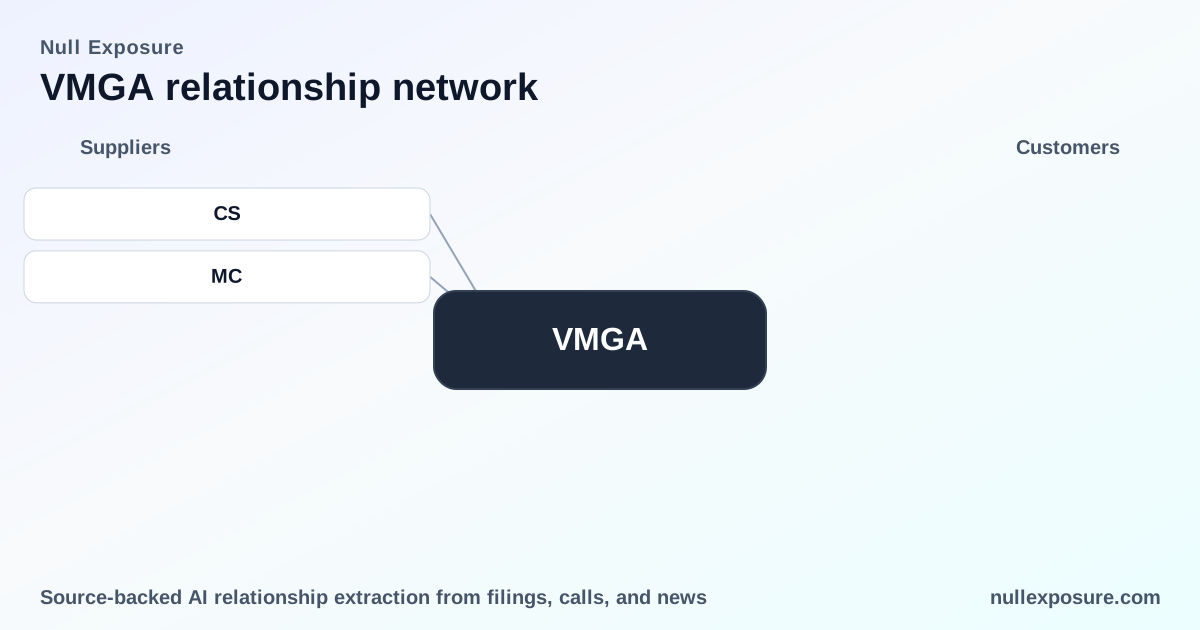
VMGA has engaged two major investment banks as book-runners for a recent offering; both are established, full-service firms that provide distribution and underwriting capabilities. These relationships are execution-critical for deal success and investor returns, because the banks determine pricing, placement, and institutional access. Below I map each named partner, provide a plain-English summary, and explain the implications for operators and investors.
Who VMGA is working with (and what they do)
Credit Suisse — joint book-running manager
Credit Suisse was appointed as a joint book-running manager on VMGA’s offering, providing underwriting and investor distribution services for the deal. According to a press release published on Yahoo Finance on March 10, 2026, Credit Suisse and Moelis & Company acted as the joint book-runners for the offering (https://finance.yahoo.com/news/vmg-consumer-acquisition-corp-announces-001700723.html).
Moelis & Company — joint book-running manager
Moelis & Company served alongside Credit Suisse as a joint book-running manager, sharing responsibilities for pricing and placing the securities with institutional investors. The same Yahoo Finance release dated March 10, 2026, lists Moelis & Company in the joint book-running role (https://finance.yahoo.com/news/vmg-consumer-acquisition-corp-announces-001700723.html).
What these partnerships mean for VMGA’s business model
VMGA’s reliance on prominent investment banks for capital markets execution signals a distribution-centered operating model. Under this posture:
- Contracting posture: VMGA functions as a principal client that outsources execution to banks rather than internalizing distribution; outsourced execution is the default operating posture and exposes VMGA to counterparty execution risk.
- Concentration: The named book-runners are large global firms; however, a small number of execution partners implies concentration risk—if one partner’s distribution falters, transaction economics and timing are directly affected.
- Criticality: These relationships are mission-critical for transactional success because pricing, market access, and syndication determine proceeds and fee capture.
- Maturity: Engagement of established firms such as Credit Suisse and Moelis suggests transactional maturity—VMGA is using experienced partners rather than boutique or untested underwriters, which reduces execution friction on complex offerings.
These are company-level operating signals; there are no supplier constraints recorded in the available materials that point to contractual limits or exclusivity clauses affecting the relationships.
If you want a deeper supplier risk analysis or ongoing monitoring for VMGA, visit https://nullexposure.com/ for coverage options.
Investor implications and risk checklist
For portfolio managers and corporate operators, the practical takeaway is straightforward:
- Execution quality equals deal economics. The choice of joint book-runners directly shapes pricing, allocation, and aftermarket support.
- Counterparty credit and reputation matter. Firms with broad distribution reduce placement risk and improve market reception; that reduces cost of capital and tail risk for VMGA transactions.
- Concentration of partners creates single-point exposure. If VMGA relies repeatedly on a narrow set of underwriters, any restriction on those banks (regulatory, reputational, or capital) becomes a company-level vulnerability.
- Operational oversight is essential. Investors should require visibility into underwriting agreements, fee schedules, and post-issuance support commitments to model transaction economics accurately.
Operational recommendations for managers
Operators should treat these book-runner relationships as strategic vendor contracts, not transitory service providers. Practical steps include:
- Negotiating transparent fee and allocation mechanics tied to performance.
- Staggering counterparty exposure where possible to reduce concentration.
- Requiring pre-commitment and stabilization plans for aftermarket support.
For a structured supplier-risk program tailored to capital markets counterparties, see service offerings at https://nullexposure.com/.
Closing assessment
VMGA’s named relationships with Credit Suisse and Moelis & Company are high-quality execution partnerships that align with a distribution-centric monetization model. The sponsor’s success depends on consistent access to underwriting capacity and institutional placement, so these relationships are both strategic and operationally critical. Absent explicit contractual constraints in the filings available, investors should nonetheless assume concentration and execution risk and demand contractual transparency around fee economics and allocation processes.
For ongoing monitoring or bespoke supplier intelligence on VMGA, visit https://nullexposure.com/ to explore subscription options and enterprise coverage.