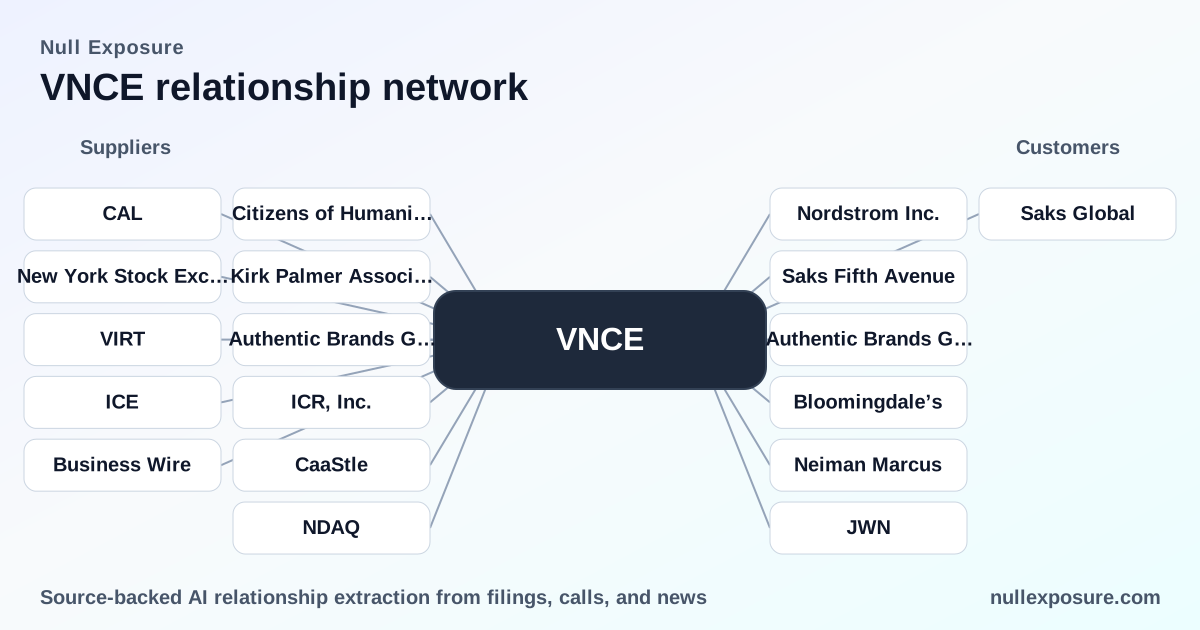
Vince Holding Corp. (VNCE): Supplier relationships and operating posture investors need to know
Vince is a contemporary apparel retailer that designs in the U.S., sources the vast majority of product from contract manufacturers in Asia, operates wholesale, retail and e-commerce channels under a long-term license with Authentic Brands Group (ABG), and monetizes through product sales while paying royalties to the brand owner. Revenue is driven by merchandise sales across channels and enhanced by select services (rental, drop-ship) and occasional capital-market transactions, while cost structure is heavily influenced by outsourced manufacturing, royalty obligations and lease commitments. For a fast, vendor-focused view tailored to diligence and supplier risk, visit https://nullexposure.com/.
Business implications are straightforward: supply-chain continuity, the ABG licensing relationship, and retail footprint lease terms are first-order drivers of margin stability. The company’s recent market actions (exchange transfer, at-the-market issuance) and modest profitability metrics force attention to capital access and partner dependency.
What the relationships tell investors — a concise run-through
Below is a relationship-by-relationship read for operators and research teams. Each entry is one or two plain-English sentences followed by the source context.
-
Citizens of Humanity — Management described a collaboration with Citizens of Humanity positively, noting product integration into stores and assortments during the FY2025 Q3 earnings dialogue. Source: FY2025 Q3 earnings call transcript (March 2026).
-
Kirk Palmer Associates — Vince engaged Kirk Palmer Associates as an executive search partner to assist in identifying a CEO, signaling use of retained search for senior leadership hires. Source: Yahoo Life report referencing the company’s retention of the search firm (article referencing FY2021).
-
Authentic Brands Group (ABG) — Vince operates under a long-term licensing arrangement with ABG that requires royalty payments and an annual minimum guaranteed royalty; the transaction was executed in 2023 and is central to Vince’s right to operate the brand’s wholesale, retail, and e‑commerce channels. Source: company disclosures and press coverage of the 2023 ABG transaction (FY2023–FY2025 reporting).
-
ICR, Inc. — Vince lists ICR as its investor relations contact, indicating the use of a professional IR firm for market communications and investor outreach. Source: company press / investor release materials cited in FY2025 coverage.
-
CaaStle — The Vince rental service (Vince Unfold and Borrow) is powered by CaaStle, which provides the platform and logistics for the rental/subscription offering. Source: WWD feature on Vince’s rental service (2021).
-
The Nasdaq Stock Market LLC (Nasdaq) — Vince voluntarily transferred its U.S. listing from the NYSE to Nasdaq and began trading on Nasdaq in late 2025, reflecting a strategic market-listing decision. Source: company listing transfer announcements and press releases (FY2025).
-
Caleres — Vince referenced a drop-ship relationship with Caleres that supplements footwear assortment via Caleres’ inventory, improving assortment and fulfillment capabilities. Source: FY2025 Q3 earnings call transcript and related coverage.
-
New York Stock Exchange (NYSE) — Vince ceased listing on the NYSE following its voluntary transfer to Nasdaq, with the change effected in October 2025. Source: company notice of listing transfer and market commentary (FY2025).
-
Virtu — Vince executed an at-the-market (ATM) issuance through Virtu that resulted in issuance of common shares and net proceeds of approximately $1.3 million in FY2025, demonstrating an active capital-markets financing channel. Source: FY2025 results commentary and ATM disclosure (TradingView/FY2025).
-
Business Wire — Company formal announcements about listing transfer and related corporate news were distributed via Business Wire as the corporate press channel. Source: Business Wire company release reprinted in FY2025 coverage.
Operating-model constraints and what they imply for vendor risk
Vince’s supplier relationships and contract posture create a profile that investors should treat as a single operational system rather than isolated facts.
-
Long-term, brand-licensing dependency is critical and contractually explicit. The company’s license with ABG commits Vince to royalty payments and a guaranteed annual minimum, making the ABG relationship a high-criticality, long-tenor commercial constraint that directly affects gross margin dynamics and cash flow. Source: License agreement language disclosed in company filings (2023).
-
Mixed lease posture with strategic flexibility. Vince maintains long-term retail and real estate leases in many markets (often initial terms up to 10 years), while recent actions show a deliberate tilt toward shorter-term leases in some locations as the company tests markets—this creates both fixed-cost commitments and optionality. Source: FY2025 filings on operating leases.
-
Manufacturing concentrated in Asia but with a diverse vendor base. The company designs product in the U.S. and sources the majority of product from contract manufacturers primarily in Asia; vendor relationships are long-standing but generally not governed by long-term manufacturer contracts, which creates operational flexibility at the cost of supplier concentration risk. Source: company operating disclosures (FY2025).
-
Service-provider reliance around logistics and ancillary services. Critical operational functions—U.S. warehousing and the rental-platform logistics—are outsourced to third-party providers, increasing operational dependency on those vendors for order fulfillment and customer experience. Source: warehouse and CaaStle service descriptions.
-
Spend profile and royalty outflows are measurable but modest at line-item level. Reported royalty outflows and specific program revenues were in the sub-$100k band in recent fiscal years for certain arrangements, demonstrating that while some contractual obligations are material to brand access, individual arrangements can be modest in direct spend. Source: FY2024–FY2025 financial disclosures.
Taken together, these constraints create a supply model that is operationally mature in sourcing but critically dependent on a single long-term licensor (ABG), offshore manufacturing, and third-party logistics—a structure that amplifies the business impact of supply disruption, licensing disputes, or abrupt changes in retail footprint economics.
Major commercial risks and what operators should monitor
-
Royalty and license economics with ABG: Because the license dictates royalties and a minimum guarantee, any erosion in retail or e‑commerce sales will compress margins faster than in vertically-owned brand models. Monitor royalty schedules and minimums in future filings.
-
Asia manufacturing concentration: Geopolitical, freight, and raw-material cost shifts in Asia will have an outsized impact; procurement teams should have contingency plans and visibility into lead-times.
-
Lease commitments vs. omnichannel optimization: Long-term leases create fixed overhead; the company’s move toward shorter leases in certain markets signals a strategy to rebalance real estate risk, but execution will determine cash-flow stability.
-
Capital access and dilution: ATM sales and exchange transfers show active capital-market management; investors should track ATM utilization and any further equity raises that could dilute existing holders.
For operators conducting vendor due diligence, focus on performance SLAs with logistics partners, clarity on ABG licensing triggers/termination clauses, and the supplier footprint across Asia.
If you want a rapid vendor-risk brief or a consolidated supplier map for VNCE, start here: https://nullexposure.com/.
Final takeaway and action items
Vince’s commercial model is retail-sales driven with an outsized dependency on a long-term brand license (ABG), outsourced Asian manufacturing, and third-party logistics. That mix supports scalability but concentrates several high-impact risks—licensing economics, supply geography, and lease commitments—that directly affect margins and cash flow. Investors and operators should prioritize monitoring license obligations, manufacturing continuity, and logistics performance.
For a tailored supplier-risk assessment, vendor scoring, or to request a dedicated VNCE supplier dossier, visit https://nullexposure.com/ and request the VNCE supplier brief.
In conclusion: ownership of execution—not brand ownership—is what determines upside for Vince. Control supply and logistics, manage the ABG relationship, and preserve capital access; those are the levers that move value.