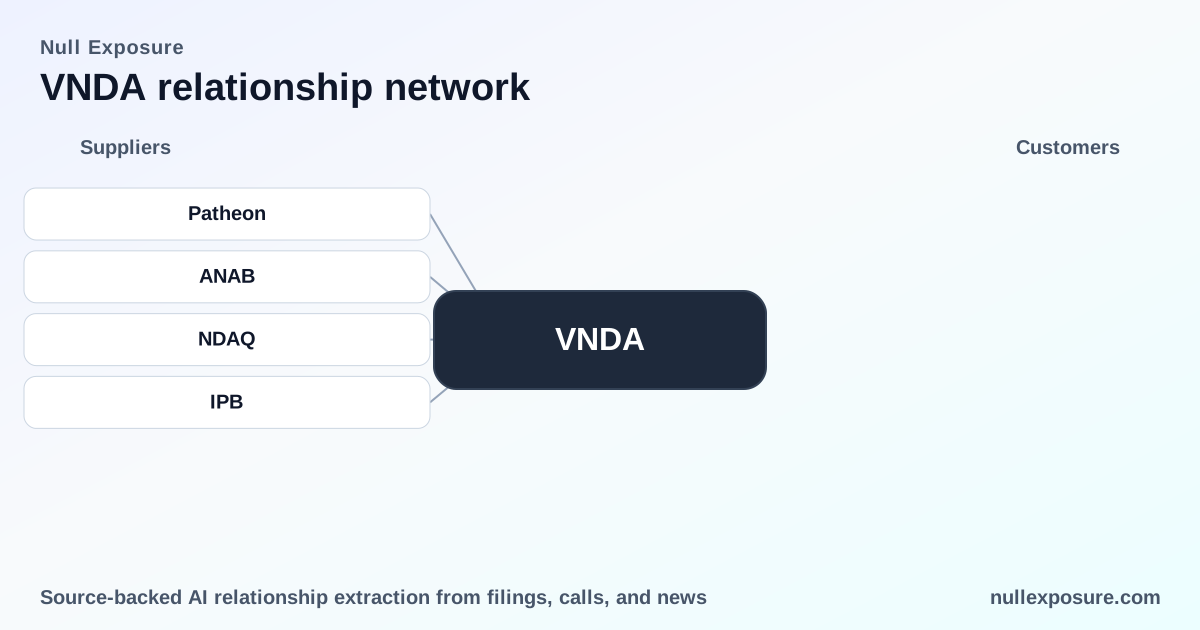
Vanda Pharmaceuticals (VNDA) — supplier relationships, commercial posture, and operational constraints investors need to price in
Vanda Pharmaceuticals commercializes specialty therapies while outsourcing virtually all manufacturing, distribution, and many commercial services; it monetizes through product sales (notably HETLIOZ® and Fanapt®) and exclusive licensing (including imsidolimab from AnaptysBio), with revenue concentrated in a handful of marketed products and recurring third‑party commitments. The company’s operating model is a virtual supply chain with material single‑source exposures and a mix of long‑tenor manufacturing contracts and shorter‑term service arrangements that drive both operational leverage and concentrated supplier risk. Learn more about supplier exposure and third‑party risk at https://nullexposure.com/.
The operating model in one paragraph: how suppliers drive the economics
Vanda runs a capital‑light commercialization strategy: it outsources formulation, manufacturing, warehousing, order management and distribution, and supplements these with fee‑based third‑party services for sales, medical affairs and clinical research. This structure converts fixed asset investment into counterparty dependency, concentrating execution risk with contract manufacturers and vendors while preserving margin optionality on marketed products. Financially, Vanda generated $216.1M in revenue TTM but retains negative EPS and EBITDA, underlining that supplier reliability directly affects profitability and cash flow execution (company filings, FY2025–FY2026). If you evaluate supplier counterparties for counterpart risk or insurance underwriting, this is a company where supplier continuity is critical. Visit https://nullexposure.com/ for supplier relationship data and analysis.
What the disclosures say about contract tenor, spend and criticality
Vanda’s public disclosures describe a clear dichotomy in its contracting posture:
- Long‑term, auto‑renewing manufacturing agreements govern core products and create extended operational lock‑in; the company specifically discloses multi‑year initial terms with automatic renewals and long notice periods for termination.
- Short‑term fee‑for‑service vendor contracts cover routine marketing, data and support activities and are generally terminable on roughly 90 days’ notice.
- Materiality is explicit: management notes reliance on a limited number of third‑party manufacturers and single‑source suppliers, and warns that supplier re‑prioritization by generic players could have a material adverse impact on revenues and operations.
- Committed spend sits in the $10M–$100M band, with non‑cancellable purchase commitments for marketing and data services scheduled across 2026–2029 (for example $13.5M expected in 2026).
These are company‑level signals drawn from the firm’s FY2025/FY2026 disclosures and are structural to how Vanda manages supply risk and commercial continuity.
How contract tenor shapes operational risk and negotiating leverage
Long initial terms with automatic renewals and multi‑year termination notice periods reduce short‑term supply disruption but increase vendor lock‑in and switching cost. Short, flexible service arrangements give the company tactical agility for commercial spend but offer limited protection against supplier concentration for manufacturing inputs. The combination yields a hybrid posture: operational resilience for routine services, but high dependency on specific contract manufacturers for core drug supply.
Supplier relationships disclosed in public sources
Patheon
Vanda has key manufacturing agreements with Patheon for Fanapt® and HETLIOZ®, indicating Patheon’s role as a principal contract manufacturer for Vanda’s marketed products; these agreements are referenced in the company’s SEC material reported for FY2026. (TradingView coverage summarizing Vanda’s SEC 10‑K, March 2026.)
AnaptysBio (ANAB)
Vanda holds an exclusive global license to develop and commercialize imsidolimab from AnaptysBio, and recent filings and press releases note FDA acceptance activity tied to that biologics license application—an important pipeline commercialization relationship that creates future revenue optionality tied to regulatory success. (PR Newswire and Yahoo Finance coverage of Vanda’s FDA acceptance announcement, March 2026.)
NASDAQ (NDAQ)
Public filings and summary disclosures identify Vanda as a NASDAQ‑listed issuer (VNDA), which anchors liquidity, public disclosure obligations and bank/broker interactions referenced elsewhere in filings. The company’s SEC filing language includes the NASDAQ listing context for VNDA. (SEC filing reposted on StockTitan, FY2026.)
Merrill Lynch
Merrill Lynch is referenced in the company’s SEC material with a corporate address; the disclosure records a relationship or reference to Merrill Lynch within filing paperwork rather than a detailed contractual description. Investors should treat this as a documented banking/broker reference in the filings rather than proof of an ongoing material supplier contract. (SEC filing reposted on StockTitan, FY2026.)
What this means for investors and operators
- Supply concentration is a material risk: the company’s virtual manufacturing model depends on a small set of third parties for finished goods and critical raw materials; disruption or reprioritization by a supplier would directly impact revenue recognition and fulfillment.
- Contract structure is mixed but leans toward long‑term manufacturing commitments that provide supply stability in the near term while creating vendor lock‑in and negotiation asymmetry over the long term.
- Cash flow and committed spend are visible and meaningful: multi‑year non‑cancellable commitments in the $10M–$100M range create predictable cash outflow for marketing/data services that should be modeled explicitly in working capital and covenant stress tests.
- Pipeline licensing relationships are value drivers: the AnaptysBio imsidolimab license is a discrete source of upside tied to regulatory milestones and eventual commercialization economics; FDA acceptance events are material catalysts.
Key takeaway: investors should price both the benefit of a capital‑light commercialization model and the concentrated counterparty risk that accompanies outsourcing core manufacturing and distribution functions.
If you want deeper due diligence on supplier contracts, renewal schedules and counterparty concentration, start here: https://nullexposure.com/.
What to watch next (actionable monitoring list)
- Track manufacturing agreement renewal windows and any notices of termination tied to Fanapt®/HETLIOZ® supply.
- Monitor FDA/clinical milestones and commercialization timeline for imsidolimab under the AnaptysBio license.
- Watch non‑cancellable purchase commitment cash flows and any amendments that change the $13.5M / $11.0M / $6.4M / $2.6M schedule disclosed for 2026–2029.
- Observe any public signs of supplier re‑prioritization by generic manufacturers or capacity constraints at named contract manufacturers.
Bottom line and next steps
Vanda’s business model creates a clear tradeoff between asset‑light economics and supplier concentration risk. For investors, the question is whether licensing optionality and product cash flows sufficiently compensate for the operational exposure to a handful of manufacturing partners and multi‑year commitments. For operators and risk underwriters, the focus should be on contract terms, termination windows, and contingency sourcing plans.
For an investor‑grade supplier map and contract‑tenor analysis that integrates these disclosures, visit https://nullexposure.com/ and request a deeper review of VNDA counterparties and contractual risk.