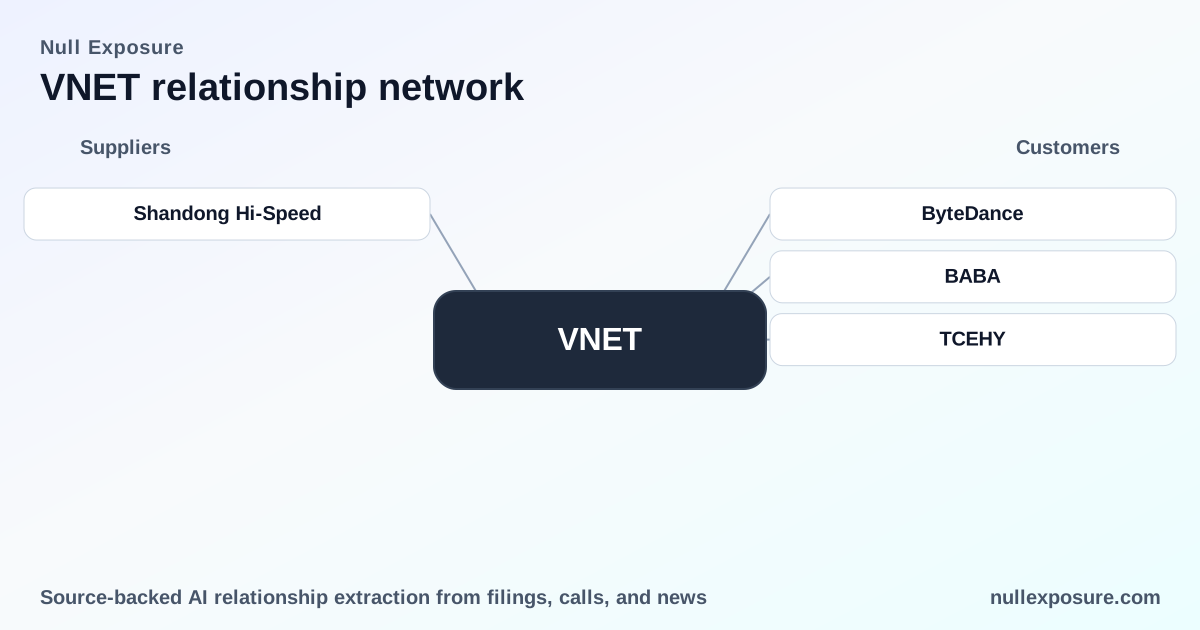
VNET Group: supplier risk and opportunity briefing for investors
VNET Group operates and monetizes a highly recurring infrastructure business: data centers, managed hosting, and cloud services for internet companies, government, and large enterprises in China, collecting subscription and usage fees tied to capacity and managed services. Its economic model is driven by long-duration capacity contracts, scale in power and network operations, and cost control on energy and facilities; strategic supplier relationships that lower energy costs directly translate to margin stability and improved operating leverage. For a concise dossier on counterparty relationships and supplier signals, visit https://nullexposure.com/.
How VNET’s business model really works — revenue, margin levers, and supplier emphasis
VNET’s revenue base is recurring and capacity-driven: customers pay for colocation, cross-connects, managed hosting, and cloud-like services, which produces predictable top-line runs and meaningful gross margins. The company reports Revenue TTM of 9.95 billion and Gross Profit TTM of 2.19 billion, with Operating Margin around 5.7% but a negative net profit margin (-2.53%), reflecting non-operating items and investment cycles. EBITDA is reported at 4.12 billion, indicating cash-generation before capex and financing.
The operating model forces supplier focus on a narrow set of critical inputs:
- Energy and land/facility agreements drive the largest controllable cost buckets for data centers; contracts that reduce electricity expense are economically leveraged across high-capacity assets.
- Network connectivity and hardware vendors determine uptime and expansion speed; multi-year terms and scale discounts compress unit costs.
- Regulatory and local-government relationships functionally underpin site availability and permitting in China.
These characteristics imply a contracting posture centered on long-duration, high-criticality contracts with a preference for partners that can guarantee energy supply and infrastructure stability. Customer concentration is distributed across internet, government, and enterprise segments, but the supplier-side concentration—power providers and facilities partners—is the single largest operational risk lever.
The supplier relationship you need on your radar: Shandong Hi-Speed
VNET has a strategic partnership with Shandong Hi-Speed focused on renewable energy integration to power its facilities, which the company has positioned as a source of energy cost savings and margin stability for FY2026. A Finviz report highlighted the partnership’s role in improving operating economics and lowering energy exposure (Finviz news, March 10, 2026).
What the Shandong Hi-Speed tie actually implies for investors
The Shandong Hi-Speed arrangement is operationally material because energy is the dominant running cost for large-scale colocation and cloud operations; securing renewables or preferential pricing from a major infrastructure player reduces volatility in unit economics and supports higher utilization margins. The public mention in FY2026 frames this as a strategic move to lock in lower-cost power and demonstrate progress on sustainability objectives (Finviz analysis, FY2026).
Additional supplier signals and company-level constraints
The results set includes no other supplier entries, which itself is informative — public reporting emphasizes select, high-impact partnerships rather than a long roll of disclosed vendors. Company-level signals derived from the operating profile and public financials:
- Contracting posture: VNET operates with long-term, capacity-focused contracts that align with capital-intensive investment cycles; supplier agreements for power and real estate therefore skew long tenor and strategic negotiation.
- Concentration risk: While customer segments are diversified, the supply-side is concentrated into a few high-impact categories (energy, facilities, network equipment), making each supplier relationship disproportionately important.
- Criticality: Supplier relationships are mission-critical; disruptions in energy or connectivity would generate immediate service and margin impact.
- Maturity: The business is mature in revenue scale and operational complexity, reflected in sizeable EBITDA and steady revenue growth, but profitability is still evolving because of investment cycles and financial structure.
These company-level characteristics shape how investors should interrogate supplier contracts: ask for tenor, pricing indexation, volume guarantees, and contingency arrangements.
Risk implications drawn from supplier posture
- Energy dependency is the principal operational risk. Any deterioration in grid availability, tariff changes, or counterparty credit at a power partner affects unit economics directly. The Shandong Hi-Speed partnership reduces this exposure but does not eliminate it.
- Supplier concentration increases bargaining risk but also creates leverage when contracts are secured. Long-term, favorable power deals amplify returns on deployed capital; conversely, failure to secure such deals compresses margins.
- Geopolitical and regulatory vectors are non-trivial. VNET’s China footprint and government-facing client base mean supplier and permitting risks are intertwined with local policy decisions.
- Margin volatility is controllable but not fully realized. Reported gross and operating margins show room for improvement; supplier-level cost reductions drive the next wave of margin expansion.
Investor action checklist
- Verify the tenor and pricing mechanics of energy and facility contracts — look for fixed-price or index-protected terms that provide predictable economics.
- Request counterparty credit assessments for critical suppliers (power providers, major landlords) to quantify default or service-risk exposure.
- Monitor operational KPIs tied to supplier performance: PUE (power usage effectiveness), renewable penetration, and forced outage rates.
- Evaluate regulatory exposure and local-government relationships that support site expansions and preferential access to infrastructure.
For a deeper read on supplier relationships and how they map into financial exposure, review the dossier at https://nullexposure.com/.
Bottom line and recommended next steps
VNET is a scale infrastructure operator whose supplier strategy materially influences future margins. The disclosed partnership with Shandong Hi-Speed for renewable energy integration is a concrete positive for margin stability in FY2026 and beyond (Finviz, March 10, 2026). Investors should focus diligence on the contractual details of energy and facility agreements, as these are the levers that convert capacity into profitable revenue. For tailored supplier-risk intelligence and to track further relationship disclosures, return to https://nullexposure.com/.
Key takeaway: supplier deals that secure energy and facilities are the single most important determinant of VNET’s path to sustained operating profitability.