VOC Energy Trust: supplier relationships that drive cash flow and operational risk
VOC Energy Trust acquires forward interests in the net proceeds from oil and gas production in Kansas and Texas and monetizes those interests through cash distributions to investors and contractual receipts from underlying operators. The trust’s economics are driven by royalty-style net-profit interests, periodic administrative fees, and operator payments tied to the active well count, producing a high-yield distribution profile against a small market capitalization and thin institutional ownership.
If you are evaluating counterparty risk or supplier concentration for VOC, start with the trust agreement and operating-party arrangements—those contracts determine how production dollars flow to the trust and what counterparty exposures exist. For a concise view of these supplier relationships and their investment implications, visit https://nullexposure.com/.
How the relationships appear in the record
Below I cover every supplier relationship identified in the available 2026 disclosures and filings, with a plain-English summary and a source note for each.
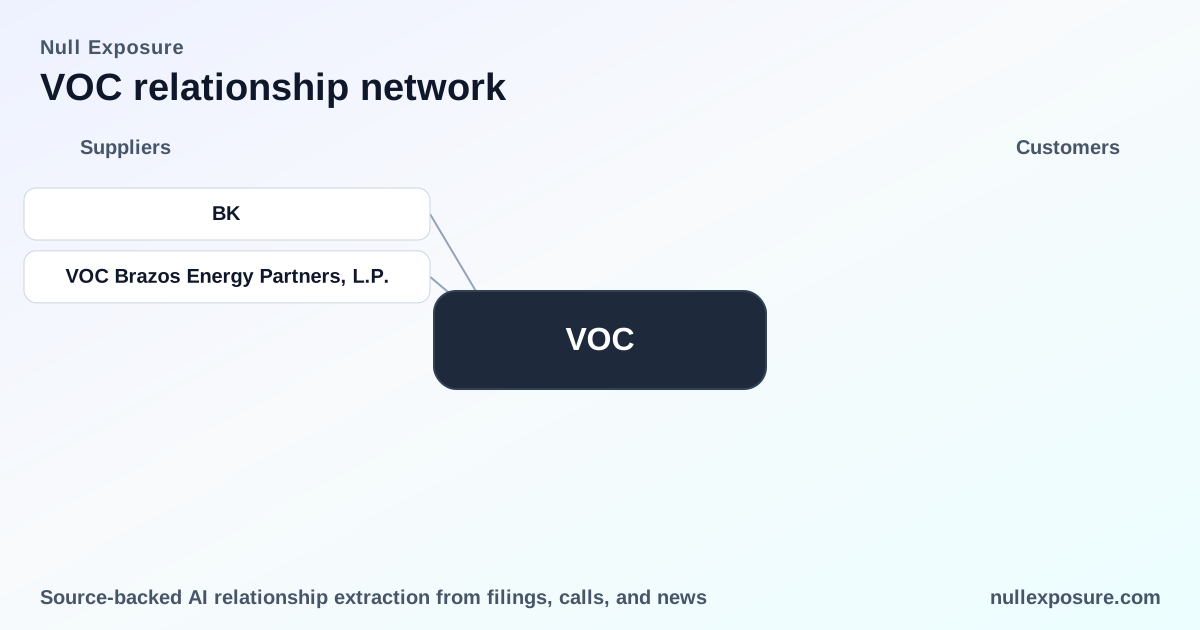
The Bank of New York Mellon Trust Company, N.A.
BNY Mellon acts as the Trustee for VOC Energy Trust and holds the legal trustee role that administers the trust structure and the conveyance of net profits interests. A registered trustee relationship places BNY Mellon at the center of governance and cash-flow custody for the trust. According to a StockTitan news release dated March 10, 2026, the Bank of New York Mellon Trust Company, N.A. is referenced explicitly “as Trustee.” (Source: StockTitan news item, March 10, 2026 — https://www.stocktitan.net/news/VOC/voc-energy-trust-announces-trust-quarterly-953rqyyh7234.html)
VOC Brazos Energy Partners, L.P.
VOC Brazos performs administrative services and serves as the operator (through affiliated VOC Operators) for substantially all underlying properties, collecting both a modest quarterly administrative fee and material per-active-well operator payments. Filings document an administrative services fee (contracted in trust documents) and operator payments that totaled approximately $1.8M in 2022, $2.0M in 2023 and $2.1M in 2024 for properties where VOC Brazos was designated operator. The trust notice captured in FY2026 and historical trust agreement language (dating back to May 10, 2011) confirm VOC Brazos’s dual administrative and operating role. (Sources: StockTitan notice, March 10, 2026; trust agreement and filing excerpts referencing May 10, 2011 and 2022–2024 payment figures.)
What the supplier map implies about VOC’s operating model
The constraints and relationship excerpts convey a concise operating picture that investors should model explicitly.
-
Contracting posture and maturity: The trustee and long-dated administrative arrangement (documented since at least May 10, 2011) indicate an entrenched governance framework and long-standing service contracts rather than ad hoc vendor relationships. That produces operational continuity but also switching friction if investors or the trust sought to replace service providers.
-
Concentration and criticality: VOC Operators (Vess Oil, L.D. Drilling, Davis Petroleum) operate substantially all the trust’s underlying properties. This concentrates operational risk in a small set of affiliated operators, making production and reserve realization highly dependent on their performance and capital allocation.
-
Spend profile and materiality: Two spend bands are present simultaneously. Administrative fees sit in the $100k–$1M band (the quarterly administrative fee cited and annual totals around low six figures), while operator-related payments are in the $1M–$10M band (the per-well monthly charge aggregated to $1.8M–$2.1M annually in recent years). That split means administrative services are immaterial to the trust’s headline cash flows, while operator payments are a material and recurring cash outflow tied to production activity.
-
Commercial posture: The service-provider signal and the active-stage designation show these are live, contractual relationships rather than dormant arrangements; the operators are currently executing field activity for the trust.
-
Market-supply exposure (company-level): Broader filings note the trust’s exposure to industry cyclicality—rig and equipment shortages drive input cost volatility. This is a company-level supply signal: when drilling and service costs rise, operator economics—and therefore trust distributions—face pressure through higher operating expenses. (Company filings and operational risk disclosures, FY periods cited in trust materials.)
Investment implications for operators and allocators
Institutional ownership is thin and insider ownership is high, while market capital is modest (market cap ~$59.5M). That ownership profile amplifies idiosyncratic event risk—operational surprises at the operator level or governance disputes could move distributions and equity value materially in a small float environment.
Key considerations:
- Governance and cash custody are centralized with BNY Mellon as Trustee, supplying legal robustness but not operational execution—operators run the wells.
- Operator concentration implies concentrated counterparty risk; underperformance by VOC Operators will translate quickly to lower receipts for the trust.
- Fee inflation and resource scarcity are direct levers on trust economics because operator payments are calculated per active well; higher input costs compress net proceeds.
- Minimal analyst coverage and a small public float reduce market liquidity and increase transaction costs for large reallocations.
If you want a compact view of counterparty roles and contractual exposure to support due diligence or risk modeling, see the detailed supplier index at https://nullexposure.com/.
Practical next steps for investors and counterparties
- Demand sightlines into operator operational KPIs (active well count, uptime, working interest) and contract mechanics (per-well charge structure), because those drive the trust’s highest cash-flow line items.
- Stress-test distributions against scenarios of increased drilling/service costs and a temporary decline in production, given the trust’s exposure to equipment shortages and input-cost inflation.
- Evaluate governance leverage: review trustee powers and replacement mechanics in BNY Mellon’s trustee agreement, since that is the legal control point for cash flows.
Three bold takeaways: BNY Mellon provides legal and administrative governance; VOC Brazos/affiliated VOC Operators run substantially all wells and capture the material operator payments; and the trust’s cash-flow sensitivity is concentrated in operator economics rather than administrative fees.
For a concise supplier risk dashboard and to build counterparty scenarios into your financial model, visit https://nullexposure.com/. For additional partner and contract-level intelligence, the supplier index and trust-document summaries are available on the same site: https://nullexposure.com/.
This relationship map is actionable: incorporate the operator-concentration and fee bands into your scenario workstreams, validate operational KPIs with field reporting where possible, and evaluate governance levers controlled by the trustee to understand the path for remediation if operational performance deteriorates.