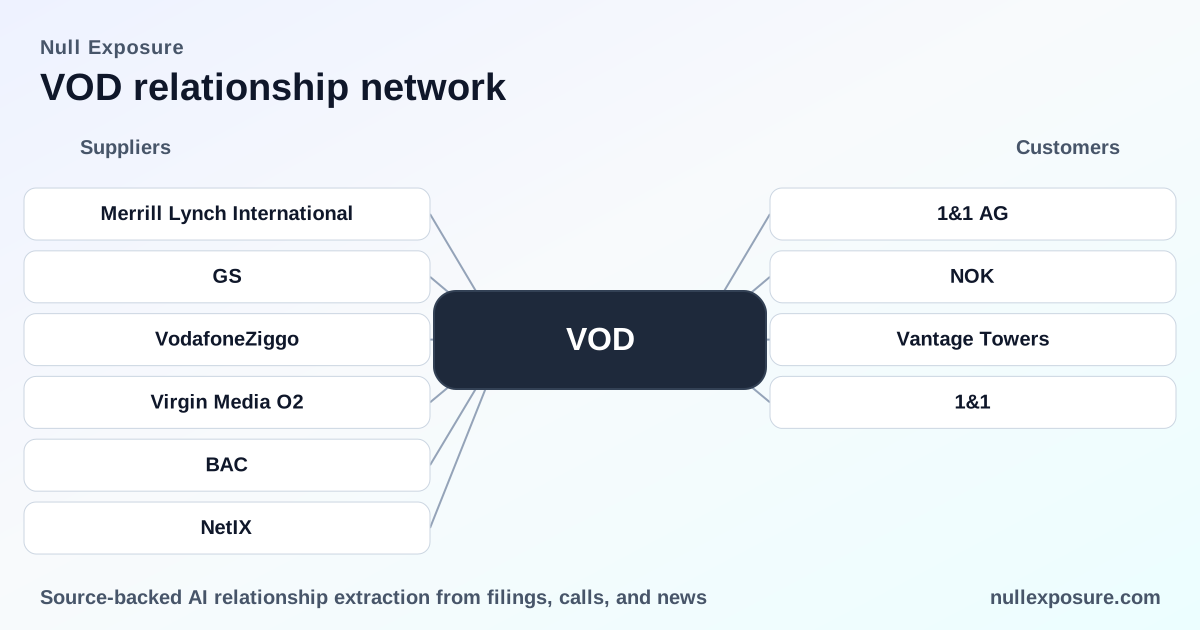
Vodafone Group PLC (VOD) — supplier relationship briefing for investors and operators
Vodafone operates as a global telecommunications provider selling mobile, fixed-line, broadband and wholesale network services across Europe and beyond. The company monetizes through recurring subscriber revenues, wholesale capacity sales, long-term group service agreements, and active capital allocation—most visibly through a concentrated program of share buybacks and treasury share management that recycles cash to shareholders while preserving balance-sheet optionality. For investors and procurement teams, the immediate signal is a company balancing operational growth (network partnerships and wholesale expansion) with deliberate capital-return mechanics executed through major investment banks. Learn more about contextual supplier exposure at https://nullexposure.com/.
The operating model that matters to commercial counterparties
Vodafone’s supplier posture is a mix of transactional engagements and strategic, multi-year service contracts. Operationally, Vodafone relies on large financial institutions to execute buybacks and treasury transactions and on specialist network providers to scale wholesale capacity in regional markets. That duality—financial counterparties for capital recycling and technical partners for network expansion—defines the vendor concentration and negotiating leverage in FY2026.
Key company signals for counterparties and investors:
- Active capital allocation through buybacks increases short-term treasury share volume and implies repeated, transactional relationships with banks that run programs on Vodafone’s behalf.
- Long-dated service charges to affiliated entities are material to cash flow planning and show a willingness to lock into multi-year internal and external commercial arrangements.
- Public financials show scale but mixed profitability: revenue of roughly €38.8bn (TTM), positive operating margin, but negative EPS, underscoring the importance of cash generation and financing decisions to near-term valuation.
If you evaluate supplier risk and opportunity for contracts with Vodafone, start with their capital program and network rollout timelines; you’ll get both the counterparty list and the cadence of future transactions. For an up-to-date supplier exposure view, visit https://nullexposure.com/.
Who Vodafone transacted with in FY2026 (what the record shows)
Below are the counterparty relationships surfaced in public reporting and news coverage for FY2026. Each entry is a plain-English summary with the original source referenced.
Merrill Lynch International / Merrill Lynch
Vodafone purchased shares through a program managed by Merrill Lynch International, with trades reported on Jan. 23 as part of its buyback activity and additional disclosures around early February executions. A market write-up from ts2.tech and trading commentary in February 2026 document these transactions and program activity. (ts2.tech, March 2026)
Goldman Sachs / Goldman Sachs International
Goldman Sachs (and its arm Goldman Sachs International) acted as a principal in multiple buyback executions, receiving non-discretionary instructions from Vodafone and transacting Ordinary Shares in February 2026 as part of a programme with a target expense cap of €500 million. Trading reports and an SEC-posted foreign issuer notice record buybacks executed on February 9, 12 and 24, 2026, raising Vodafone’s treasury share count materially in short order. (TradingView/Research-Tree/StockTitan reposts, Feb–Mar 2026)
VodafoneZiggo
Following a sale of a stake, Vodafone agreed to continue supplying certain group services to VodafoneZiggo with expected charges of approximately €625 million over the next ten years, indicating a long-term, material internal services arrangement that affects consolidated cash flow between the entities. This was described in regulatory and news summaries covering the transaction. (Reuters/TradingView summary, Feb 2026)
Virgin Media O2
Commercial talks have surfaced between Vodafone’s UK unit and Virgin Media O2 to give Vodafone access to sell fixed-line broadband using Virgin Media O2’s network, presenting a potential commercial partnership to leverage fixed infrastructure capacity in the UK market. Market coverage reported the negotiations and the strategic rationale for expanding fixed-line distribution. (ts2.tech, early 2026)
NetIX
Vodafone’s carrier division announced a network upgrade program in Greece partnering with NetIX to expand wholesale internet capacity—backed by subsea and terrestrial fibre routes—to scale traffic both into and out of the country. Media coverage framed this as part of a broader push to capture wholesale growth in a strategically important region. (ts2.tech and TradingView summaries, Feb–Mar 2026)
What these relationships mean for risk and opportunity
- Counterparty concentration in investment banking is high and transactional. Vodafone’s recurring use of major banks to execute buybacks means counterparties can expect standardized, high-volume trades rather than bespoke financing structures. That supports predictable execution risk, but also signals reliance on a small set of banks for capital recycling services.
- Long-term affiliated services are material to consolidated cash flow. The VodafoneZiggo arrangement—€625m over ten years—demonstrates operational interdependence inside the group and a willingness to commit to long-dated internal revenue streams that can both stabilize and complicate cash management.
- Network expansion partners are strategic and region-specific. Deals like the Greece wholesale expansion with NetIX are operationally critical for regional growth and demand-driven revenue; these relationships carry execution and capital intensity risks tied to infrastructure rollouts.
- Contracting posture mixes standard procurement with strategic, long-form agreements. For banks and network vendors the posture is largely transactional for buybacks and more strategic/long-term for network and service agreements.
For procurement and investor due diligence, focus on counterparties’ role (execution vs strategic partner), contract tenor, and operational criticality—those three axes determine supplier leverage, termination costs, and the timing of cash flows.
If your investment or sourcing decision depends on the cadence of Vodafone’s capital returns or wholesale rollouts, we track these counterparties and program signals in real time at https://nullexposure.com/.
Bottom line: where to watch next
Vodafone in FY2026 shows a clear two-track supplier footprint: banks for capital execution and specialist network partners for growth. Investors should prioritize monitoring buyback cadence and treasury share movement as a near-term valuation lever; operators and vendors should prioritize contract tenor and regional execution risk on network projects. The VodafoneZiggo service charges are a standout, long-duration cash flow item that operators and investors should model explicitly.
For detailed supplier intelligence and ongoing monitoring of counterparties like Goldman Sachs, Merrill Lynch, NetIX and strategic partners, visit https://nullexposure.com/ and subscribe for vendor-level alerts and analytical briefs.