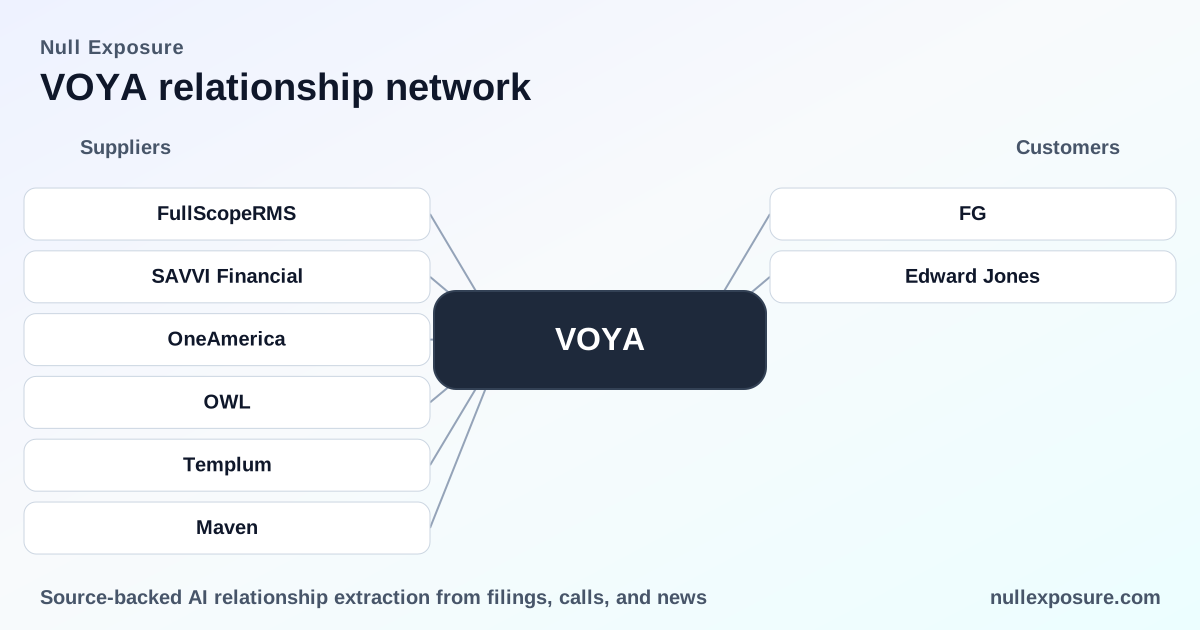
Voya Financial (VOYA) — supplier map and what it means for investors
Voya Financial is a U.S.-focused retirement, investment and employee benefits firm that monetizes through insurance premiums, asset management fees, adviser and institutional distribution fees, and investment spread income. The company runs a capital-intensive, contract-driven business where reinsurance, third‑party partnerships and private‑market access extend product reach while concentrating operational and counterparty risk. Investors should evaluate supplier relationships for how they support distribution, expand product capability, and introduce integration or reinsurance risk into Voya’s P&L.
Learn more about supplier intelligence at the source: https://nullexposure.com/
How Voya uses partners to extend product reach and manage risk
Voya’s operating model blends fee‑based asset management with traditional insurance economics. That hybrid creates four practical supplier constraints investors should track:
- Contracting posture: Voya executes both long‑duration and short‑duration contractual arrangements — long leases and long‑term reinsurance exposures sit on the balance sheet alongside short‑term ceded premium arrangements. This mix creates differing dependency horizons for suppliers and counterparties. (Company signal: long_term and short_term contract mentions in company filings, FY2024–FY2025.)
- Criticality: Reinsurance and leave‑management partners are operationally critical because they directly affect benefit delivery and insurance risk transfer; integration partners that power distribution and private markets expand revenue streams but increase execution complexity.
- Geographic exposure: Voya reports material European exposure (amortized cost c.$2.45bn as of 2024) that influences asset allocation and counterparty concentration in EMEA markets.
- Maturity and concentration: Long operating leases (the longest term cited to 2039 in filings) and large institutional ownership highlight a mature, institutionalized business with concentrated contractual timelines and investor expectations.
These are company-level signals drawn from Voya’s disclosures and recent reporting; they shape how supplier relationships affect near‑term cashflow and longer‑term strategic optionality.
The supplier roster — relationship-by-relationship read
Below are every supplier relationship identified in public filings and recent reporting, each summarized in plain English with its source.
FullScopeRMS
Voya partners with FullScopeRMS as a third‑party insurer to provide leave management and reinsure 100% of Voya’s group disability offering, making FullScopeRMS a critical transfer counterparty for benefits delivery. This is disclosed in Voya’s 2024 Form 10‑K (FY2024). (Source: Voya 2024 10‑K)
SAVVI Financial
Voya launched a retirement income guidance tool developed with SAVVI Financial to support workplace savers approaching retirement, indicating a distribution and product enhancement partnership for adviser and workplace channels. (Source: simplywall.st report on FY2026 coverage)
OneAmerica
Voya reported that the OneAmerica integration meaningfully exceeded financial targets and broadened adviser reach, signaling successful inorganic expansion that improved capabilities and client access. (Source: Q4 2025 earnings call transcript published on InsiderMonkey, FY2026)
Blue Owl (OWL)
Voya described Blue Owl’s private market capabilities as complementary and already embedded into advisor‑managed accounts, reflecting deeper private‑asset distribution and product integration with a notable alternative asset manager (Blue Owl, ticker OWL). (Source: Yahoo Finance coverage of FY2025/FY2026 commentary)
Templum
Voya Investment Management and Pomona Capital agreed to digitize investment access to the Pomona Investment Fund through Templum, indicating a technology and distribution tie that enables private fund access within Voya’s platforms. (Source: Finviz news item referencing the FY2026 announcement)
Maven
Voya referenced full access to benefits programs like Maven as evidence of corporate support for women and caregivers, reflecting a supplier relationship that augments employee benefits and talent retention programs. (Source: Fortune company profile referencing FY2026 programs)
What these relationships mean for returns and risk
The supplier map shows a deliberate strategy: extend distribution and private‑asset capabilities while offloading some insurance delivery and leave management to specialized partners. That strategy drives growth but creates measurable execution and counterparty risk.
- Growth levers: Partnerships with Blue Owl and Templum push Voya deeper into private markets and digital fund access, increasing fee revenue potential from advisor channels and institutional clients. SAVVI’s guidance tool and OneAmerica integration accelerate adviser adoption and client engagement, supporting fee growth.
- Operational risk: FullScopeRMS reinsuring 100% of group disability is a single-point operational dependency for that product line; failures in partner performance would have immediate claims and service delivery consequences. Maven‑type suppliers improve workforce outcomes but have less direct P&L impact.
- Balance‑sheet implications: The company’s mix of long‑duration reinsurance arrangements and long leases (long‑term contracts noted through 2039) locks in obligations and counterparty exposures that affect capital and liquidity planning. Short‑duration reinsurance accounting is used for other ceded arrangements, creating a dual horizon for counterparty risk.
- Geographic nuance: Voya’s reported EMEA exposure (~$2.45bn amortized cost as of 2024) requires attention to regional counterparties and asset concentration in the UK, Netherlands, France and Germany when assessing supplier credit and market risk.
Key takeaway: the supplier strategy strengthens distribution and product depth, but investors should underwrite counterparties for reinsurance, private‑market custody and integration execution as part of any valuation or operational due diligence.
Learn more about how to vet supplier risk in financial services at https://nullexposure.com/
How to use this supplier intelligence in an investment process
- Prioritize diligence on reinsurance counterparties for credit and settlement performance, since those arrangements transfer direct insurance risk.
- Validate integration KPIs for acquisitions and platform partnerships (OneAmerica, Blue Owl) because earnings leverage depends on successful adviser adoption.
- Monitor EMEA asset exposure and counterparties separately from U.S. domestic partners given regional concentration noted in filings.
Final takeaways and next steps
Voya’s supplier set is strategically diverse: reinsurance and leave management secure core insurance delivery, while FinTech partners and alternative managers expand fee pools and distribution. Investors should weight these relationships by criticality: reinsurance partners like FullScopeRMS are high‑impact on claims and reserves, while Blue Owl and Templum are growth multipliers for fee income.
For a deeper supplier risk profile and continuous monitoring, visit https://nullexposure.com/ and consider integrating partner‑level diligence into your investment checklist.