Voyager Technologies (VOYG): Supplier network that underwrites a space‑era growth story
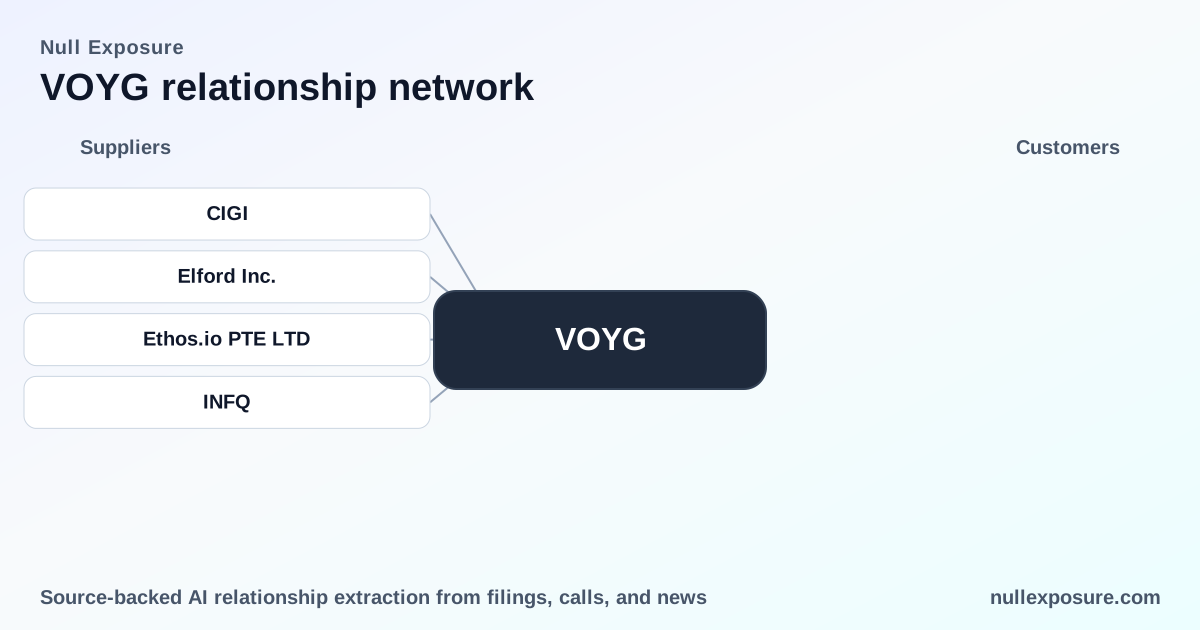
Voyager Technologies sells defense and space systems and monetizes through a mix of government and commercial contracts, platform integrations, and partner‑led deployments that place proprietary hardware and software onto orbital platforms. The company converts R&D and integration capability into contract revenue and strategic tethering with platform owners and technology vendors, producing revenue growth while the business scales toward operating leverage. For a concise mapping of supplier exposures that affect delivery timing and program risk, review the company supplier relationships below. Learn more about supplier risk tools at https://nullexposure.com/.
How Voyager makes money and where suppliers matter
Voyager’s revenue base derives from systems integration, space hardware, and mission services sold to defense and commercial customers. Contracts are delivery‑and‑integration heavy, which makes supplier performance and specialty suppliers (clock makers, construction partners, tenant‑recruitment firms) central to program schedules. The company reported $166.4M in trailing revenue with negative operating margins and EBITDA losses, indicating a stage of scaling where top‑line growth trades off against investment in launch, demonstrations, and integration.
Financial profile signals: market capitalization roughly $1.63B, unprofitable operations (negative EBITDA), and analyst consensus price target around $42. Institutional ownership is high at ~58%, indicating professional investor interest in the strategic growth narrative even as Voyager matures its cost structure.
Operating model constraints and what they tell investors
Voyager’s supplier relationships and public metrics reveal several company‑level operational characteristics:
- Contracting posture: Execution is integration‑led; Voyager wins program work that is contingent on third‑party components and platform access, which creates milestone‑driven cash and schedule risk.
- Concentration and criticality: Strategic suppliers are critical for demonstration milestones (e.g., space station integration, specialized clocks). Failure or delay from a single supplier can produce program slippage and revenue timing shifts.
- Maturity and margin profile: The company is in a growth‑at‑cost phase — accelerating revenue (quarterly revenue growth year‑over‑year ~23.7%) but negative profitability — so supplier cost control and reliable partner delivery are immediate drivers of near‑term margin improvement.
- Governance and investor base: Heavy institutional ownership aligns incentives toward scaling and de‑risking program execution ahead of value realization.
Supplier relationships that matter — what the records show
Colliers International (CIGI) — tenant recruitment for Columbus project
Colliers International is leading global tenant recruitment for Voyager’s Columbus Space Science Park project, positioning Colliers as the commercial real‑estate supplier responsible for populating the facility and unlocking recurring occupancy revenue. According to a Columbus Navigator article published in March 2026, Colliers is heading up global tenant recruitment for the Columbus development.
Elford Inc. — pre‑construction delivery partner in Columbus
Elford Inc., a Columbus‑based contractor, is leading the pre‑construction phase of the Columbus Space Science Park, making Elford a critical on‑the‑ground supplier for facility delivery and tie‑in of Voyager’s ground and integration capabilities. The Columbus Navigator piece (March 2026) identifies Elford as the pre‑construction lead for that project.
Ethos.io PTE LTD — earlier wallet and custody integration (2018)
Voyager announced a partnership with Ethos.io in 2018 to incorporate Ethos Bedrock as a self‑custody option and to integrate the Ethos Universal Wallet alongside Voyager’s execution, data and custody services, indicating a prior strategy of leveraging external crypto custody and wallet suppliers for digital asset functionality. A Newswire release from 2018 detailed the Ethos and Voyager collaboration on custody and wallet integration.
Infleqtion (INFQ) — quantum clock integration for ISS and Starlab (press and industry reporting)
Infleqtion and Voyager announced a partnership to demonstrate advanced quantum technologies by integrating Infleqtion’s Tiqker Quantum atomic clock aboard the International Space Station and later on Starlab, marking Infleqtion as a high‑value technology supplier for precise timing and navigation demonstrations. Voyager’s press release (Nov 2025) and a November 2025 industry report on SatNews documented the collaboration and the planned integration roadmap.
Infleqtion (INFQ) — company release confirms project sequencing
In a complementary company press release on Voyager’s website (Nov 2025), Voyager reiterated the integration plan with Infleqtion’s Tiqker Quantum clock and the staged demonstrations on ISS then Starlab, underscoring the supplier’s role in enabling high‑profile technology validation milestones.
What these supplier relationships imply for investors
The supplier roster spans real‑estate and construction contractors on Earth (Colliers, Elford) and high‑technology vendors in orbit‑grade components (Infleqtion) as well as legacy digital custody partners (Ethos). That mix exposes Voyager to both infrastructure delivery risk and specialized technology integration risk — delays in either domain can move revenue recognition and compress near‑term cash flow.
Key investment implications:
- Execution hinge: Revenue and valuation catalysts depend on successful coordination between terrestrial delivery partners (to build and operate infrastructure) and technology suppliers (to validate spaceborne systems).
- Proof points matter: Infleqtion integrations are high‑visibility, technology‑validation events that will materially de‑risk the product narrative if executed on schedule.
- Cost and timing risk: Construction and tenant‑recruitment suppliers determine when facilities can host revenue‑producing tenants, linking real‑estate supplier performance directly to Voyager’s commercial ramp.
If you want a supplier‑level risk digest or to map counterparty exposures across Voyager’s program pipeline, visit https://nullexposure.com/ for tailored supplier intelligence.
Practical takeaways for portfolio managers
- Focus on milestone calendars for the Infleqtion integrations and construction schedules for the Columbus project; these are the near‑term de‑risking events that convert investment into repeatable revenue.
- Monitor supplier contract terms and visibility of contingency planning; Voyager’s delivery model relies on third‑party performance, so contractual protections and schedule buffers are value drivers.
- Track operating leverage: improved supplier management and on‑time integrations will be the lever that shifts negative operating margins toward profitability.
Visit https://nullexposure.com/ to subscribe to supplier monitoring and receive alerts tied to these exact counterparties.
Bottom line
Voyager’s supplier network is a mixed basket of high‑technology integrators and real‑estate delivery partners that collectively determine whether the company converts its technical capability into recurring enterprise revenue. Successful program execution across these suppliers is the single biggest value driver for the equity: timely Infleqtion demonstrations and on‑schedule Columbus facility delivery will substantively reduce program risk and unlock the revenue path implied by current analyst expectations. For investors and operators, the critical question is not whether Voyager can design advanced systems — it is whether its suppliers can deliver them into operational contexts on schedule. Explore ongoing supplier exposure analysis at https://nullexposure.com/.