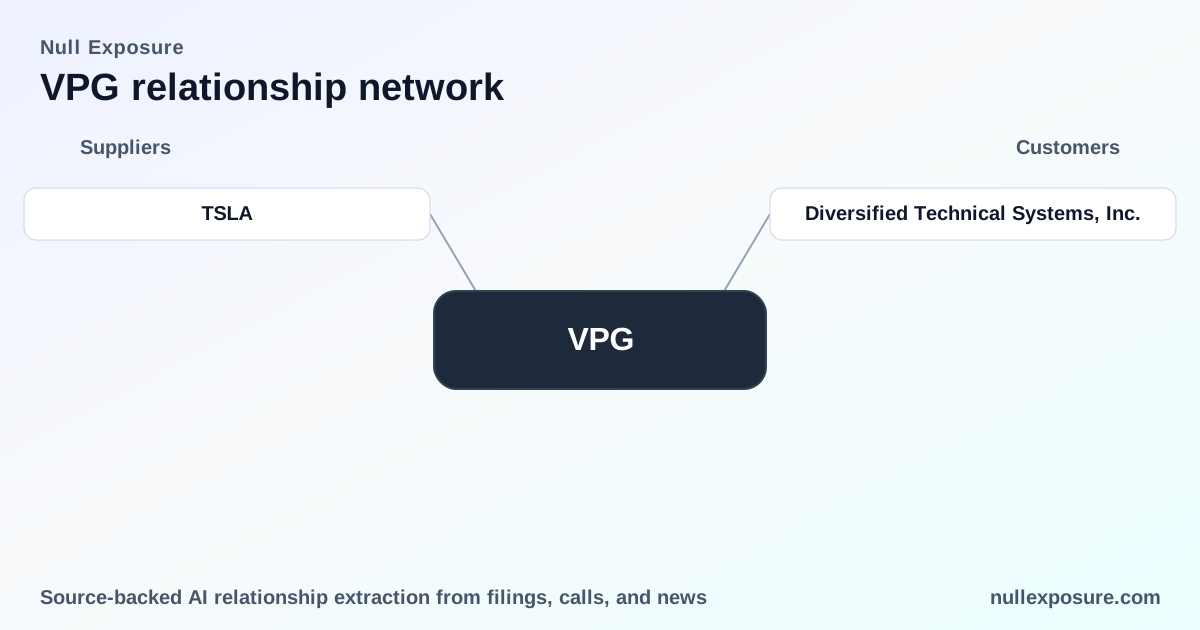
Vishay Precision Group (VPG): Supplier Footprint, Risks, and the Tesla Link Investors Should Price In
Vishay Precision Group (VPG) designs and manufactures sensors, sensor-based measurement systems, special resistors, and strain gauges and monetizes through product sales to industrial, aerospace, automotive and research customers worldwide. Revenue is generated from engineered hardware and measurement systems sold directly and through distributors, with margin sensitivity driven by component sourcing and specialty-material content. As of the latest quarter (ending 2025-12-31), VPG reported roughly $307.2M in revenue and an EBITDA of $25.2M, while the market values the company at about $547M—a mix that frames VPG as a specialized industrial-tech franchise with premium valuation multiples and thin absolute profitability.
For a concise supplier-risk profile and relationship map, visit the VPG coverage hub at https://nullexposure.com/.
How VPG’s business model converts engineering into cash
VPG’s product portfolio is tightly focused on measurement and sensing hardware: strain gauges, resistors, sensor-based measurement instruments, and related assemblies. The company monetizes through unit sales of higher-margin engineered components and through systems sales where integration and calibration add value. Geography and end-market diversification are useful guardrails—the business operates across the United States, Europe, Israel, Asia and Canada—but product-level concentration on specialty materials elevates supply-side risk.
Key financial context that defines investor expectations:
- Revenue (TTM): $307.2M; Gross profit $119.7M.
- Trailing P/E ~102.9; Forward P/E ~61.35; EV/EBITDA ~18.9. These multiples imply the market prices in substantial future margin or growth improvement relative to current earnings.
- Operating margin (TTM) ~2.3% and net profit margin ~1.72%, which signals operating leverage and procurement control are material drivers of near-term earnings.
Explore additional supplier intelligence and portfolio signals at https://nullexposure.com/.
What the public record shows about supplier and customer links
Below I cover every supplier/partner relationship flagged in available sources and explain the investor-relevant implication in plain English.
Tesla — an industrial customer mention in market commentary
A StockTwits news piece dated March 10, 2026, described VPG as a “picks-and-shovels” supplier supporting Tesla’s humanoid robotics ambitions, spotlighting VPG’s relevance to advanced electromechanical systems. The article frames VPG as a critical parts supplier for Tesla initiatives and implies strategic exposure to a high-profile OEM: https://stocktwits.com/news-articles/markets/equity/citron-long-on-tesla-supplier-vishay-precision/chfes1KRbeJ (Mar 10, 2026).
This is a single public-market mention rather than a formal customer disclosure; treat it as a short-form media assertion of relevance rather than documentary proof of contract size.
Supply constraints and what they mean for operations and risk
VPG’s public disclosures include language that some of its most specialized materials are available only from a relatively limited number of suppliers and some are sourced from a single vendor, and that the company maintains safety stock for certain critical materials. That language is an explicit company-level signal; it is not tied to any one named customer in the excerpts but materially shapes operational posture.
Investor-relevant implications:
- Concentration risk: Single-vendor sourcing for specialized inputs creates a defined procurement vulnerability. Interruptions to those suppliers directly threaten production cadence for the highest-value SKUs.
- Criticality and contracting posture: The company’s decision to hold safety stock indicates an established recognition of critical supply dependencies and implies negotiations structured around continuity rather than purely spot-market pricing.
- Operational maturity: Maintaining safety stock and acknowledging single-source elements reflect a mature supply-management approach, but the approach transfers inventory and working-capital burden to VPG rather than to upstream suppliers.
- Risk-to-profit trade-off: Given low absolute margins, any sustained disruption, price increase, or forced dual-sourcing program would compress profitability quickly; conversely, stable supply enables margin expansion given high valuation multiples.
What investors should watch next — an actionable checklist
- Verify customer exposure to major OEMs. The Tesla mention is notable but unverified in contract terms; investors should seek line-item revenue disclosure or supplier confirmations to convert market chatter into model inputs.
- Probe single-source items and mitigation plans. Determine which materials are single-sourced, supplier location concentration, and the costs/timelines to qualify alternates.
- Monitor inventory and working-capital trends. Safety-stock policies reduce outage risk but raise working-capital needs; track changes in inventory days and procurement cost trends in quarterly reporting.
- Margin sensitivity analysis. Given thin operating margins, model scenarios where raw-material cost inflation or supply disruption reduces gross margins by increments of 100–300 bps to see earnings leverage.
Mid-analysis resource: for a deeper supplier-risk walkthrough and comparative supplier intelligence, visit https://nullexposure.com/.
Pricing, valuation and strategic takeaways
- Valuation reflects future margin or growth potential more than current cash earnings. With a trailing P/E north of 100 and EV/EBITDA near 19, VPG’s market price embeds expectations about margin improvement or higher growth. Execution risk sits in procurement and sales conversion to higher ASP systems.
- Supply-side concentration is the primary operational risk. The company’s own language on single-vendor sourcing and maintained safety stock is a clear red flag investors must quantify; it is a company-level constraint that crosses all customer relationships.
- Customer publicity can lift sentiment but not replace contract visibility. High-profile mentions—such as the Tesla story—can drive trading and attention, but underwriting value requires revenue breakdowns and confirmed order flow.
Bottom line and next steps for investors
VPG is a specialized industrial-tech manufacturer with discernible upside tied to executing margin expansion and protecting supply continuity, and downside concentrated in single-vendor exposures and thin current profitability. Confirmations of meaningful orders from large OEMs would materially de-risk the valuation; conversely, any supplier interruption would rapidly erode earnings. For a practical next step, corroborate customer revenue line items in the 10‑K/10‑Q and insist on supplier diversification evidence in investor calls.
For ongoing coverage and supplier-risk tools tailored to investors and operators, go to https://nullexposure.com/.
Key links referenced:
- StockTwits news coverage of VPG’s mention with Tesla (Mar 10, 2026): https://stocktwits.com/news-articles/markets/equity/citron-long-on-tesla-supplier-vishay-precision/chfes1KRbeJ
- Company disclosure language on single-source materials and safety stock (company filings; disclosure excerpts aggregated from investor materials and regulatory filings through FY2025).