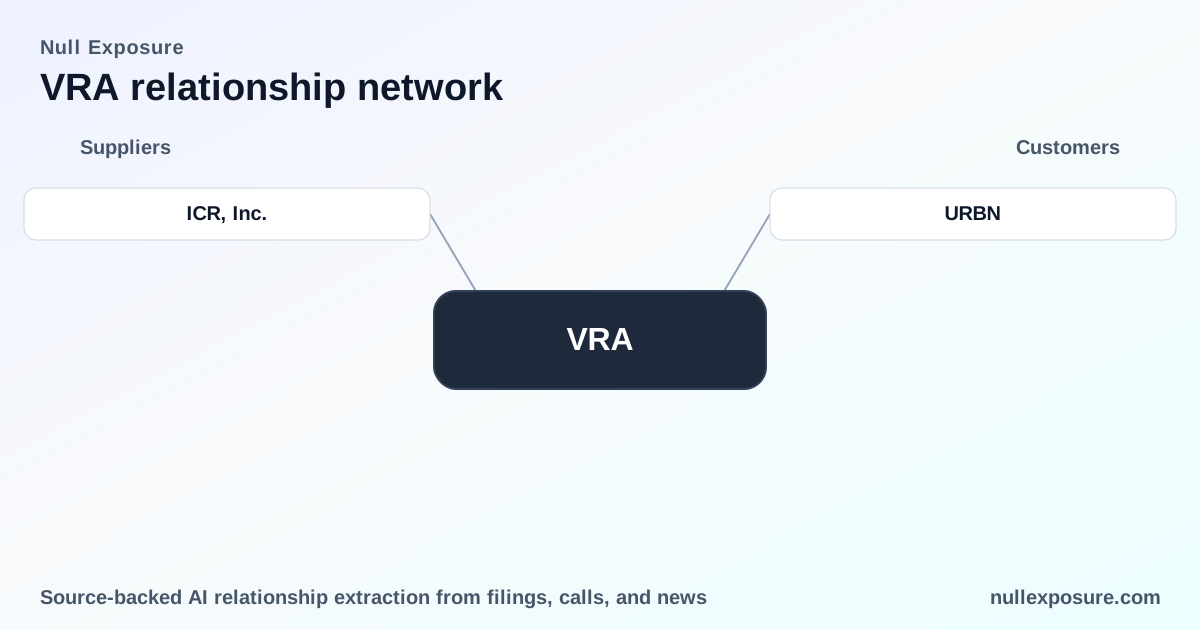
Vera Bradley (VRA) — supplier posture, partner signals, and what investors should price in
Vera Bradley is a branded lifestyle retailer that designs, sources and sells women's handbags, luggage, accessories and home goods, monetizing through wholesale, owned retail and direct-to-consumer channels; the company operates a network of leased stores, sells through indirect retailers and runs an e-commerce channel. For investors, the core economic levers are gross margin on finished goods sourced offshore, retail footprint economics under long-term leases, and distribution cost control via third‑party carriers. If you evaluate supplier relationships for exposure and resilience, prioritize the company’s APAC manufacturing footprint, Latin American specialty sourcing, and logistics providers. Learn more about mapping supplier risk at https://nullexposure.com/.
What the supply picture actually looks like for investors
Vera Bradley sources a majority of its finished goods from manufacturers located across Cambodia, Vietnam, Indonesia, China and the Philippines, while certain branded partners such as Pura Vida are sourced primarily from El Salvador. The company also leases all its retail stores, with lease terms generally around ten years and renewal options, which fixes occupancy costs and makes retail network changes slow and capital‑intensive. Company disclosures show that finished goods are produced by a variety of global manufacturers rather than a single dominant factory, and finished product movement to stores and customers is handled via third‑party common carriers.
- Supply concentration: The manufacturing base is geographically concentrated in APAC and selected LatAm suppliers, which trades off lower unit costs for elevated geopolitical, transport and labor risks.
- Contracting posture: Long‑term retail leases reduce short‑term flexibility but support network stability and predictable occupancy expense.
- Operational criticality: Finished‑goods manufacturers and logistics carriers are critical to revenue realization; a disruption in APAC production or in ocean/air freight would directly pressure near‑term sales and margins.
- Maturity and diversification: Using many small manufacturers in several countries signals operational diversification but creates management complexity and supplier quality/mix risk.
Detailed supplier and partner relationships surfaced in public releases
Below are every relationship instance found in recent press coverage; each entry is concise and sourced.
ICR, Inc. — investor relations contact for FY2026 reporting date
A StockTitan news post dated March 10, 2026 lists Tom Filandro, Partner at ICR, Inc., as the investor contact for Vera Bradley’s FY2026 fourth quarter reporting date, indicating the company’s use of an external IR partner for investor communications. (StockTitan, March 10, 2026)
ICR, Inc. — investor relations contact for FY2025 results announcement
A Globe and Mail press release referencing Vera Bradley’s FY2025 third quarter results names Tom Filandro at ICR, Inc. as the investor relations contact, underscoring continuity in outsourced investor communications across reporting periods. (The Globe and Mail press release, March 2026)
ICR, Inc. — contact referenced in board appointment announcement
A StockTitan item covering a board appointment in 2026 again lists ICR, Inc. (Tom Filandro) as the investor relations contact, suggesting ICR’s retained role in managing outreach around governance and corporate events. (StockTitan, March 10, 2026)
How these relationships affect valuation and operational risk
ICR, Inc. shows up consistently as the external investor relations provider, which is material to how management frames performance and to the market’s access to guidance and clarifying commentary. That is a communications/market‑facing relationship rather than an operational supplier, so its direct impact on production or margins is limited, but it influences share liquidity, price discovery and investor confidence.
Operationally, the company signals two primary supplier exposures:
- APAC manufacturing is the backbone of finished‑goods supply; that gives cost leverage but exposes Vera Bradley to factory disruptions, rising freight costs, and regional wage inflation.
- LatAm specialty sources (e.g., Pura Vida from El Salvador) introduce single‑country concentration risk for certain product lines and require separate supplier oversight.
Long‑term retail leases amplify downside when traffic or sell‑through falters because fixed occupancy costs are sticky; conversely, those same leases stabilize retail presence when product and marketing execution is strong.
Investment implications and red‑flag checklist for due diligence
For investors and operators assessing supplier relationships, focus on these actionable points:
- Evaluate the APAC supplier roster and relative concentration by country and vendor: diversified country exposure reduces single‑point failure risk, but vendor fragmentation increases quality and logistics oversight needs.
- Stress test margin models for freight inflation and lead‑time shocks; third‑party carrier dependence shifts transport cost and capacity risk to the company.
- Review lease obligations in the footnotes: ten‑year average retail leases constrain network optimization and raise fixed overhead sensitivity to revenue shortfalls.
- Monitor corporate communications cadence and clarity because ICR’s role as IR contact means market perception and guidance delivery are outsourced, which affects how quickly the market prices surprises.
If you want structured supplier maps and red‑flag monitoring tools for retail supply chains, explore more at https://nullexposure.com/.
What to watch next and how to position
- Watch for quarterly commentary on order books, lead times, and freight cost pass‑through; management disclosures provide the earliest signs of margin pressure.
- Track any updates to the supplier roster or strategic sourcing changes—moves toward near‑shoring or consolidation would materially change cost and risk profiles.
- Monitor the company’s retail portfolio optimization and any attempts to sublease or renegotiate long‑term retail leases; such moves signal willingness to flex fixed costs.
Bottom line and investor action
Vera Bradley runs a manufacturing‑intensive, leased‑store retail model with concentrated APAC and targeted LatAm sourcing and third‑party logistics reliance. These structural elements create both cost upside when sourcing is controlled and downside when supply or freight markets dislocate. For investors, the principal risks to price into multiples are supply‑chain disruptions, freight inflation, and lease fixed‑cost rigidity—while the primary levers to improve enterprise value are sourcing optimization and retail productivity.
For hands‑on supplier mapping and monitoring resources tailored to retail supply chains, visit https://nullexposure.com/ to start a deeper review.
For further diligence or to see supplier‑level signals across apparel and accessories names, the platform and reports linked at https://nullexposure.com/ provide structured views that accelerate investor workflows.