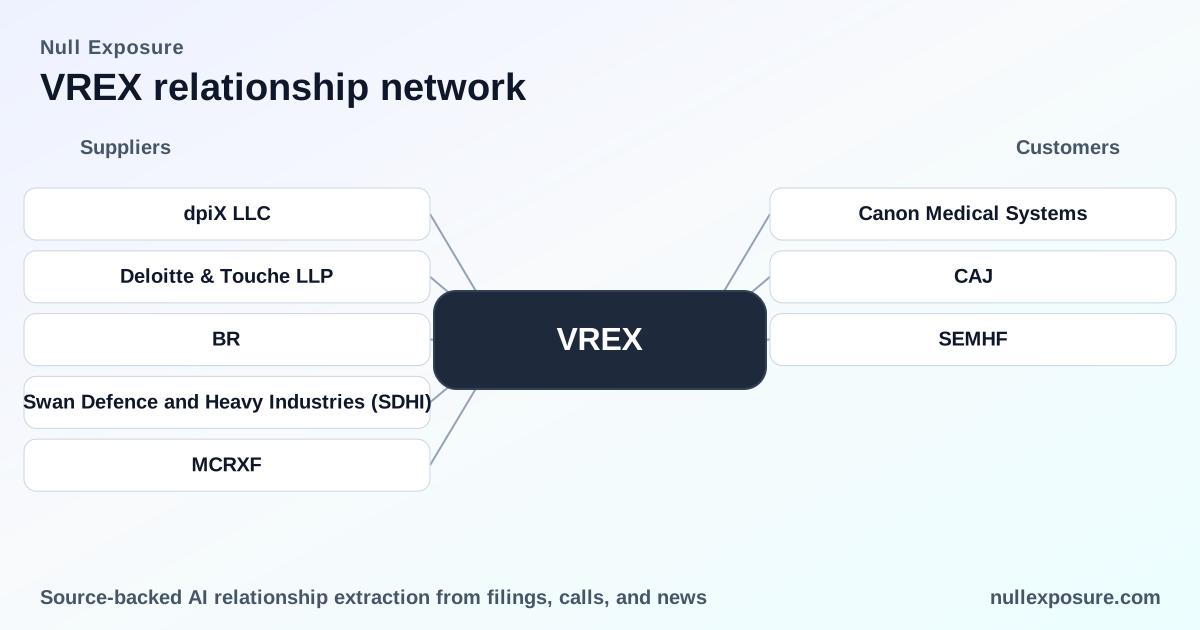
Varex Imaging (VREX): Supplier footprint, contract posture, and investor implications
Varex Imaging designs and manufactures X‑ray imaging components and monetizes by selling detectors, tubes, and sub‑assemblies to OEMs and service providers in medical and security markets; the company combines in‑house system design with outsourced manufacturing of certain sub‑assemblies, collects product revenue from hardware sales, and supports recurring aftermarket and service demand. Varex’s supplier relationships and partial ownerships are operationally meaningful because they influence production continuity for key detector components and the company’s ability to meet OEM timelines and aftermarket demand. Learn more at https://nullexposure.com/.
How Varex organizes supply and production in practice
Varex runs a mixed model: system design, final assembly, and testing are retained internally, while certain sub‑assemblies and specialized manufacturing are outsourced to contract manufacturers or supplied through minority ownerships. The company reports non‑cancellable supplier purchase obligations of roughly $3.0 million as of October 3, 2025, signaling a degree of committed spend and multi‑period supplier exposure (constraint confidence: 0.60). This structure drives two principal commercial characteristics: predictable near‑term cash obligations to suppliers and concentrated dependence on a limited set of specialized vendors for high‑value detector components.
Visit https://nullexposure.com/ for a consolidated view of supplier signals and filings.
Supplier and partner relationships you need to know
Below are the supplier and meeting‑service relationships disclosed in Varex’s filings and recent reporting, each summarized in plain English with source context.
dpiX LLC — strategic supplier and partly owned holding
Varex holds a 40% ownership interest in dpiX Holding Company LLC, which owns dpiX LLC, a supplier of amorphous silicon thin‑film transistor arrays used in Varex digital image detectors; this is both a supplier relationship and an equity interest that aligns supplier incentives with Varex product needs. According to Varex’s FY2025 10‑K, dpiX supplies critical detector arrays to the company.
Deloitte & Touche LLP — independent auditor ratified for FY2026
Shareholders ratified the appointment of Deloitte & Touche LLP as Varex’s independent registered public accounting firm for fiscal 2026, reaffirming continuity in external audit oversight and financial reporting. This ratification was reported in preliminary meeting results covered in a StockTitan SEC‑filings summary and a MarketBeat recap of the 2026 virtual annual meeting (Feb–Mar 2026).
Broadridge Financial Solutions — virtual meeting and vote tabulation services
Broadridge served as the inspector of elections for Varex’s 2026 virtual annual meeting, validating shareholder votes and facilitating online question submission, which broadens shareholder participation and streamlines governance workflows. MarketBeat’s write‑up on the 2026 virtual AGM described Broadridge’s role in meeting administration (Feb 2026).
Swan Defence and Heavy Industries (SDHI) — exclusive contract manufacturer for high‑energy systems in India
Varex contracted SDHI to exclusively manufacture its high‑energy imaging systems at SDHI’s Pipavav, Gujarat facility, extending Varex’s manufacturing footprint and leveraging regional capacity for cargo/scanner products. A March 2026 news report on the agreement noted exclusive manufacturing and local production arrangements.
Micro‑X — technology transfer payment completed
Varex recorded the final $1.0 million payment related to a technology transfer from Micro‑X, reflecting the completion of a negotiated transfer of IP/technology that supports specific product capabilities. This payment was disclosed during Varex’s Q1 FY2026 earnings call transcript (reported March 2026).
What the contract excerpts and constraints reveal about operating risk
The company’s disclosures and extracted constraints paint a consistent operational picture:
-
Contracting posture: Varex enters into purchase agreements that include non‑cancellable obligations — the company reported about $3.0 million in non‑cancellable supplier purchase obligations as of October 3, 2025. That figure signals firm near‑term cash commitments rather than purely spot purchasing (constraint: long_term, confidence 0.60).
-
Spend scale and concentration: The disclosed non‑cancellable obligations place supplier spend in the $1M–$10M range, implying material but not enormous committed spend lines relative to $854M revenue TTM; however, concentration on specialized components elevates operational criticality (constraint: spend_band 1m_10m, confidence 0.90).
-
Supplier criticality: Varex explicitly flags reliance on a limited number of suppliers for key components—transistor arrays, cesium iodide coatings for detectors, specialized ICs, X‑ray tube targets and housings—making those suppliers critical to product delivery and margin preservation (constraint: materiality critical, confidence 0.60).
-
Role definition: The company acts primarily as buyer for components while also outsourcing manufacturer roles for sub‑assemblies—this dual posture allows focus on higher‑margin system integration but creates dependency on contract manufacturers for scale and cost management (constraint: relationship_role buyer and manufacturer, confidence 0.80).
Taken together, these signals highlight a supplier base that is operationally critical, moderately concentrated, and supported by explicit contractual commitments.
Investor implications and a short risk checklist
- Supply continuity is a first‑order risk. Concentration in detector arrays and coatings means production outages at a single supplier could materially disrupt revenue from imaging systems.
- Minority equity stakes (e.g., dpiX) reduce but do not eliminate supplier risk. A 40% stake in the supplier holding company aligns interests but leaves Varex without full operational control.
- Contract manufacturing extends capacity but shifts quality and timing risk to partners like SDHI; exclusive manufacturing relationships can accelerate scale but create single points of failure.
- Governance and audit continuity reduce reporting risk. Ratification of Deloitte and use of professional meeting services like Broadridge are governance positives for institutional investors.
Use this checklist when you model downside scenarios: supplier outage duration, replacement lead times for single‑source components, and margin sensitivity to price pass‑through for bespoke parts.
Final takeaways and next steps
Varex’s supplier landscape combines strategic minority holdings, exclusive manufacturing agreements, and standard purchase commitments, creating a profile that is operationally efficient but exposed to concentrated supplier risk for critical detector components. For investors and sourcing partners, the emphasis should be on monitoring supplier continuity indicators, contractual terms on exclusivity, and any incremental capital commitments to in‑house production.
Explore supplier signaling and filing‑level context in more depth at https://nullexposure.com/ — the homepage offers access to the primary sourcing and disclosure signals used in this analysis.
If you want a focused supplier risk brief or a scenario‑driven stress test for Varex’s supply chain, start here: https://nullexposure.com/.