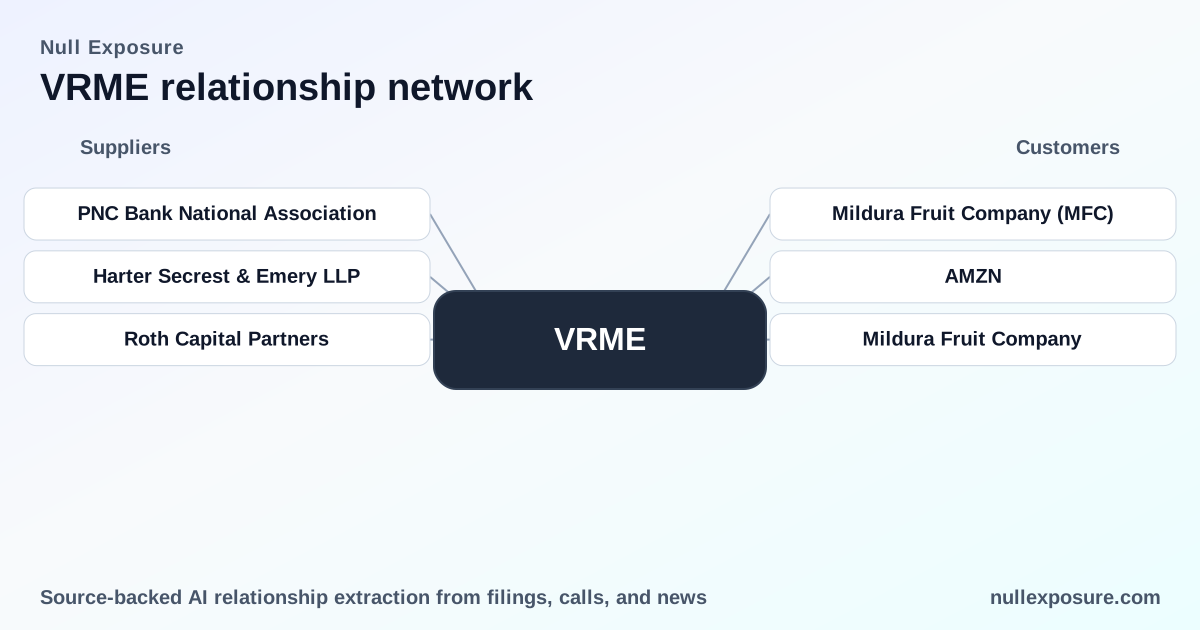
VerifyMe (VRME): Supplier relationships, constraints, and what investors should know
VerifyMe operates as a provider of brand protection and supply-chain services, monetizing through a mix of technology-enabled services, licensing, and transaction-based logistics tied to identity and authentication offerings. The company funds operations with working capital facilities and occasional capital-marketing arrangements while engaging external counsel for strategic transactions. This review maps the supplier and service-provider relationships disclosed in public sources and translates contract concentration and operational constraints into investor-grade risk signals.
If you want a broader view of counterparty exposure across small-cap suppliers, see our research hub: NullExposure homepage.
Quick investor thesis: business model and monetization
VerifyMe generates revenue from label- and tag-based authentication, supply-chain visibility services, and a logistics-oriented segment called Precision Logistics. Revenue flows come from recurring services and per-shipment fees in time- and temperature-sensitive parcel management, supplemented by occasional licensing or transaction-based financing events. Profitability is fragile; quarterly results show negative EPS and thin margins, so supplier concentration and financing arrangements materially affect operational resilience.
Banking relationship that underpins working capital
PNC Bank National Association
VerifyMe maintains a credit facility with PNC Bank that includes a $1 million revolving line of credit (RLOC) used for short-term working capital. This is disclosed in the company’s FY2024 10‑K and represents the principal bank liquidity provider reported by management. (Source: VerifyMe FY2024 10‑K filing.)
Legal counsel for strategic M&A activity
Harter Secrest & Emery LLP
In connection with VerifyMe’s announced merger with Open World Ltd., Harter Secrest & Emery LLP is serving as counsel to VerifyMe, indicating the firm’s role in executing material corporate and securities work for the company. The engagement is reported in March 2026 merger coverage and aligns legal resources with the company’s strategic transaction. (Source: March 2026 news release reported by QuiverQuant.)
Capital markets relationship recently closed
Roth Capital Partners
VerifyMe terminated its at‑the‑market (ATM) sales agreement with Roth Capital Partners, signaling a change in how the company intends to access small equity raises in public markets; termination removes an immediate channel for incremental share issuance under that program. The termination was reported in March 2026 trading coverage. (Source: March 2026 coverage on TradingView.)
Company-level constraint signals that matter to investors
The filings and relationship excerpts contain three clear operational constraints that define risk posture and supplier dependence:
-
Critical vendor concentration for transportation: Company disclosures state that during the years ended December 31, 2024 and 2023, a single vendor accounted for 99% of transportation costs in the Precision Logistics segment. This is a structural concentration risk: one provider effectively controls the segment’s delivery economics and operational continuity, which creates outsized supplier power and single-point-of-failure exposure. (Source: company disclosure cited in constraints, referencing fiscal years 2023–2024.)
-
Service-provider role and outsourcing posture: Excerpts highlight that PeriShip Global partners with a major global carrier for all its customers’ shipping needs, and the business relies on third-party parcel management for time- and temperature-sensitive logistics. This demonstrates a heavy outsourcing model for core fulfillment functions where the company operates more as a value-added coordinator than an in-house carrier. The contracting posture is vendor-driven and operationally dependent on external logistics platforms. (Source: company disclosure excerpts describing PeriShip Global and Precision Logistics operations.)
-
Segment maturity and criticality: The Precision Logistics line is presented as a services segment focused on specialized parcel management; its economic significance is amplified by the transportation concentration. For investors, that combination indicates a mid-stage services business—not a fully integrated logistics operator—where margin and reliability are contingent on partner performance and contract terms. (Source: company narrative in FY2024 filings and constraint excerpts.)
These constraints are company-level signals unless a disclosure explicitly names a relationship; only PeriShip Global is named in the constraint excerpts, so all other supplier concentration commentary should be read as enterprise-wide operational risk.
What these relationships imply for governance and liquidity
-
Banking exposure is limited but essential. The $1 million RLOC with PNC provides baseline liquidity but is modest relative to working-capital volatility in logistics; therefore, access to equity markets or additional credit lines is effectively strategic optionality for the business. (Source: FY2024 10‑K.)
-
Legal counsel engagement signals active deal execution. Retaining Harter Secrest & Emery for the Open World transaction indicates management is prioritizing legal support for transformative activity rather than incremental commercial arrangements. This is consistent with a company seeking scale via M&A rather than organic expansion. (Source: March 2026 news coverage.)
-
Termination of the ATM agreement reduces a near-term capital engine. Ending the Roth Capital ATM removes a convenient but potentially dilutive financing tool; the company will now need alternative paths for small, opportunistic equity raises or rely more heavily on debt and strategic investors. (Source: March 2026 TradingView report.)
If you want to monitor how counterparty exposures evolve across filings and news, track our analysis here: NullExposure homepage.
Investment implications and risk management priorities
For investors and operators evaluating supplier relationships, the takeaway is clear: VerifyMe’s operational continuity and margin profile depend heavily on external logistics partners, while capital flexibility is constrained by a modest bank facility and the recent ATM termination. Key action items for underwriters and portfolio managers:
- Demand disclosure on the identity, contract duration, and replacement cost of the vendor representing 99% of transportation spend. This is the primary operational vulnerability.
- Monitor post-merger counsel filings and definitive agreements for representations and indemnities that might transfer liabilities or introduce contingent obligations.
- Reassess liquidity forecasts given the termination of the Roth Capital ATM and the modest PNC RLOC; plan financing contingencies ahead of seasonal shipping peaks.
For ongoing monitoring and to see how VRME’s counterparty graph changes as filings and news arrive, visit our tracker: NullExposure homepage.
Bottom line
VerifyMe is a small-cap provider of authentication and logistics services whose operational resilience is concentrated in a single transportation provider and whose financing toolbox includes a limited bank facility and changing equity-raise channels. Investors must treat supplier concentration as a material risk factor and require clearer disclosure on vendor contractual terms and contingency plans. These supplier and capital relationships will determine how quickly the company can scale the Precision Logistics segment without incurring outsized operational or liquidity stress.