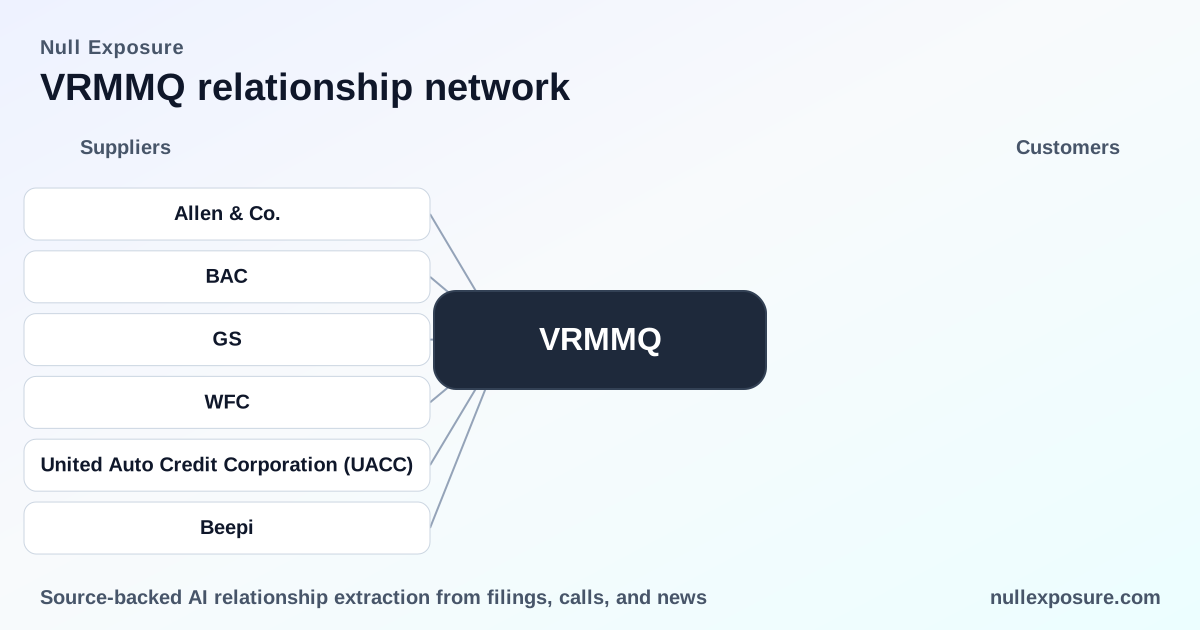
Vroom, Inc. (VRMMQ): supplier relationships and what they signal for investors
Vroom operates as an online used-car retailer that monetizes through retail vehicle sales, captive-style auto finance, and related logistics services. The business sells cars directly to consumers, underwrites or partners on loans to capture financing yield and fees, and layers fulfillment and reconditioning revenue on top of margins from vehicle turnover. For investors and operations managers, the key sensitivities are capital access for inventory, the maturity of in-house financing versus third‑party originations, and the stability of underwriting and banking relationships that support both IPO and working capital needs.
Explore more supplier profiles and relationship intelligence at https://nullexposure.com/.
How the business model shows up in the numbers
Vroom combines e-commerce retailing with auto finance. Revenue TTM is $638M with a gross profit of $62M, but operating margin is deeply negative and EBITDA is negative, indicating the company is still consuming capital to scale or restructure. Price-to-sales and enterprise multiples are low relative to typical consumer cyclicals: EV/Revenue sits around 1.17 while market capitalization is modest. These metrics underscore a contracting posture that is capital-dependent and sensitive to funding and capital markets access.
There are no explicit supplier constraints captured in the vendor-relationship feed for VRMMQ; this absence is itself a company-level signal: no constraint excerpts were extracted that tie Vroom to contractual limitations or supplier-imposed service constraints. Investors should interpret that as neither confirming nor denying concentration risk from that data source, and instead rely on relationship disclosures described below to judge partner criticality and maturity.
Why banking and financing partners are first-order risks
Vroom’s history of tapping public markets and underwriting syndicates for capital is visible in its IPO coverage and underwriter list. The company’s ability to secure financing for inventory and to support loan originations is a core operational dependency. When underwriting banks, captive finance acquisitions, and historical asset buys are aligned, Vroom reduces dependence on third parties; when those links fray, liquidity and originations are the first lines of exposure.
Learn how relationship mapping informs counterparty decisions: https://nullexposure.com/
Supplier and capital‑market relationships you must know
Allen & Co.
Allen & Co. was listed among the syndicate of banks that led Vroom’s IPO offering, signaling participation from boutique investment bankers in the company’s capital markets debut (LA Times, FY2020: coverage of Vroom’s IPO).
Source: LA Times coverage of Vroom IPO (2020) — https://www.latimes.com/business/technology/story/2020-06-09/vroom-online-used-car-marketplace-surges-to-5-billion-in-ipo
Bank of America Corp.
Bank of America served as one of the lead underwriters on Vroom’s public offering, indicating an institutional capital markets tie that supported the company’s liquidity and public listing process (LA Times, FY2020).
Source: LA Times IPO report (2020) — https://www.latimes.com/business/technology/story/2020-06-09/vroom-online-used-car-marketplace-surges-to-5-billion-in-ipo
Goldman Sachs Group Inc.
Goldman Sachs acted as a lead underwriter for Vroom’s IPO, reflecting Goldman’s placement in the company’s capital-raising and market transition activities (LA Times, FY2020).
Source: LA Times IPO report (2020) — https://www.latimes.com/business/technology/story/2020-06-09/vroom-online-used-car-marketplace-surges-to-5-billion-in-ipo
Wells Fargo & Co.
Wells Fargo appeared alongside other major banks as a lead in the IPO syndicate, confirming traditional banking relationships in Vroom’s access to institutional underwriting and distribution (LA Times, FY2020).
Source: LA Times IPO report (2020) — https://www.latimes.com/business/technology/story/2020-06-09/vroom-online-used-car-marketplace-surges-to-5-billion-in-ipo
United Auto Credit Corporation (UACC)
Vroom acquired United Auto Credit Corporation in February 2022 and successfully integrated the finance platform such that approximately 40% of Vroom-originated loans were routed through UACC in Q3 2023, demonstrating a strategic move to internalize originations and reduce reliance on external finance partners (CityBiz, FY2023). This acquisition materially shifts Vroom’s supplier/partner profile toward internal financing capacity.
Source: CityBiz report on executive and integration (2023) — https://www.citybiz.co/article/502493/vroom-ceo-tom-shortt-named-executive-to-watch-in-2024-by-auto-finance-news/
Beepi
Vroom purchased software and parts of the failed Beepi business as part of earlier consolidation in the online used-car sector; those assets were absorbed for operational capability rather than a straight supplier relationship (TechCrunch, FY2018). That transaction reflects Vroom’s approach to inorganic capability build via selective asset acquisitions.
Source: TechCrunch reporting on Beepi and Vroom acquisitions (2018) — https://techcrunch.com/2018/09/01/used-car-site-vroom-is-raising-70m-six-months-after-a-big-round-of-layoffs/ and https://techcrunch.com/2018/03/05/used-car-site-vroom-lays-off-staff-25-50-says-source-as-it-halts-dallas-and-indiana-operations/
What each relationship implies for operational exposure
- Underwriting banks (Goldman, BofA, Wells, Allen): These relationships historically provided public-market access and syndication muscle for Vroom’s IPO and capital raises; continued engagement with tier‑one banks indicates the company retains lines to institutional equity and debt markets, which is critical given negative operating cash flow.
- In-house finance (UACC): The UACC integration is a strategic lever to control origination economics and reduce third‑party finance dependency; 40% of originations through UACC in Q3 2023 is a material shift that improves control but concentrates risk inside the enterprise finance platform.
- Acquired tech/assets (Beepi): Acquisitions of failed competitors’ assets demonstrate willingness to absorb technology and reduce time-to-market, but they are not a recurring supplier relationship—these moves alter capability but not ongoing counterparty risk.
Investor implications and action points
- Prioritize counterparties that enable liquidity: Underwriter relationships and bank facilities remain key to inventory funding. Review bank facility covenants and syndicate continuity when assessing liquidity risk.
- Treat in-house finance as both an asset and a source of concentration: UACC increases margin capture but concentrates credit and operational risk; stress test originations and loss assumptions under tighter credit cycles.
- Monitor operating leverage and cash burn: Negative EBITDA and operating margins require durable access to capital or rapid path to positive unit economics.
If you need deeper supplier mapping or a custom counterparty risk report, start here: https://nullexposure.com/
Final takeaway
Vroom’s supplier and partner set is a combination of capital-market underwriters, an acquired finance platform, and opportunistic asset purchases—a structure that shifts exposure from third-party lenders toward an internally controlled financing engine while still depending on capital markets for broader liquidity. For investors and operators, the critical diligence is on underwriting relationships, the credit performance of in-house originations, and how quickly the company can translate vehicle gross profit into consistent operating profit. For comprehensive relationship intelligence and tailored supplier risk analysis, visit https://nullexposure.com/.