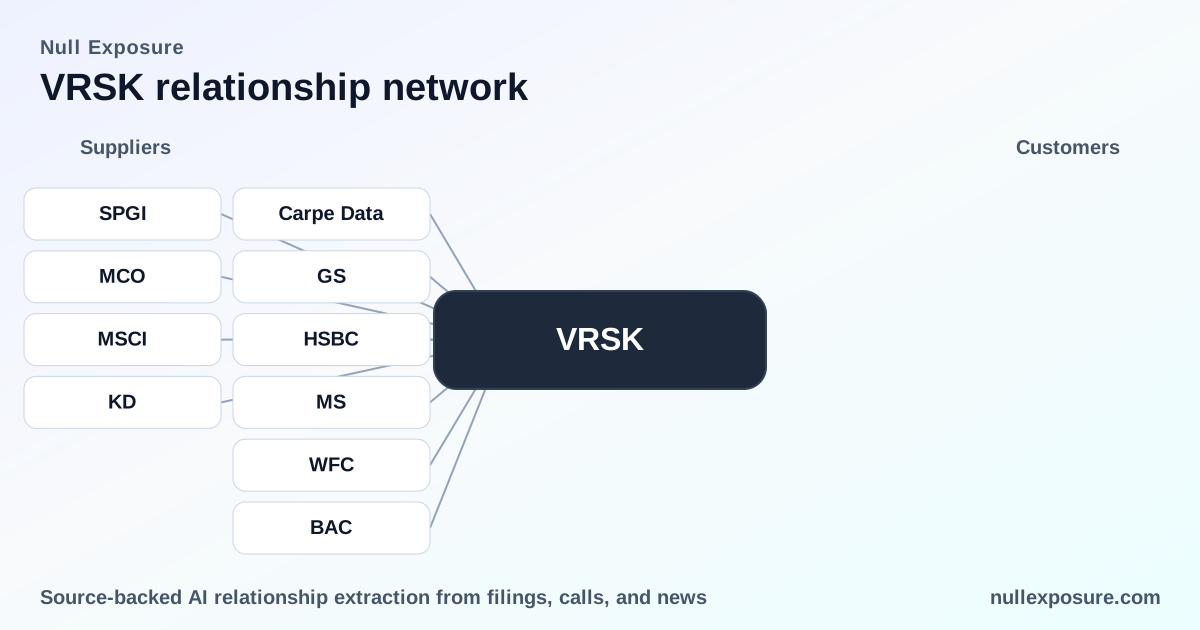
Verisk Analytics (VRSK): supplier network and what it means for investors
Verisk monetizes proprietary insurance, climate and risk datasets through recurring software subscriptions, licensing and professional services while supplementing product capability via third‑party data and capital market transactions; the company captures durable margins by selling decision‑support tools to insurers, reinsurers and commercial clients and funds capital return activity through debt and ASR programs. Verisk’s operating model is a blend of owned analytics and bought‑in inputs — resilient revenue with supplier‑driven cost and renewal dynamics that investors should monitor closely.
For a fast look at counterparty exposures and supplier signals, visit https://nullexposure.com/.
How Verisk’s supplier posture shapes business economics
Verisk builds core products (actuarial models, ClaimSearch, catastrophe analytics) on a mix of proprietary assets and purchased inputs. The company’s public disclosures highlight two structural constraints that determine supplier risk: short‑term contracts with many data suppliers and a buyer role for standardized market data purchased at prevailing prices. These are company‑level signals that affect negotiating leverage, margin volatility and product differentiation rather than a single partner.
- Short‑term agreements reduce lock‑in, increasing flexibility to change vendors but raising exposure to unpredictable price increases and renewal risk — a structural cost pressure on margins if third‑party pricing hardens.
- Purchases at market pricing for common elements (tax assessor records, hazard descriptions, licenses) indicate Verisk is a buyer in competitive markets where exclusivity is limited, constraining long‑term pricing power on those inputs but preserving product breadth.
These constraints combine into a predictable operating pattern: Verisk is highly repeatable on the revenue side through subscriptions and services, while input cost and supplier renewal cycles represent its primary external margin lever.
The network you need to know: partner and supplier entries observed in FY2026
Below I cover every supplier/partner name surfaced in the FY2026 results, with plain‑English summaries and source citations.
-
Carpe Data — Verisk integrated Carpe Data’s injury claim insights into ClaimSearch to strengthen fraud detection and claims handling, adding an external feed to a core claims product. Source: Simply Wall St community update (first seen Mar 10, 2026).
-
Goldman Sachs (Goldman Sachs & Co. LLC) — Listed among joint book‑running managers for Verisk’s capital markets activity, indicating Goldman’s role in underwriting and distribution for debt offerings. Source: Intellectia.ai summary of investor day / offering (Mar 10, 2026) and GlobeNewswire (Feb 24, 2026).
-
HSBC (HSBC Bank USA, National Association) — Counterparty to an accelerated share repurchase (ASR) agreement as part of a $1.5 billion buyback program, reflecting HSBC’s role as an ASR execution bank. Source: Sahm Capital press release summarizing Verisk ASR announcement (Feb 23, 2026).
-
Morgan Stanley (Morgan Stanley & Co. LLC) — Named as a joint book‑running manager on Verisk’s senior notes offering, placing Morgan Stanley among the banks supporting Verisk’s debt issuance. Source: GlobeNewswire / Manilatimes coverage of senior notes pricing (Feb 24, 2026).
-
Wells Fargo (Wells Fargo Bank, National Association; Wells Fargo Securities, LLC) — Two roles surfaced: Wells Fargo Bank acted as an ASR counterparty in the $1.5 billion repurchase program, and Wells Fargo Securities served as a joint book‑running manager on the debt offering. Source: Sahm Capital announcement (ASR, Feb 23, 2026); GlobeNewswire / Manilatimes (debt offering, Feb 24, 2026).
-
BofA Securities (BofA Securities, Inc.) — Identified as a joint book‑running manager on the senior notes offering, positioning BofA in Verisk’s capital markets syndicate. Source: GlobeNewswire / Manilatimes (Feb 24, 2026).
-
S&P Global (S&P Global Energy / S&P Global) — Entered a climate‑risk data sharing partnership to jointly deliver climate catastrophe risk intelligence and integrated modeling solutions, extending Verisk’s catastrophe product set with peer collaboration. Source: Simply Wall St coverage of the S&P Global tie‑up (Mar 10, 2026).
-
Moody’s — Mentioned among peer partnerships, positioning Moody’s as an adjacent collaborator or comparator in risk and capital intelligence offerings. Source: Simply Wall St (Mar 10, 2026).
-
MSCI — Cited alongside Moody’s and S&P Global as part of Verisk’s ecosystem of peer collaborations, indicating strategic alignment on market data and risk solutions. Source: Simply Wall St (Mar 10, 2026).
-
KYND — Verisk expanded collaboration by integrating KYND’s cyber risk insights into Rulebook for underwriting and pricing applications, strengthening Verisk’s cyber risk analytics capability. Source: Simply Wall St community narrative update (Mar 10, 2026).
Note: multiple entries for the same banking or underwriting firms appear across releases (Intellectia, GlobeNewswire, Manilatimes, Bitget). Those references reflect repeated roles in ASR and debt syndication across February–March 2026.
What these relationships mean for investors — drivers and risks
Verisk’s ecosystem shows three clear operational patterns:
-
Capital markets partners are execution‑focused. Banks like BofA, Goldman Sachs, Morgan Stanley and Wells Fargo appear as joint book‑runners and ASR counterparties in Feb–Mar 2026, signaling robust access to capital markets and active balance‑sheet management. Source: GlobeNewswire, Manilatimes, Sahm Capital (Feb–Mar 2026). This supports buybacks and debt issuance without straining liquidity.
-
Product expansion via peer and niche data integration. Collaborations with S&P Global and KYND demonstrate a deliberate strategy to augment proprietary models with external capabilities — product breadth is being bought where it accelerates go‑to‑market. Source: Simply Wall St (Mar 2026).
-
Input cost and renewal risk are persistent. Company disclosures flag short‑term supplier agreements and market‑priced purchases as ongoing constraints, so margin upside is contingent on either improved vendor economics or higher value capture on the product side. This is a company‑level constraint extracted from Verisk’s supplier disclosures.
For a concise dossier on Verisk counterparties and supplier signals, start here: https://nullexposure.com/.
Investment takeaway and recommended next steps
Verisk’s recurring revenue base and expanding climate/cyber product set support a premium multiple and durable cash flow generation, while short‑term supplier contracts and market‑priced purchases create a recurring cost risk that investors must track alongside capital allocation events (ASRs, note offerings). Key watch items: supplier renewal terms, integration cadence with S&P Global and KYND, and quarterly disclosure on ASR completion and debt metrics.
If you evaluate supplier counterparty exposure or need a tailored supplier risk brief, explore additional resources at https://nullexposure.com/.